
Editor's Note
This editor’s note highlights the key facts and market implications behind “Neodymium Market Size, Share, and Growth | Trend”, with emphasis on sourcing, product fit, fabrication, logistics, or buyer impact.
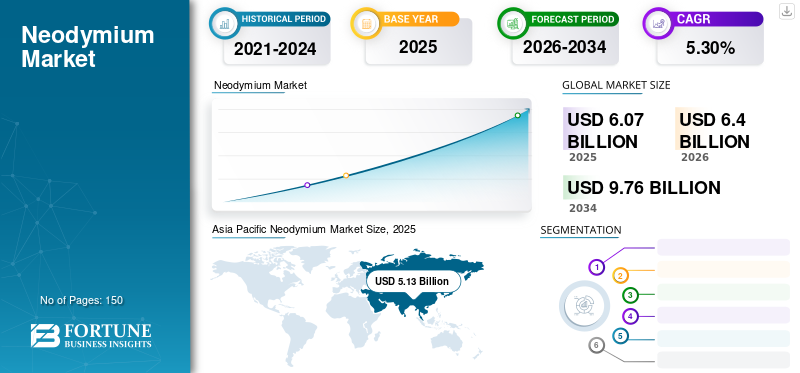
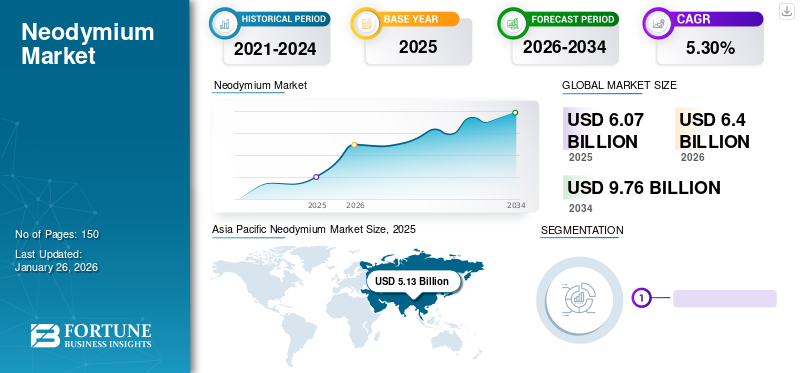
The global neodymium market size was valued at USD 6.07 billion in 2025. The market is projected to expand from USD 6.4 billion in 2026 to USD 9.76 billion by 2034, with an expected compound annual growth rate (CAGR) of 5.30% during the forecast period. In 2025, the Asia Pacific region dominated the neodymium market with an 84.60% market share. Furthermore, significant growth is also forecast for the U.S. neodymium market, with its size expected to reach approximately USD 571.1 million by 2032, driven by expanding electric vehicle production and increasing focus on environmental issues. This growth is anticipated to create attractive business opportunities due to rising demand for NdFeB (neodymium magnets). Neodymium (Nd) is one of the rarest metals with atomic number 60 and appears as a silvery metal. Processes such as sintering and bonding are used in the mining of the element. Furthermore, this metal offers excellent magnetic properties and is resistant to extreme temperatures. Consequently, it is primarily used in permanent magnets. Therefore, increasing demand for neodymium iron boron (NdFeB) permanent magnets from the automotive and electronics industries is driving the market. Additionally, the rising adoption of NdFeB across the healthcare industry to reduce swelling and aid rapid healing can further enhance market growth during the forecast period. The market was severely impacted during the Covid-19 period. Many countries worldwide imposed restrictions on trade activities, transportation, and the distribution of raw materials and finished goods. This disrupted the market's value chain. As a result of this issue, mining activities for several companies were hindered, and demand decreased dramatically. However, after restrictions eased, the supply chain returned to normal, allowing industry players to pursue opportunities. This helped mitigate the impact on annual performance during the coronavirus years.
Japanese Neodymium Market Insights
Neodymium, essential as a high-performance magnet across various industries, is a key material in Japanese manufacturing. The changing global supply structure, driven by increasing demand for next-generation motor technologies and energy systems, provides critical perspectives for Japanese companies in securing stable procurement and enhancing technology.
Global Neodymium Market Overview
Market Size and Forecast: 2025 Market Size: USD 6.07 billion 2026 Market Size: USD 6.4 billion 2034 Forecast Market Size: USD 9.76 billion 2026–2034 CAGR: 5.30% Market Share: In 2023, the Asia Pacific region held the leading share at 84.42%, increasing from USD 5.71 billion in 2022 to USD 4.66 billion in 2023. This was driven by electric vehicle production, electronics demand, and China's dominant position in rare earth mining. By Application: The magnet application segment led, driven by demand from automotive, electronics, and renewable energy sectors. The catalyst segment held an 8.7% share in 2023, supported by tire manufacturing. The ceramics & glass segment expanded due to the use of Nd as a glass colorant in construction and specialty applications. Key Country Highlights: China: The world's largest producer, accounting for approximately 85% of rare earth oxides and 90% of permanent magnets and alloys. United States: Driven by EV expansion and permanent magnet demand, projected to grow to a USD 571.1 million market by 2032. Germany: Adoption advancing in EV motors, safety systems, and lightweight components within the automotive sector. Japan: Sustained demand in electronics, medical equipment, and precision motors. Middle East & Africa: Moderate growth driven by consumer electronics and renewable energy projects.
Neodymium Market Trends
Increasing demand from the EV industry due to growing environmental concerns is creating new market opportunities. Neodymium is considered the optimal magnet for use in EV motors. In over 90% of EV cases, brushless DC (BLDC) motors manufactured using NdFeB are utilized. Therefore, rising demand for DC motors drives product adoption. Consumption of Nd in electric vehicles is increasing primarily due to powerful magnets, which are further used in anti-lock braking system sensors, distributor sensors, cam sensors, electric generators, alternators, ignition coils, power steering motors, pump motors, and starters. Consequently, the growth of electric vehicles worldwide will thrive in the market during the analysis period.
Neodymium Market Growth Factors
Rising demand for NdFeB magnets from end-use industries such as automotive and electronics promotes product consumption. Magnets made from Nd are compact, lightweight, offer top performance, and have a larger magnetic field compared to conventional magnets. Their demand has increased rapidly from automotive, elevators, voice coils, and energy-saving motors. Furthermore, NdFeB magnets are preferred in applications such as electric vehicles, advanced audiovisual equipment, and wind turbines. Increasing demand for more powerful magnets that require less mass and offer better results compared to iron-based electromagnets is augmenting their demand. These factors are set to promote NdFeB consumption and drive industry expansion over the forecast period.
Expansion in ceramic & glass products to drive product demand due to the growing construction industry. Dramatic population growth has created significant opportunities for the construction industry. Moreover, people are moving to metro cities to earn and grow professionally. This necessitates residential and non-residential spaces such as buildings, shopping malls, airports, and co-living apartments. Therefore, contractors, engineers, and architects are devising modern structural designs, advanced windows, ceramic basins with integrated Internet of Things (IoT), and toiletries. Neodymium is a chemical used as a glass colorant. Consumption of the product enables glass and ceramics in various shades, from burgundy to violet. The color-imparting properties of such products are expected to increase demand from the construction industry.
Restraining Factors
Fluctuations in product prices hinder market growth. Volatility in neodymium prices has limited market growth during the study period. Supply chain disruptions, expensive mining activities, government environmental regulations, and high demand factors from the automotive and electronics industries affect product pricing. Furthermore, China holds a monopoly in rare earth production. Consequently, the country raises export prices and restricts product supply. Additionally, the Chinese government is implementing strategic material management on Nd and other rare earth elements, which is expected to cause significant price fluctuations. These factors may restrain the growth of the neodymium market during the forecast period.
Neodymium Market Segmentation Analysis
By Application Analysis Based on application, the market is segmented into Magnets, Catalysts, Ceramics & Glass, and Others. The magnet segment holds the dominant neodymium market share and is expected to continue its supremacy during the forecast period. Consumption of rare earth element-based magnets can be primarily seen in conventional automobiles, electric vehicles, industrial products, home appliances, air conditioners, and elevators. Furthermore, the expansion of residential and commercial buildings has led to a surge in demand for electronics such as televisions, computers, speakers, generators, mobile phones, and motors. Therefore, the rapid growth of the electronics industry boosts product demand for magnet production. Increasing utilization of catalysts in tire production is promoting product adoption. The product used in this segment is primarily associated with its notable properties, such as high CIS content, high resilience, improved hysteresis, and better wear resistance. In ceramics & glass applications, Nd(III) oxide is used for decolorizing iron glass, glass coloring, and as an additive in solar control glass. This neodymium glass is further used to make lasers and laser pointers, utilized in cosmetic plastic surgery, eye surgery, and cancer treatment. Other segments include batteries and battery alloys, metallurgy, and polishing. Increasing adoption of batteries and technological advancements in the automotive and electronics industries drive the other segments.
Regional Insights
The Asia Pacific market size was USD 4.666 billion in 2023. Increasing manufacturing of electric vehicles and electronic products such as televisions and mobile phones is expected to boost demand for neodymium magnets. This facilitates product adoption in the Asia Pacific region. Furthermore, the global manufacturing and supply of rare earth elements, including neodymium, is dominated by China. This country accounted for the largest revenue share in 2023. According to the 2019 Chinapower Association, China produced approximately 85% of the world's rare earth oxides and about 90% of rare earth metals, permanent magnets, and alloys. Therefore, government-supportive regulations, low-cost labor, and extensive mining facilities are factors attributed to China experiencing the largest metal production. In North America, increasing product consumption is attributed to rising demand for permanent magnets. Consequently, it enables the miniaturization of electronic products such as computer hard drives, mobile phones, speakers, and electronic vehicle components. Furthermore, increasing demand for wind turbines is positively impacting market growth. According to Goudsmit UK, substantial development in NdFeB is occurring due to ongoing developments in both the performance and design of wind turbines. Increasing product demand for wind turbines to enhance reliability, reduce costs, and decrease the need for expensive maintenance is strengthening market growth in Europe. Moreover, increasing commercialization of electric vehicles and growth in infrastructure development further drives product adoption in this region. Additionally, growth in Europe's automotive industry promotes product demand. Key applications include electronic control units, automotive safety and information systems, energy transfer systems, and vehicle multimedia systems. Furthermore, increasing demand for vehicles with less weight and lower carbon emissions positively impacts the German market. Product usage in Latin America, the Middle East, and Africa is expected to grow moderately due to increasing demand for home appliances.
List of Key Players in the Neodymium Market
Companies are increasing mining activities as a strategic initiative. Major players operating in the market are primarily involved in mining rare earth metals to meet emerging market demand. For example, Lynas Corporation is an Australia-based metals and mining company. Rare earth oxides are mined and initially processed at the company's facility at Mount Weld in Australia, with its refining and separation facility located in Gebeng, Malaysia. Furthermore, as part of the "Lynas 2025" growth strategy plan, the company is expanding its industrial footprint at the rare earth processing facility in Kalgoorlie, Western Australia. On the other hand, Rainbow Rare Earths controls deposits of dysprosium, neodymium, praseodymium, and terbium. The company is primarily engaged in rare earth mineral projects located in South Africa and Burundi. Its project names are the Phalaborwa Project and the Gakara Project. List of Profiled Key Companies: Arafura Resources Limited (Australia) Lynas Rare Earths Ltd (Australia) Hefa Rareearth Canada Co. Ltd. (Canada) MP Materials Corp. (U.S.) Peak Rare Earths (Australia) Rainbow Rare Earths Limited (UK) Texas Mineral Resources Corp. (U.S.) IREL (India) Limited (India)
Source: Read the original article | Published: March 23, 2026