
Editor's Note
This editor’s note highlights the key facts and market implications behind “Building & Construction Materials Market Size to”, with emphasis on sourcing, product fit, fabrication, logistics, or buyer impact.
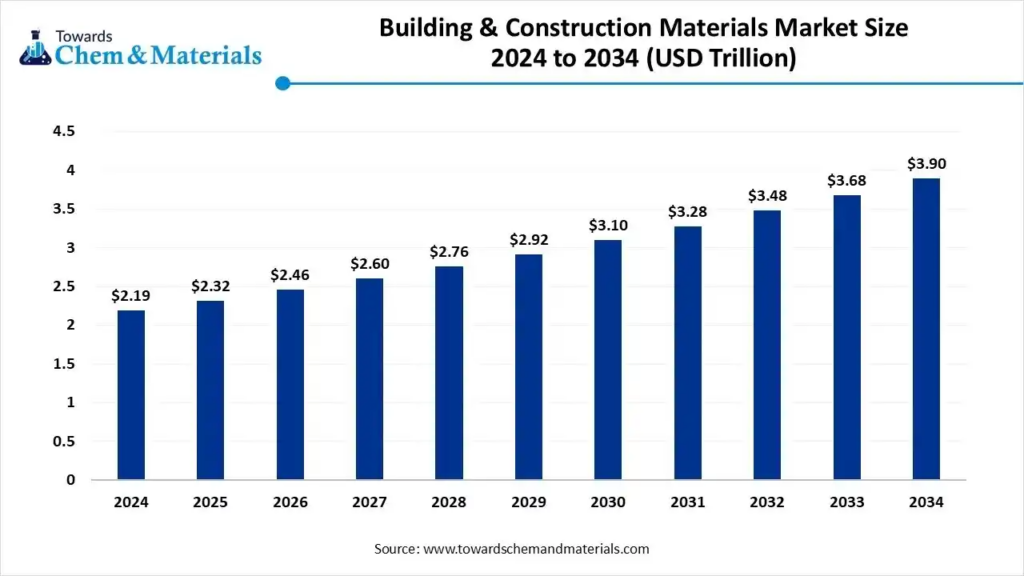
According to Towards Chemical and Materials, the global building and construction materials market size is calculated at USD 2.32 trillion in 2025 and is expected to be worth around USD 3.90 trillion by 2034, growing at a compound annual growth rate (CAGR) of 5.95% over the forecast period 2025 to 2034.
The global building and construction materials market size was estimated at USD 2.19 trillion in 2024 and is projected to reach USD 3.90 trillion by 2034, growing at a CAGR of 5.95% from 2025 to 2034. A study published by Towards Chemical and Materials, a sister firm of Precedence Research.
The rising urbanization and infrastructure development worldwide is driving increased demand for construction materials, fueling market growth.
AI’s Role in Market Growth
In 2025, AI is poised to amplify growth in the building & construction materials market by enabling smarter material innovation, streamlined project planning, and enhanced operational efficiency. Through AI-powered design tools and integration with BIM, materials can be tailored more precisely for performance, sustainability, and resilience, moving beyond trial-and-error experimentation. AI also supports optimized supply chains and logistics, improving demand forecasting, inventory management, and delivery scheduling to reduce waste and cost in material distribution. Furthermore, AI contributes to lifecycle assessment and predictive maintenance by modeling material degradation and environmental impact, which encourages longer-lasting products and eco-friendly choices. Altogether, these capabilities strengthen efficiency, innovation, and sustainability in the sector, boosting demand for advanced, AI-integrated construction materials.
Sustainable Construction and Wood Products
The wood and engineered wood segment is anticipated to grow with the highest CAGR in the market during the studied years. This surge is attributed to the growing preference for sustainable and renewable building materials. Engineered wood products, such as cross-laminated timber and glulam, offer enhanced strength and stability, making them suitable for mid-rise and high-rise constructions. Their lighter weight compared to traditional materials reduces transportation costs and simplifies handling on-site. Additionally, the aesthetic appeal and natural insulation properties of wood contribute to energy-efficient designs and healthier living spaces.
North America’s Market Dynamics
North America is experiencing rapid growth in the building & construction materials market during the forecast period, driven by significant infrastructure investments, technological advancements, and a shift towards sustainable construction practices. Governments are allocating substantial funds to modernize infrastructure, including transportation networks, energy systems, and urban development projects. Technologies such as 3D printing, modular construction, and smart building materials are gaining traction, enhancing efficiency and reducing costs. Additionally, there is a growing emphasis on using eco-friendly materials and adopting green building standards to meet environmental goals. These factors collectively contribute to North America’s dynamic and expanding building & construction materials market.
Company Strategy: Saint-Gobain
Saint-Gobain, a global leader in construction materials, has unveiled a strategic roadmap for 2026-2030, committing approximately €12 billion to investments and acquisitions. The company aims to enhance its presence in high-growth regions such as North America and Asia Pacific, targeting nearly 60% of sales from these areas in the long term. This initiative underscores Saint-Gobain’s commitment to sustainable growth and innovation in the building materials sector.
Fire Safety Challenges
Fire safety remains a critical issue in the building materials market, especially following the Grenfell Tower fire in London. Insurance premiums for fire coverage in UK buildings have surged, leading to increased costs for building owners and tenants. Efforts to remediate hazardous buildings have been slow, with fewer than half of identified at-risk buildings formally addressed by August 2024. This situation highlights the ongoing challenges in ensuring fire safety within the construction industry.
Source: Read the original article | Published: October 08, 2025