
Editor's Note
This editor’s note highlights the key facts and market implications behind “Quartz Market Size, Share, Growth Industry, and “, with emphasis on sourcing, product fit, fabrication, logistics, or buyer impact.
Market Overview
In Europe, quartz is the most common material found in passage tombs such as Newgrange and Carrowmore in Ireland. Quartz is a semi-precious stone and is increasingly used in European jewelry and hardstone carvings, such as in luxurious containers, sand vases, and gemstones. One well-known quartz manufacturer in Europe is Technistone. The high-strength quartz produced by Technistone is used for floor tiles, bathroom tiles, kitchen shelves, and is known for its durability. Technistone is accelerating the development of many new products. Regarding gemstone production, Asia and South America are more abundant than Europe.
Baba Quartz, HIGH PURITY QUARTZ MATERIALS, Quality Quartz Engineering, Creswick Quartz, Caesarstone Ltd, and Quartz Corporation are key players.
Tata Consultancy Services (TCS) announced that its new “Quartz” won the “Best New Post-Trade Solution” award at the 2022 FTF News Technology Innovation Awards. Quartz’s services include end-to-end services for tokenized securities for Market Infrastructure Institutions (MII).
Market Size and Outlook 2023-2031
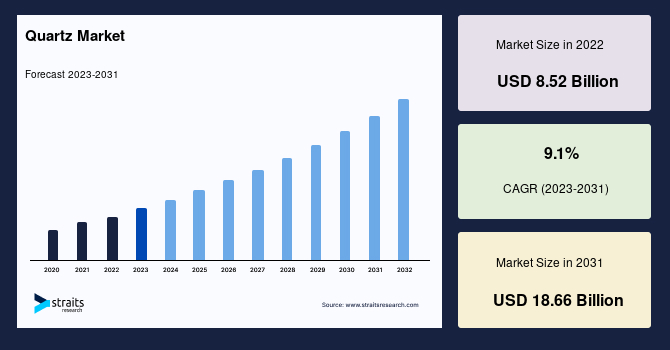
The global quartz market was valued at USD 8.52 billion in 2022. It is estimated to reach USD 18.66 billion by 2031, growing at a compound annual growth rate (CAGR) of 9.1% during the forecast period (2023–2031).
Quartz is a natural crystalline mineral composed of silicon dioxide (SiO2), solid at room temperature. The name quartz derives from its appearance. Quartz is abundant in various rocks, including sedimentary, igneous, and metamorphic rocks. Quartz has piezoelectric properties, generating positive and negative charges on alternating edges of a prism. It is utilized as a pressure gauge in depth measurement devices because the piezoelectric property aids in generating charges.
Due to its durability, corrosion resistance, and extremely high resistance to chemical and mineral weathering, quartz is widely used in the manufacture of various electronic devices. For these reasons, quartz is extensively utilized in many industrial applications. Various types of quartz available in today's market are sold, including crystal, stone, pebbles, engineered stone, high-purity quartz, and crucible stone. Quartz is also contained within crucibles.
Market Trends
Drivers of the Global Quartz Market:
Increasing Demand for Quartz: Quartz is a key mineral with diverse applications. Sand composed of fine quartz stones is essential for glass assembly. Quartz sand is used in various electronic devices such as oscillators in optical and radio research, clocks, and weight scales. It also serves as a lattice for precision stone cutting, glass hammering, and sandblasting.
Furthermore, quartz is critical for the PC industry as it is used in manufacturing important silicon semiconductors. In addition to these applications, quartz plays a significant role in the jewelry sector. Pearls are made from many quartz stones. The most impressive pearl assortments are amethyst and citrine. Aventurine, quartz crystal, quartz glass, and quartz sand are also polished or carved for jewelry. Some people wear small crystals as pendants to attract luck. The expanding use of crystal in various end-user sectors is expected to drive the growth of the global crystal market.
Technological Advancements: The continuous development of new technologies in the crystal industry is significantly contributing to market expansion. Crystal gem components are used in many of today's electronic devices. Some end-user sectors in China use crystal, including parts of China's robust crystal industry. Transformations in the US and European crystal gem businesses directly impact the globalization and redesign of crystal gem jewelry production in China, significantly influencing both the market and innovation.
Meanwhile, many assembly sites for major OEM companies and the gadget industry, especially factories handling media transmission and machinery, use numerous valuable crystal gems sourced from Japan and South Korea. Chinese organizations have cooperative relationships with various groups to promote innovation and development in the quartz industry. Examples of ongoing activities in the global quartz business include joint projects with remote organizations, innovative research in collaboration with academic studies, and donations to administrations for high-quality quartz production. These are just a few of the many programs.
Restraints of the Global Quartz Market:
High Cost: The relatively high price of quartz is a factor hindering its expansion in the global market. Quartz is primarily produced in China, which has become the global leader in this industry. Currently, all quartz materials imported from China are subject to additional tariffs. Following an investigation into illegal dumping of imported quartz into the US, it was announced that additional tariffs would be imposed on quartz. This announcement was made by the US Department of Commerce. Quartz prices have risen in several countries, leading to reduced utilization. This aspect is expected to slow market expansion.
Opportunities in the Global Crystal Market:
Active Research and Development Activities: Ongoing research and development for more effective crystal manufacturing methods is creating new possibilities for future market expansion. Manufacturing crystal plates from large crystals weighing several pounds requires a long, labor-intensive process involving constant cutting, surface treatment, and checking plate progress. Each step requires operations like crushing and polishing, demanding high precision to give the crystal the desired hardness. Until gemstones became widely used in electrical work, crushing hard and brittle substances was mainly limited to gemstones. The processes and materials used at that time were not very suitable for large-scale crystal manufacturing. Therefore, Bell Laboratories is currently conducting research to identify the optimal strategies and structures for the most demanding crystals. Such advancements utilize expensive machinery. These R&D efforts are expected to lead to business expansion.
Segment Analysis
The global quartz market is segmented by product and end-user.
By Product: The global quartz market is categorized into quartz surfaces & tiles, high-purity quartz, quartz glass, quartz crystal, quartz sand, and others.
The quartz surfaces & tiles segment holds the majority of the global market and is projected to grow at a CAGR of 6.50% during the forecast period. Transition metals like iron contained in quartz can form the purple variety of the mineral known as amethyst. Amethyst can also be formed by trace elements in quartz. Due to its high hardness, amethyst is an ideal material for surfaces and tiles. Amethyst is discovered and mined from volcanic rocks in Minas Gerais, Brazil, and exported. Amethyst is abundant in Brazil and Uruguay. Quartz surfaces and tiles are reported to be produced in large quantities in the Artigas region of Uruguay and the adjacent state of Rio Grande do Sul in Brazil.
Quartz is becoming increasingly common as a surface material in construction. From kitchen countertops to bathroom flooring, the applications of quartz are expanding. Furthermore, quartz is often used as a substitute for expensive materials like granite and marble due to its affordability and durability. The expansion of the global quartz market is expected to be largely driven by increased adoption of quartz for kitchen counters and bathroom flooring.
By End-User: The global quartz market is categorized into electronics & semiconductors, solar power, building & construction, medical, optics & telecommunications, and others.
The electronics & semiconductors segment is the largest contributor to the market and is projected to exhibit a CAGR of 6.40% during the forecast period. Semiconductor materials are created by doping impurities into a material to alter its electronic properties in a controllable manner, producing a semiconductor material. This material is an insulator with an extremely small band gap. These are inorganic solids with consistent crystal structures, distinguished by the periodic table. For example, germanium and tin belong to Group IV, while selenium and tellurium belong to Group VI. In the PC business and solar power sector, electronic and semiconductor materials are used in manufacturing lasers, solar cells, and transistors. In the semiconductor industry, high-quality quartz is used as a raw material for silicon wafers. However, such situations are very rare and expensive. In the development of microelectronics, integrated circuits, and silicon chips, using pure quartz sand as a raw material for manufacturing silicon metal semiconductors for transistors is essential.
Regional Analysis
North America Dominates the Global Market
By Region: The global quartz market is divided into North America, Europe, Asia Pacific, and LAMEA (Latin America, Middle East, and Africa).
North America holds the largest share in the global quartz market and is projected to have a CAGR of 6.10% during the forecast period. The market is expanding because North America has significant quartz manufacturing hubs. Amethyst is produced throughout the United States. Cities where amethyst was first discovered include the Mazatzal Mountains in the Gila-Maricopa district, Amethyst Mountain in Texas, Arizona, Red Plume Lakes, and North Carolina. In Ontario and Nova Scotia, Canada, amethyst is often basic. Thunder Bay, Ontario, has the largest amethyst mine in North America. These regions possess a strong quartz production base, greatly contributing to market growth. The official gemstone of South Carolina is amethyst. Amethyst from South Carolina is used in manufacturing gems and jewelry. These elements are expected to support market expansion.
The Asia Pacific region is expected to exhibit a CAGR of 7.10% during the forecast period. Economic growth in the region and the enactment of government regulations regarding the transition from thermal to solar energy are expected to expand the region's quartz market. This factor is increasing the demand for quartz glass in the solar power industry. Major quartz glass manufacturing companies are also based in the Asia Pacific region. Currently, the largest markets are China and India, but Japan and South Korea are also expected to boost business growth. The presence of key companies is driving market expansion. Samsung Radianz, Baoliya, Quarella, Hanwha L&C, and Baoliya are companies promoting market expansion. These companies supply quartz products to the medical, solar power, building & construction, semiconductor, electronics, and semiconductor industries. With the development of these sectors, the demand for quartz is expected to increase dramatically. This element is expected to support market expansion.
However, Europe continues to produce beautiful diamonds. Gold is also available in various parts of the continent, but Poland has shops handling the best gold products. Russia is the source for most of the gemstones on the European continent, including lapis lazuli, precious stones, topaz, alexandrite, tourmaline, quartz, and emerald. Spain, which produces quartz, has numerous other European gemstone shops. These precious stones are increasingly used in end-use industries such as solar power, semiconductors, construction, and electronics. The demand for quartz in these industries is expected to increase dramatically with rising production. This element is expected to support market expansion.
Source: Read the original article | Published: January 01, 2024