
Editor's Note
This editor’s note highlights the key facts and market implications behind “Bathroom Manufacturer Uses Ceramic 3D Printing t”, with emphasis on sourcing, product fit, fabrication, logistics, or buyer impact.
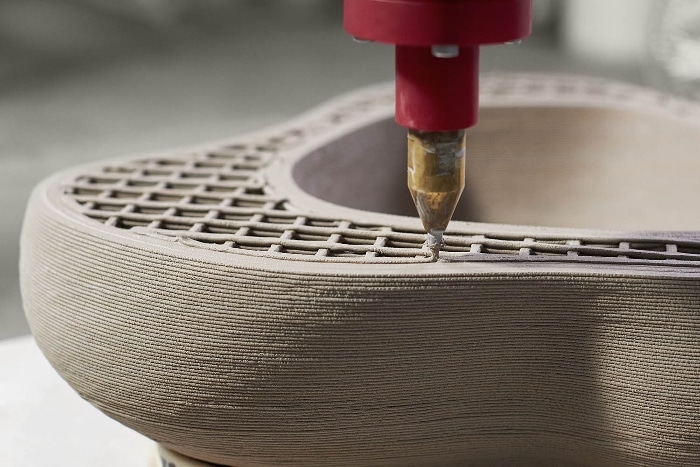
Known for the added value it can bring to the building construction sector, additive manufacturing is now making its way into our bathrooms. Recently, Kohler, one of the largest manufacturers of kitchen and bathroom products, partnered with an American artist named Daniel Arsham to design a unique sink using 3D printing technology. Named Rock.01, this basin, intended to be a symbol of the marriage between new technologies and traditional manufacturing methods, features a 3D-printed porcelain element and another element made of hand-cast brass. Because it was too complex to be produced using only classical techniques, KOHLER reveals it leveraged an internally developed ceramic additive manufacturing system. The result is an asymmetrically shaped sink that rests against a brass-molded rock. The latter displays the same greenish-gray patina as Arsham's bronze sculptures.
“Kohler contacted me about a year and a half ago, specifically about a new technology they had developed around 3D printed ceramics,” recounts Arsham. “The technology is quite nascent, but beyond the possibility of making incredible things that are not possible with traditional slip casting, there is a huge sustainability factor. There is very little waste and it uses much less water than usual casting methods. I wanted to create something that would be iconic or representative of the technology itself, and I wanted to think big.”

While Kohler is very discreet about how its additive technology works, the few photos released by the company show the use of a 3D printer based on an extrusion process. This approach differs from, for example, SANDHELDEN, a specialist in sustainable bathroom products that relies on an industrial sand binder jetting 3D printer from ExOne. The manufacturer explains that using sand as a printing material is more ecological and cost-effective than many traditional options. Released in a limited edition of 99 units, the 3D-printed Rock.01 basin measures 592 x 391 mm with a total weight of 26 kg. The time dedicated to printing the vitrified porcelain part is said to be 7.5 hours. Each piece is delivered in a case designed by Arsham Studio with a certificate verifying its authenticity and edition number.
Source: Read the original article | Published: March 16, 2022