
Editor's Note
This editor’s note highlights the key facts and market implications behind “She Transforms a 3 m² Bathroom for €200 Without “, with emphasis on sourcing, product fit, fabrication, logistics, or buyer impact.
In January 2026, Silvia, a renovation expert, tackled a bathroom of less than 3 m² stuck in the 2000s, with a budget of barely €200. Without breaking or moving a single element, how did she achieve a before/after that looks like it came from a design hotel?
In the middle of January 2026, Silvia, a renovation expert, was faced with a tiny bathroom, less than 3 m², frozen in the 2000s. Sad beige tiles, patterned border, glossy melamine vanity, and cold lighting gave the impression every morning of entering an old catalog rather than a relaxing cocoon.
With a tight budget after the holidays, a major construction project was out of the question for her. Silvia set herself a strict brief: zero demolition, no plumbing relocation, and a ceiling of around €200. By betting on slow decor and smart restyling, she achieved a before/after so spectacular that it's hard to believe today it's the same room.
Before: A Dated Mini Bathroom That Darkens Everything
This small 3 m² bathroom accumulated everything that dates a room. The walls were covered in beige tiles leaning towards ochre, highlighted by a very typical 2000s decorative border. Under the basin, a cherry wood-effect melamine vanity weighed down the look, topped by a large rectangular mirror stuck to the wall, lit by unflattering cold spotlights.
With so little surface area, every detail counted and no element brought any real warmth. Silvia wanted neither dust nor rubble, let alone immobilizing the bathroom for several days. She therefore decided to keep everything: tiles, shower, vanity, and sanitaryware, to focus on a complete restyling of the existing elements, faithful to the idea of working with what you have rather than throwing everything away.
Paint and Resin: The Bulk of the Change Without Breaking
The starting point was the repainted tiles. Silvia chose a special renovation paint for wet rooms, which covers tiles and borders without removing them. In a few coats, the outdated patterns faded in favor of a uniform background that is much calmer visually. On such a small surface, a can for around thirty euros, about €30 to €40, was enough to transform the atmosphere.
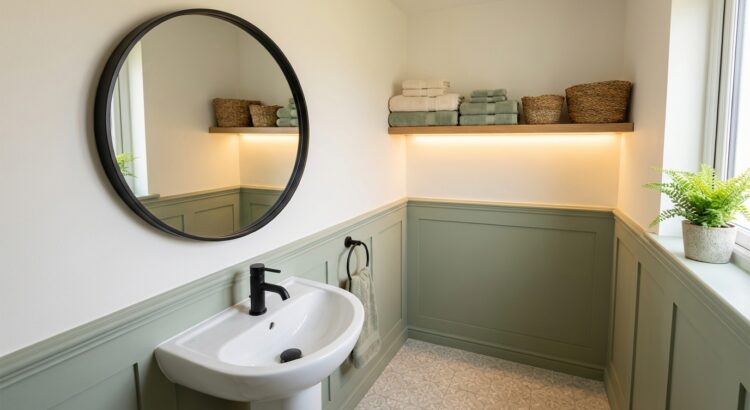
To counter the original yellowish look, she bet on a bright palette: an off-white on most of the walls, a soft sand or linen beige to soften, and a very light sage green on a non-tiled section, like a mini spa. These natural and soothing shades, still very much in vogue in early 2026, immediately visually enlarged the room and gave an impression of impeccable cleanliness.
Vanity, Accessories, and Lighting: A “Hotel” Effect for About €200
For the basin vanity, Silvia refused to buy new. After light sanding, she repainted it matte black to create a chic contrast with the light walls. The matte finish gives a much more high-end look to this basic vanity. Another possible option in this type of restyling: color drenching, using the same shade as the walls to blend the volume. She then replaced the old plastic handles with sleek models in black metal or brushed brass, a low-cost but immediately visible detail.
The real "heroes" of the budget, however, are in the most looked-at elements on a daily basis: the faucet, the mirror, and the lighting. The old lime-stained mixer tap gave way to a sleeker design model in matte black or chrome, bought for between €35 and €90. In front of the basin, the rectangular mirror was replaced by a large round mirror with a thin black or gold frame, to break the strict lines and become the focal point of the room. To finish, Silvia abandoned the cold spotlights in favor of warm white lighting around 2700K, paired with a small wall light above the mirror, transforming the atmosphere into a true cocoon.
Trendy round mirror: about €50
Paint and materials: about €30
New faucet: about €40
Warm light fixture: about €35
Accessories and storage (baskets, textiles, handles): about €45
By adding two identical baskets to hide products, a nice tray for soap, and a few coordinated plain towels, Silvia reached a total close to €200. The bathroom, still under 3 m² and without a single wall knocked down, became a calming, bright, and very current space, worthy of a small hotel, with only paint, a few well-chosen accessories, and a real sense of priorities as its weapons.
Source: Read the original article | Published: March 25, 2026