
Editor's Note
This editor’s note highlights the key facts and market implications behind “Imminent Revision of Building Codes Signals Majo”, with emphasis on sourcing, product fit, fabrication, logistics, or buyer impact.
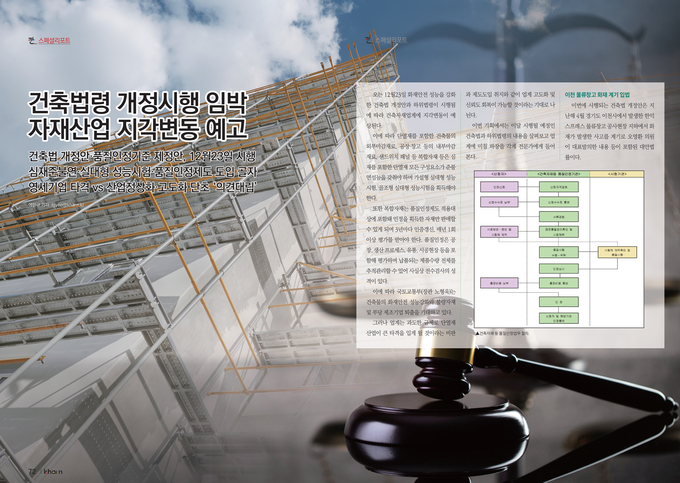
Imminent Revision of Building Codes Signals Major Shift for Materials Industry
The implementation of revised building codes and new quality certification standards on December 23 is expected to cause a major shift in the construction materials industry. With the enforcement of the revised Building Act and its subordinate statutes, which strengthen fire safety performance, a seismic change is anticipated for the architectural materials sector. Consequently, external finishing materials for buildings (including insulation), internal finishing materials for factories and warehouses, and composite materials like sandwich panels must have all components, including the core material, meet quasi-non-combustible performance standards. They must also pass performance tests for mock-up structures and frame-type mock-ups. Furthermore, composite materials will be subject to a quality certification system, meaning only certified materials can be sold. Certification must be renewed every three years, with evaluations conducted at least once a year. Quality certification involves assessing the factory, production process, distribution, and construction sites, effectively requiring full traceability and inspection of all delivered products. The Ministry of Land, Infrastructure and Transport (Minister Noh Hyung-wook) expects these measures to enhance the fire safety performance of buildings and eliminate substandard materials and unethical manufacturers. However, the industry is divided. Some criticize the regulations as excessive and predict significant damage to the insulation industry, while others hope the system will lead to industry advancement and restored trust, aligning with the intent of the new rules.
Legislation Prompted by Icheon Warehouse Fire
The revised Building Act set for implementation was proposed following a fire in April last year at a Han Express logistics warehouse construction site in Icheon, Gyeonggi Province. The amendment includes proposals initially made by lawmaker Oh Young-hwan. According to the revision, when composite materials are used as interior finishes, even the core material (if not non-combustible) must be a material that does not hinder fire prevention. If an exterior wall finish is made of two or more materials, each material must also not hinder fire prevention. Specifically, Article 52 (Finishing Materials for Buildings) has been amended. Clause 1 now adds 'including the core material in the case of composite materials.' Clause 2 specifies that for finishing materials 'made of two or more materials, [the requirement] includes each material.' A new Article 52-5 (Quality Certification of Building Materials, etc.) establishes that composite materials must be certified as meeting standards for fire performance and quality control set by the Ministry. Construction stakeholders must use only certified materials and manufacture, distribute, and construct them as certified. A new Article 52-6 (Designation and Operation of Quality Certification Agencies for Building Materials, etc.) was also created. The Minister can designate public institutions to perform quality certification duties. These agencies can conduct certification, charge fees, and revoke certifications. Certification can be revoked if: obtained through false or improper means; manufacturing, distribution, or construction differs from the certified content; the certified material fails to meet quality control standards; or test results for certification renewal are not submitted. Certification agencies must inspect testing facilities, manufacturing sites, distribution locations, and construction sites to verify compliance and can request data. If violations are found, they must immediately notify the Ministry, which can request work stoppages, usage bans, or business suspensions. Penalties have been added. A new clause in Article 108 (Penal Provisions) stipulates that granting certification to non-compliant materials can result in up to 3 years imprisonment or a fine of up to 500 million won. A new clause in Article 113 (Administrative Fines) imposes fines of up to 2 million won for refusing, obstructing, or evading inspections by certification agencies or building safety monitors.
Composite Materials Subject to Quality Certification Standards
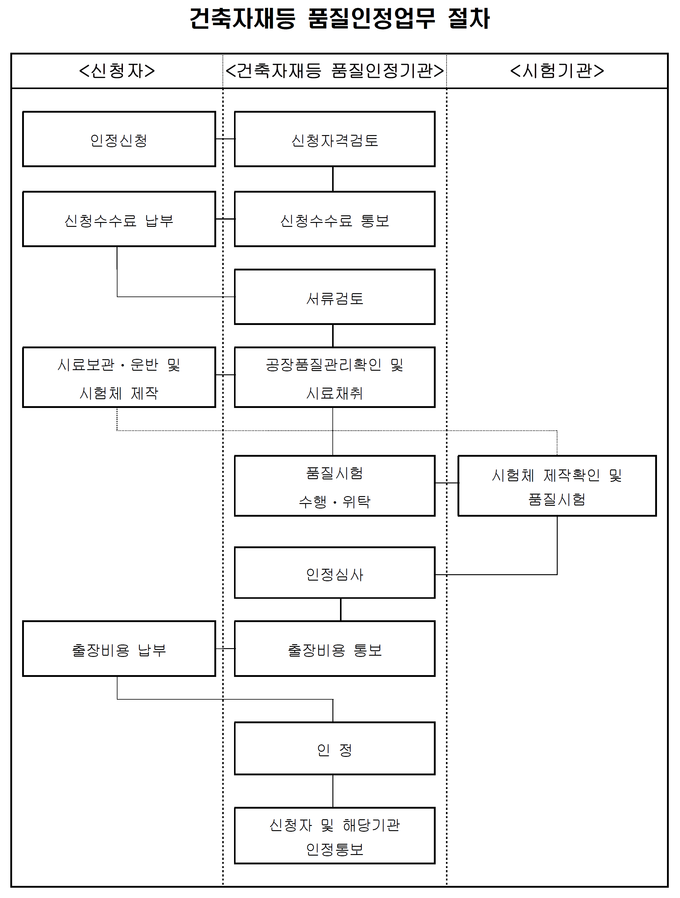
In line with the Building Act revision, the Ministry is also implementing the 'Standards for Quality Certification and Management of Building Materials, etc.' (hereafter Quality Certification Standards). These new standards integrate and replace existing ones for flame-retardant performance, fire spread prevention structures, fire-resistant structure certification, and fire doors/automatic fire shutters. The Korea Institute of Civil Engineering and Building Technology (KICT) has been designated as the certification agency and must operate a committee of at least 15 members. The applicant is typically the manufacturer, though on-site contractors may apply in some cases. For complex structures, a component manufacturer can apply if under agreement with another manufacturer. Application is restricted if a certification process for an identical item is ongoing; a new application must wait 6 months from the previous application date. Upon application receipt, the agency must process it within 25 days, extendable once by up to 15 days with notice to the applicant. Certification evaluation assesses: appropriateness of quality test methods/results, durability/safety of structure/product, manufacturing/quality control at the factory, appropriateness of construction, on-site quality control, and adequacy of detailed specifications/descriptions. Quality tests can be omitted if fire resistance is already certified per KS standards. Tests are performed at a separate testing institution chosen by the applicant. If wait times exceed 60 days, the institution can be changed through consultation. Testing institutions must report to the certification agency if test specimens are made from different materials, testing is obstructed, or specimens are arbitrarily modified. The agency must suspend testing if deficiencies are identified. Upon certification, manufacturers must mark products/packaging as specified. Validity is 3 years from certification/renewal date. The committee may adjust validity for structures/items deemed to have stable quality. Certified entities must implement quality control identical to certified content for products, facilities, and processes. They must record and preserve detailed production/sales records and sales site details, submitting them quarterly. The certification agency must inspect manufacturing sites at least once a year and can conduct construction site and unannounced inspections. If improvements are needed, the agency can request them. If the certified entity fails to address the cause, it faces temporary suspension and eventual certification revocation at 30-day intervals. However, certification is revoked immediately for: obtaining certification through improper testing; certification for products with different raw materials; selling general products as certified; selling products with different mix ratios than certified; selling products under temporary suspension; or failing renewal review. After revocation, re-application is restricted for 6-24 months, and the revoked structure/product name cannot be used. For renewal, application must be made between 12 and 6 months before expiry. Without renewal notification, validity ends on the expiry date.
Enhanced Fire Performance Testing for Materials
The revised fire safety performance standards include: exemption from cone calorimeter tests for inorganic insulation materials; requiring melt/shrinkage ≤20% after cone calorimeter test; all insulation component materials must pass tests; sandwich panels require mock-up performance tests; exterior wall finishes containing insulation require mock-up performance tests; cone calorimeter tests for exterior wall finishes (non-single material) must test three sides (front, back, side); and cone calorimeter/gas toxicity tests for sandwich panels are conducted on the core material.
For fire spread prevention structures, the space between exterior finishes and their support structures must be tightly filled for at least 400mm with materials like fire-resistant gypsum boards, gypsum/cement boards, or mineral wool insulation. The standards also cover contents and issuance/display methods for test reports of single/composite materials and surface information of insulation.
Significantly Strengthened Fire Performance… Industry Shock
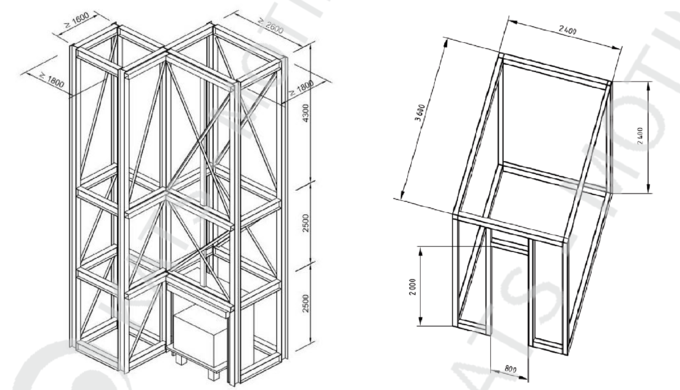
The implementation of the revised Building Act and Quality Certification Standards focuses on two aspects: enhanced performance and quality of insulation materials. Regarding performance enhancement, material testing difficulty has increased significantly. The introduction of mock-up performance tests means insulation must now ensure structural fire safety. Previously, for the cone calorimeter test (applying radiant heat), product development involved methods like foil coating, steel plate attachment, or carbon coating on the insulation surface to block radiant heat for materials with good insulation but poor heat resistance. However, the revised standard requires testing all parts of the specimen and three sides after cutting, meaning the untreated core material itself must pass. This fundamentally changes the traditional production process where quasi-non-combustible treatment was a post-production step, forcing manufacturers to improve processes, replace equipment, and change raw materials. The regulation limiting mass loss to ≤20% poses a barrier for the bead-method expanded polystyrene (EPS, commonly Styrofoam) insulation industry. Typically, EPS vaporizes when heated, differing from materials like rigid polyisocyanurate (PIR) or phenolic foam (PF), which carbonize and harden. Conversely, PIR and PF store radiant heat during carbonization, putting them at a disadvantage regarding heat release rate standards compared to EPS. For mock-up performance tests, composite materials (per KS F ISO 13784-1) involve placing an ignition source in the corner of a mock-up building made of sandwich panels. The test must show no: combustion of newspaper bundles on the internal floor; flashover (simultaneous ignition) when doors are open; flame observation from outside; average upper temperature exceeding 650°C; or floor radiant heat flux exceeding 25 kW/m². For general insulation, mock-up tests are currently only required for external insulation systems. Per KS F 8414, a wall is built to match the actual application structure, with wood piles stacked to a standard at the bottom and ignited by gas. Temperature sensors are placed inside and outside at 5m above, and no point should exceed 600°C for 30 seconds within 15 minutes. This means insulation manufacturers must demonstrate a structure that maintains quasi-non-combustible performance in an actual fire, even if the material itself meets the standard. The level of regulatory strengthening is considered substantial.
Proactive Strengthening of Quality Control
The quality enhancement aspect is evident in the implementation of the quality certification system. Initially, this system applies only to composite materials like sandwich panels. Sandwich panels are insulation boards with materials like EPS or PIR sandwiched between steel plates, also serving as wall elements. However, the Ministry has signaled plans to expand the certification system to all insulation materials by 2022, putting the insulation industry on high alert. Materials subject to certification cannot be delivered—effectively making sales impossible—without obtaining certification and submitting the certificate for each construction site. Obtaining certification requires passing audits of the factory, processes, and even construction sites. While existing KS tests and building safety monitoring included factory audits, KS certification was voluntary, allowing sales without it. Building safety monitoring was limited to sampling test specimens at the factory, offering restricted oversight of production process quality control.
Source: Read the original article | Published: December 12, 2021