This editor’s note highlights the key facts and market implications behind “Material Board Feature: Super-Realistic Tiles”, with emphasis on sourcing, product fit, fabrication, logistics, or buyer impact.
Super-Realistic Tiles
The application of color and pattern to tiles is called "decoration." In recent years, with the evolution of digitally controlled printing technology, decoration techniques that impart an expression as close as possible to specific materials have become mainstream, and numerous "super-realistic" tiles have been released by various tile manufacturers.
Unlimited Visual and Tactile Freedom with Digital Printing
Just as a household inkjet printer prints on paper, tiles can express various patterns by spraying ink (glaze) onto a formed tile body and then firing it. Any "image" that can be photographed or scanned can, of course, be printed onto the tile body. Furthermore, digital control allows for printing different patterns on each individual tile.
Moreover, tiles that are realistic not only in appearance but also in touch are continuously emerging. This is due to the development of new printing machines packed with technology, such as mechanisms that prevent nozzle clogging even with fine printing—allowing color and gloss to be applied according to surface relief—and advancements in glaze research. It is also supported by the development of large kilns capable of beautifully firing these tiles.
“Actually, It’s a Tile” – Possessing the Authentic Feel
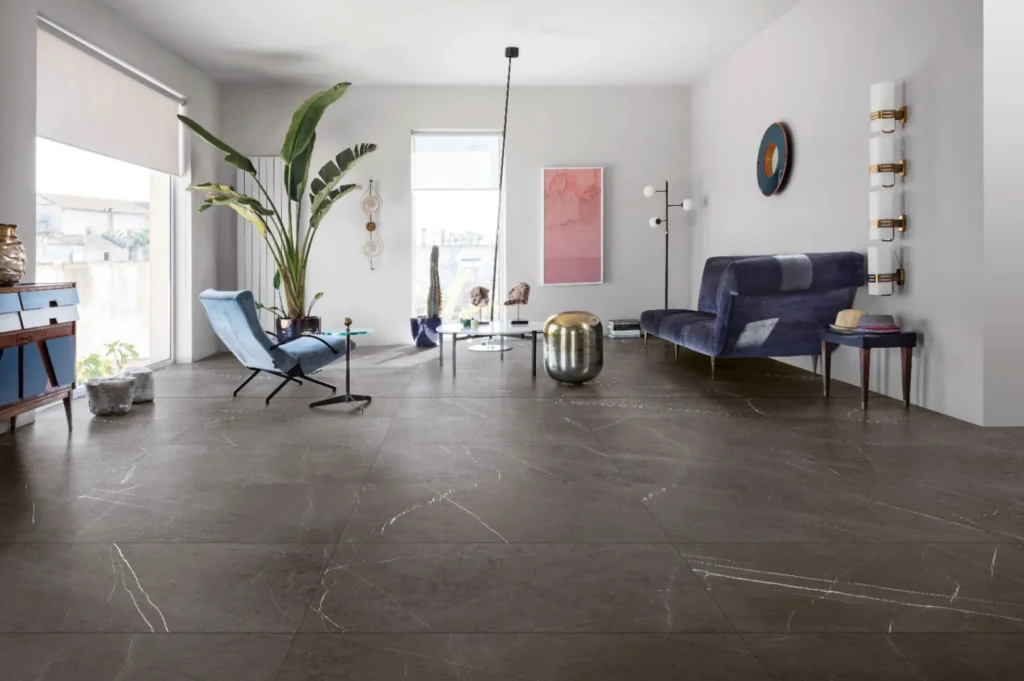
1. Marble-Look Tiles In recent years, printing technology with dramatically improved resolution has led to the emergence of marble-look tiles that reproduce the natural colors and patterns unique to each quarry. They come in a wide range of colors including white, brown, green, and black tones, and can delicately express flowing stripes and speckles in white, pale yellow, and other hues.
Marble is expensive, and its extraction can sometimes cease due to scarcity. On the other hand, marble-look tiles are lighter and easier to handle than real marble, offering advantages in terms of workability and cost, making them suitable for a wide variety of spaces. Manufacturer Picks! Marble-Look Tiles NCT-101/1200X600MAT (Danto Tile) 169060SANPE660RM (DINAONE) DTL-600/MBT-1 (LIXIL) MEM2 (Marazzi Japan) IN-66 (Laminam Japan) 2. Stone-Look Tiles Tiles that mimic slate, a type of shale, reproduce even the shallow, rock-like texture. There are also tiles that express the grain, spots, and color tones of granite or terrazzo, which vary by quarry. Some tiles even have the same texture from the surface to the edge, allowing them to be used just like real stone. Ceramic tiles are resistant to acids and alkalis, making them increasingly popular for areas with high cleaning frequency where real stone is difficult to use. Manufacturer Picks! Stone-Look Tiles EVS-102/1200×600 (Danto Tile) 1060229EMATITE60X60 (DINAONE) DTL-600/BRA-22 (LIXIL) MZSX (Marazzi Japan) IN-11 (Laminam Japan) 3. Metal-Look Tiles
Metal-look tiles range from those expressing the characteristic dull color and luster of metal to those that can depict oxidation and weathering. Their adoption is increasing in hotels, apartment buildings, and stores. They can exhibit a rust-like texture right from installation, and since the rust does not progress further, the as-completed condition can be maintained. This allows for use outdoors where environmental changes are severe, while maintaining both design appeal and durability. Manufacturer Picks! Metal-Look Tiles OXD‐100/900 (Danto Tile) DTL-600N/MNE-3 (LIXIL) M8LV (Marazzi Japan) OX-6 (Laminam Japan) 4. Concrete & Mortar-Look Tiles These are tiles that can express the wet-finish look of concrete or mortar without the need for curing. Beyond workability, some tiles meticulously reproduce color variations, the texture of dried cement, and even the dots of form-tie holes (P-con holes). The ability to choose from various finishes also makes them excellent in terms of design. Using tiles allows for flexible installation to create an exposed concrete-like finish in part of a room, broadening the possibilities for spatial design. Manufacturer Picks! Concrete & Mortar-Look Tiles DOT-201/1200×600 (Danto Tile) PLAINCINDERSOFTR75X75 (DINAONE) DTL-600/ICI-2 (LIXIL) M9SW (Marazzi Japan) 5. Wood-Look Tiles
Wood-look tiles express various "finishes," from the texture of wire-brushed wood grain to wood grain that looks stain-finished, and even pale, unstained wood grain that looks like the wood itself.
They include tiles with the character of vintage wood and those with a matte finish like untreated solid wood, showcasing each company's technology. Many are shaped to look like real wood planks. Using the same tile for interior floors and decks can create a sense of unity. Their adoption is increasing for outdoor areas or places requiring high durability and frequent cleaning where one might want to incorporate wood or reclaimed lumber. Manufacturer Picks! Wood-Look Tiles NTM-101/1200×200 (Danto Tile) J89971TMLSAVECRURET (DINAONE) DTL-1017/BTW-2 (LIXIL) M9EA (Marazzi Japan) LV-3 (Laminam Japan) In this way, super-realistic tiles can unify the design of room walls, floors, and even exteriors, while also offering design aesthetics as an alternative to finite resources like marble. They also excel in durability, workability, and cleanability, making them suitable for locations where natural materials like wood and stone are difficult to use. Their low water absorption makes them stain-resistant. They are also evolving in practical aspects like thinness and strength. Attention is focused on super-realistic tiles, which are being widely adopted not only in new construction but also in renovation projects.
Request samples of such super-realistic tiles on "TECTURE" and be sure to see and feel them for yourself!