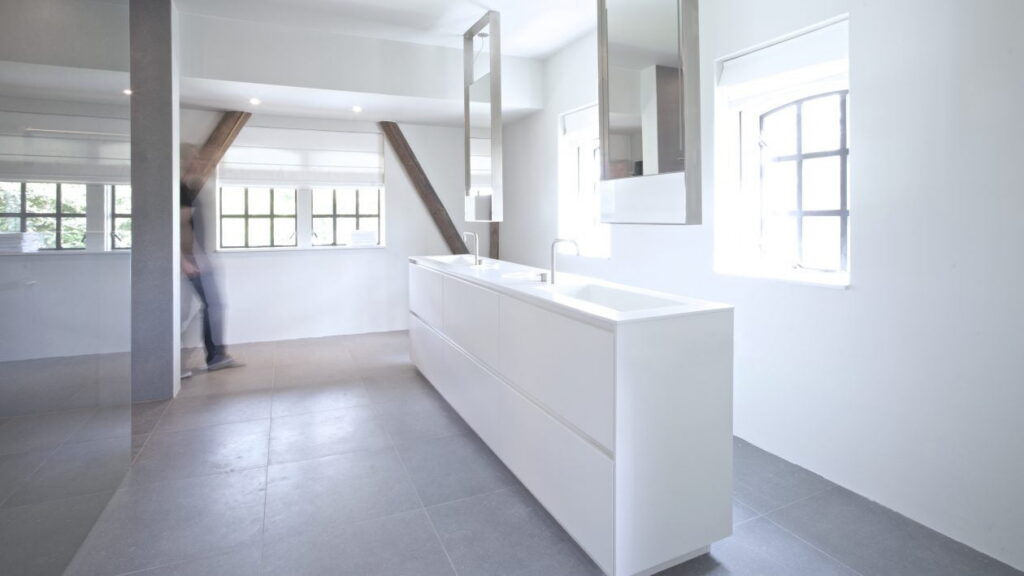
This editor’s note highlights the key facts and market implications behind “Sanitary Design”, with emphasis on sourcing, product fit, fabrication, logistics, or buyer impact.
Marike Andeweg (born 1978) is making a strong impact with her label NotOnlyWhite, which she founded five years ago. She is likely the only woman in the Netherlands specializing in sanitary ware. Her passion lies particularly with washbasins. This love dates back to her time working at Pastoe after studying Industrial Product Design, where she had the opportunity to design a washbasin on the side. Today, she designs complete collections of washbasins, bathtubs, and accessories—excluding toilets—such as colorful cabinets, shelves, and a bright red stool. These products are distributed through dealers, architects, and other designers, reaching both private clients and projects like the Hilton hotel at Schiphol, where vast numbers of her washbasins will soon be installed in rooms and public spaces.
‘Although sanitary ware is still often overlooked, it is something you wake up with and go to bed with. The bathroom is a place where you need to feel safe and comfortable. I evoke that feeling through materials and design,’
she says about her collection, which is characterized by simplicity, functionality, and soft, refined forms.
Sanitary Design
You wake up with it and go to bed with it. Although white, chrome, and gray still dominate the bathroom, we are also seeing new materials, organic shapes, extensive customization, and—albeit hesitantly—color. Four young Dutch designers and labels show that sanitary ware is no longer a neglected area.
NotOnlyWhite by Marike Andeweg
New Materials: Hi-Macs and Cristalplant Everyone was used to ceramic, but Andeweg decided to work with Hi-Macs. It is an exciting synthetic material that still offers added value because it is easy to apply and hygienic. Customization is essential; at least eighty percent of Andeweg’s collection consists of unique products. Recently, she developed the floating-looking washbasin Fuse, where straight and curved forms merge. Fuse (winner of the German Design Award 2015) is made from Cristalplant. This is also a blend of acrylic and natural minerals, with the difference that Hi-Macs comes in sheets while Cristalplant is cast in a mold, allowing for more organic shapes. The latest addition to the collection is Cristalplant with a soft-touch paint, making the Fuse snow-white on the inside while the exterior gains a rubbery, almost indefinable dark gray-blue color that adapts to its surroundings.
‘People are increasingly bringing the luxury and wellness they know from hotels into their homes. They choose to optimize space, luxury faucets, a beautiful, generous washbasin, rounded forms, and practical solutions: unsightly elements are concealed, making way for, for example, a hidden flat drain,’
says Andeweg. Her washbasins are sometimes combined with the colorful retro furniture of DutchdeLuxes, a Dutch label by Sebastiaan Eerhart in Eindhoven.
‘It shows well that my collection can also be applied in a different way,’
she says.
Sebastiaan Eerhart: Color and Cheerfulness
So, finally some color in the white and gray bathroom world? Of course, you don’t replace a bright yellow bathroom cabinet as quickly as a pink sofa or rug you’ve grown tired of, but it can be a bit less serious, thinks Sebastiaan Eerhart (born 1975).
‘I was ready for a different movement in the industry,’
he explains his choice to add more cheerfulness under the name ‘Le chique bathfurniture’ by DutchdeLuxes (also producer of ‘Foodplatters’ and side tables).
‘People pay a lot of attention to the most beautiful beds and kitchens, while in the bathroom, something standard is often chosen, and the bathroom cabinet remains an afterthought. A pity,’
he finds. The bathroom furniture line consists of three variants titled Freak Classic, Neo Classic, and Retro Steel. With recognizable neoclassical forms and a seventies retro style with a wink, he offers a colorful counterpoint to what Eerhart describes as:
‘Gray, anthracite, brown-gray, chrome, and even more gray. Colors that dominate the bathroom world.’
The oak and tulipwood cabinets with tops, turned or curved legs, and a drawer in the most vibrant high-gloss lacquer, he successfully promotes at the Maison & Objet fair in Paris. But also through architects, interior architects, and NotOnlyWhite:
‘The bathroom cabinet and the matte white, sleek washbasins of NotOnlyWhite and a Vola faucet combine nicely, also because of the contrast,’
he says. Eerhart studied fashion, clothing & home textiles and worked, among others, for the brand Diesel. He has a preference for interior and architecture but wants to do things differently than what is common.
‘I only design items that I would want to have at home myself.’
With his own black duo-Neo Classic furniture with satin-smooth NotOnlyWhite washbasins, bold wallpaper, and wall-mounted faucets, he makes a bathroom statement against safe gray.
Oliver Drent: Natural and Timeless
Oliver Drent (born 1979) of Studiodoccia believes that exciting things are indeed happening in the sanitary ware world. His specialty lies in a gray area, a niche. Often using natural materials, Drent creates timeless custom designs. With a great sense of detail, line work, and finish, the former bathroom advisor, who has a passion for architecture and design as he says himself, works on exclusive bathrooms. He enjoys collaborating with architects, interior architects, and other specialists from his network in creating this architecturally most technical space of the house.