
Editor's Note
This editor’s note highlights the key facts and market implications behind “Material Consumption: Ademe’s 2035-2050 Scenario”, with emphasis on sourcing, product fit, fabrication, logistics, or buyer impact.
Through two prospective studies published in December 2019, the French Environment and Energy Management Agency (Ademe) has estimated the material requirements for new construction and renovation up to 2050. According to the agency, the construction of new buildings would be "17 times more" resource-intensive than their renovation to BBC (Low-Consumption Building) standards.
Faced with resource scarcity and growing constraints on their exploitation, Ademe sought to estimate the quantities of materials consumed by new construction and the renovation of the residential building stock for the 2035 and 2050 horizons. The studies "Prospectives 2035 and 2050 for material consumption for new construction and BBC renovation," conducted in partnership with the CSTB (Scientific and Technical Centre for Building), have made it possible to identify the consumption of raw materials associated with several scenarios for the evolution of the housing stock in France.
This long-term prospective exercise could help anticipate and adapt to potential resource shortages, as well as better identify waste streams and their potential for recovery.
Study 1 – Prospective for material consumption for new construction up to 2050
The first study concerns the new building sector and provides prospective elements on the quantities of materials consumed by the production of new buildings by 2050. The scope considered covers residential buildings (detached and grouped single-family homes, multi-family housing, and nursing homes) and certain types of tertiary buildings (large-scale retail, hotels, education, offices).
The use of about twenty materials commonly used in construction in mainland France (aggregates, sand, cement, fired clay, wood, steel, etc.) was modeled to estimate material consumption.
The prospective approach is based on evolutions in the volume of housing and floor area constructed annually derived from the greenhouse gas emission reduction scenario of the National Low-Carbon Strategy (SNBC), and on an evolution in the representativeness of different building typologies.
In terms of construction volume, the SNBC scenario corresponds to two trends:
A decrease in construction for the residential sector (-7% in 2035 and -38% in 2050), with the exception of nursing homes (EHPAD) which show a growing dynamic (+22% in 2035 and +43% in 2050). The volume of housing would decrease from 117,000 to 71,000 for scattered single-family homes, from 41,000 to 25,000 for grouped single-family homes, and from 176,000 to 107,500 for multi-family housing, while 2,000 additional nursing homes are expected to be built between 2015 and 2050.
A decrease in floor area constructed in the tertiary sector by 2035, followed by an increase between 2035 and 2050, at different rates depending on the building use: a 50% decrease in floor area constructed in 2035 for Offices and administration, then a 7% increase by 2050; and decreases of 26%, 10%, and 20% respectively for new floor area destined for education, large-scale retail, and hotels in 2035, followed by an increase of about 5% between 2035 and 2050.
In terms of the evolution of construction product markets and construction methods, two technical scenarios were considered:
Scenario "Business as usual": stability of market shares for construction products and technical solutions for the residential sector, and stability of floor area constructed by construction method for the tertiary sector.
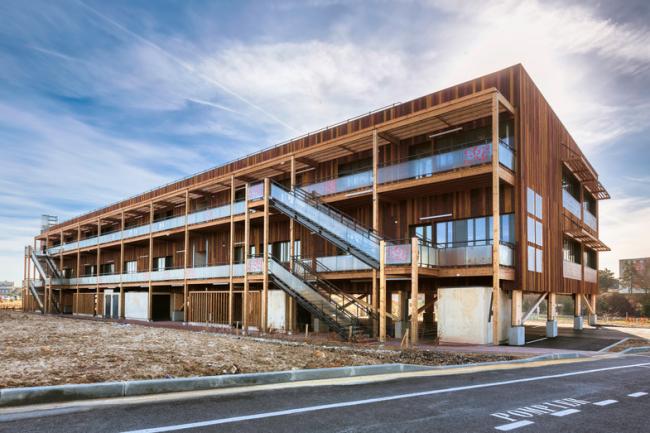
Scenario "Wood and Bio-based Materials": increase in market share for wood and bio-based materials, and development of wood or mixed wood/concrete construction methods, with bio-based material usage rates representing at least 20% and going up to 35% in 2050 (compared to generally less than 10% in 2015).
Key Figures
Material consumption for new construction today:
51 million tonnes of materials were consumed in 2015 for new construction, of which about 35% was for foundations and infrastructure.
More than 80% of the consumption concerns the residential sector, predominantly represented by single-family home construction.
95% of the consumption consists of mineral materials, where aggregates and sand represent more than 40% and more than 30% respectively.
Material consumption for new construction up to 2050:
In the "Business as usual" scenario – stability of consumption trends between 2015 and 2050 – material consumption up to 2050 would amount to 1.5 billion tonnes, of which 85% is for the residential sector. Heavy materials (cement, sand, and aggregates) would represent 85% of the total material consumed.
In the "Wood and bio-based materials" scenario, a slight decrease in material consumption between 2015 and 2050 is predicted due to the substitution of heavy materials with wood and bio-based materials compared to the consumption expected in the first scenario (-2% by 2035 and -6% from 2035 to 2050). Wood consumption would be 13% higher than that announced in the first scenario, and consumption of wood and bio-based insulation would be nearly 2.3 times greater.
Annual consumption of raw materials should decrease by nearly 40% compared to 2015 due to the anticipated reduction in constructed floor area (-37%).
Source: Read the original article | Published: May 16, 2024