
Editor's Note
This editor’s note highlights the key facts and market implications behind “Transforming Work Practices: ‘Integrated Substra”, with emphasis on sourcing, product fit, fabrication, logistics, or buyer impact.
Kondo Yasumasa, President of Sangetsu, a leading company in the interior materials field, describes the current bottleneck in the interior industry as "a phenomenon linked to Japan's lost 30 years." He notes that beyond superficial economic fluctuations, alongside a decline in housing starts, the aging of skilled craftsmen and a decrease in new talent inflow have progressed. While demand remains, the supporting supply capacity has quietly been eroded.
Sangetsu's business involves planning and developing products in collaboration with manufacturers, delivering them to the market through its logistics network, where their value is only realized upon installation. The entire value chain, including logistics and installation, must function for the business to succeed. However, the latter stages are highly dependent on manual labor, making supply constraints apparent.
“Unless logistics and installation are completed, the product does not function as a product. How to streamline and stabilize this phase through labor-saving measures is a critical issue for business continuity,” said President Kondo.
President Kondo's goal extends beyond pursuing design and price competitiveness. It involves providing functions that address social issues such as environmental consideration and labor-saving installation, from both product and system perspectives. The company is exploring a form of interior finishing where quality can be maintained regardless of who performs the work.
Addressing the Social Issue of Skilled Labor Shortage: Redesigning Interior Materials
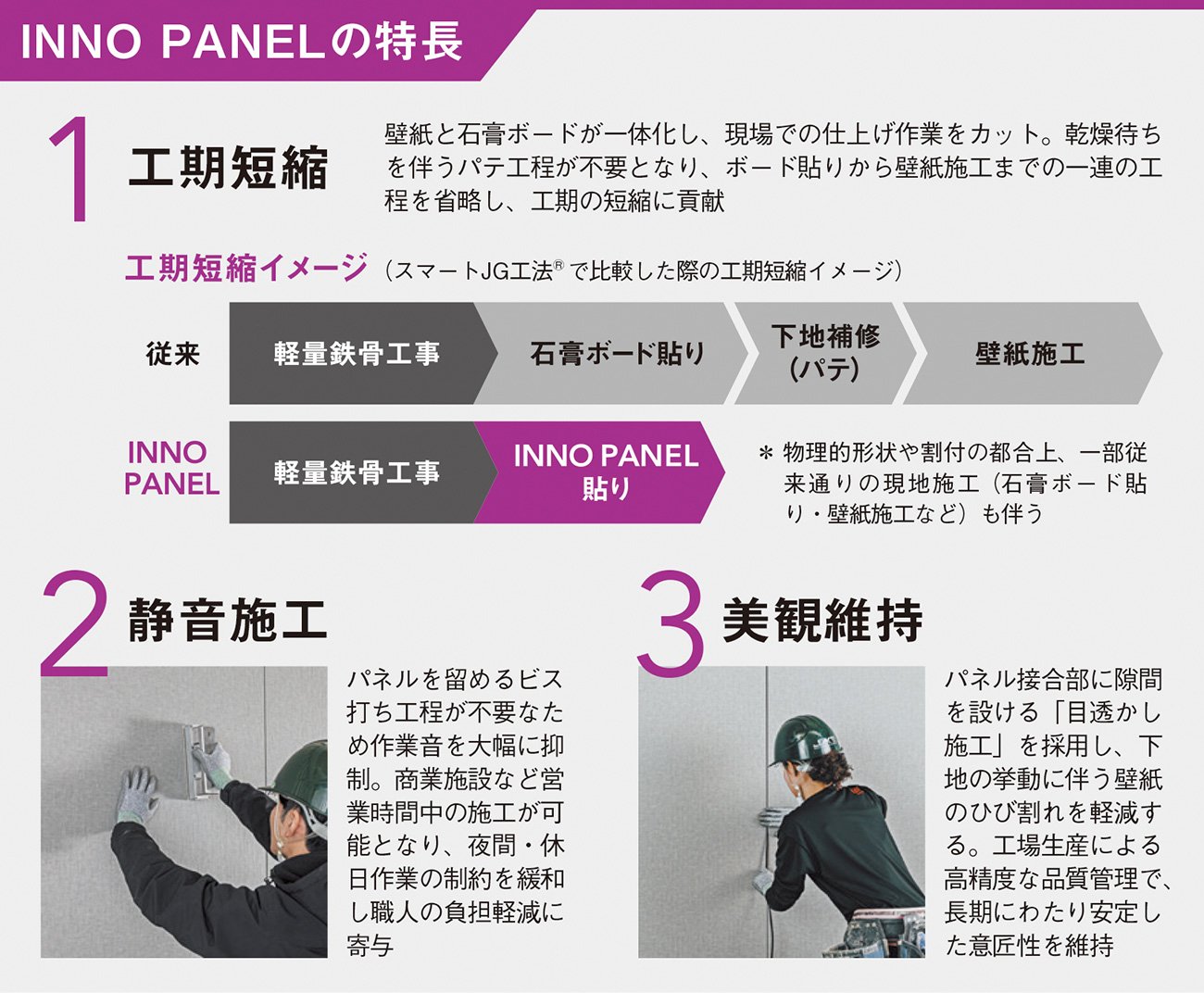
The embodiment of this strategy is the new building material "INNO PANEL," which integrates the substrate (gypsum board) and wallpaper at the factory. By eliminating the putty process and on-site wallpaper installation, it enables shorter construction periods. Since no screws are required, work noise is reduced, allowing for installation during business hours in commercial facilities. It also features reduced wallpaper cracking and long-term maintenance of aesthetics.
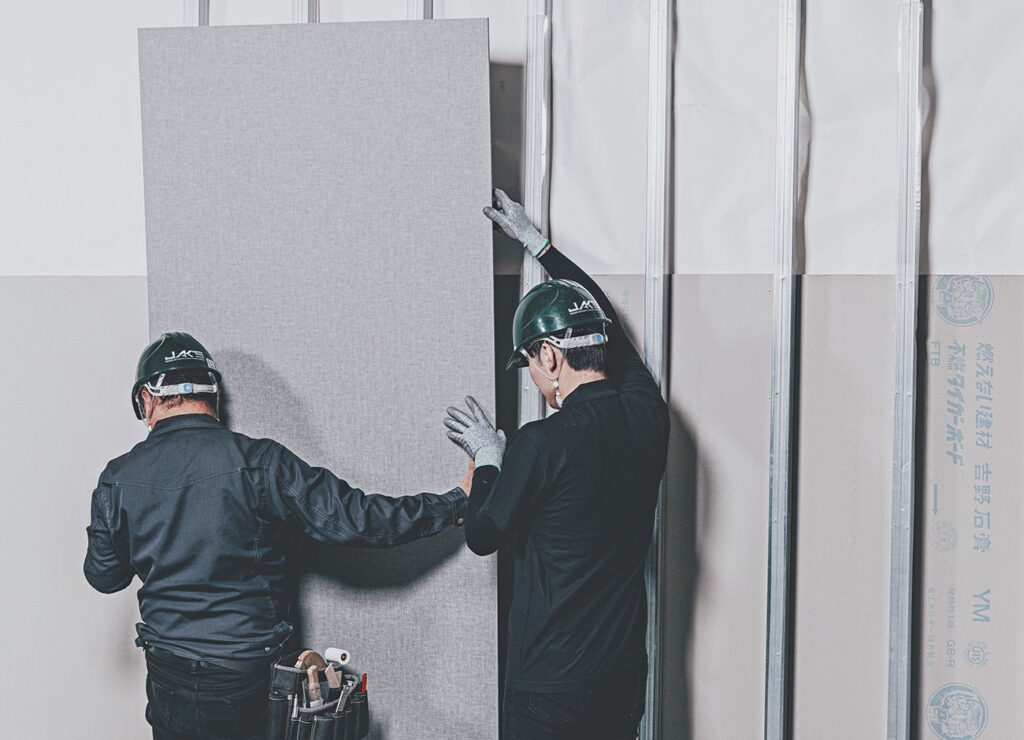
INNO PANEL is designed to change job sites battling labor shortages "from the wall." Installation is possible with a minimum of two people, even if they are not veterans.
INNO PANEL is designed so that stable quality can be ensured by craftsmen with a certain level of knowledge and field experience, without requiring special advanced skills. This broadens the pool of personnel capable of handling installation compared to traditional methods.
Regarding this approach to human resources, Kenji Gomiya, Department Manager and Project Manager who led the development, clearly dismissed concerns that "it might take jobs away from craftsmen." By streamlining the installation of flat surfaces, even less experienced craftsmen can handle the work with confidence. Meanwhile, skilled craftsmen can focus on more complex tasks, leading to an environment where their technical value is properly recognized.
This division of labor increases overall site productivity while alleviating the concentration of work on skilled veterans, creating an environment where they can take on more important roles, including training younger workers. Consequently, this promotes improvement in site environments where long working hours and sudden night work had become the norm, making it easier to create conditions that prevent turnover and encourage retention of younger craftsmen. Furthermore, process reduction through labor-saving installation also helps reduce environmental impact by curbing noise and waste generation. This truly uses the power of the product to offer solutions to the multi-layered challenges on job sites stemming from labor shortages. Department Manager Gomiya, who has been on the front lines of sales interacting with job sites for about 20 years since joining the company, states that the distress of interior contractors scrambling to adjust schedules due to an inability to secure craftsmen during peak periods has been an unchanged challenge for 20 years.
“Consultations about a lack of craftsmen have existed for a long time, but in recent years, site stagnation due to limits in supply capacity has reached a level that cannot be overlooked,” he said.
The concept for INNO PANEL took concrete shape about two years ago. While the idea of a "new building material integrating wallpaper and substrate" had existed within the company before, it initially remained at the stage of envisioning design possibilities and had not evolved into the idea of transforming the installation process.
The turning point was encountering Yoshino Gypsum's screw-free construction method "Smart JG Method®" (*). Furthermore, by collaborating with Fuji Purearm, which possesses technical strength in the lamination field, they established a production system to integrate gypsum board and wallpaper with high precision at the factory. "Lamination was an unprecedented area for our company," recalled Department Manager Gomiya. He added that bringing together each company's strengths—architectural base materials, wallpaper, and lamination technology—and sharing the direction of aiming to solve industry challenges led to completion.
Creating Value That Cannot Be Measured by Cost
Looking solely at material unit cost, INNO PANEL may be more expensive than conventional products. However, President Kondo emphasizes the need to change the evaluation criteria itself.
“In construction sites, delivery delays have become the norm. If INNO PANEL increases the certainty of the construction schedule, contractors can reliably fulfill contracts with their clients. That trust is a new economic value that cannot be measured by simple cost comparison,” said President Kondo.
In an era when the word "interior" was not yet heard in Japan, the company began handling wallpaper and has been responsible for the spread and development of wallpaper in the domestic construction market while adapting to the times.
“The interior industry is an essential business supporting people’s comfortable lives and productivity. While continuously upgrading traditional products, we want to shape the next interior culture together with the people involved in the industry,” said President Kondo.
INNO PANEL is the first move towards the future in addressing the structural challenges faced by the interior industry.
(*) "Smart JG Method®" is a registered trademark of Yoshino Gypsum.
Source: Read the original article | Published: March 09, 2026