
Editor's Note
This editor’s note highlights the key facts and market implications behind “Outdoor Porcelain Tile Floors: Characteristics a”, with emphasis on sourcing, product fit, fabrication, logistics, or buyer impact.
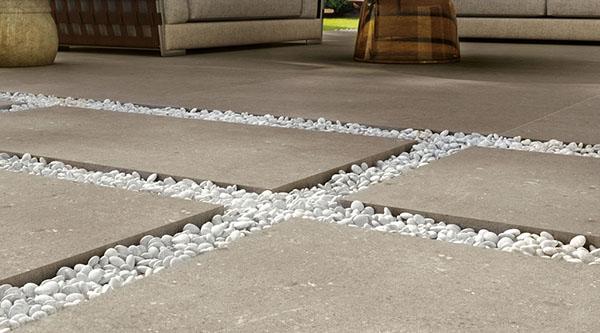
Porcelain stoneware is a particularly suitable material for creating outdoor flooring thanks to its resistance to weathering, abrasion, and wear.
Porcelain Stoneware: Perfect for Outdoor Floors Too
Porcelain stoneware is an excellent material for outdoor floors such as sidewalks, balconies, gardens, and roof terraces. This year, we again saw a wide representation of the possibilities this material offers for outdoor paving at Cersaie 2018 in Bologna, where the most important Italian and international companies in the sector presented their new collections. Porcelain stoneware possesses all the performance requirements necessary to remain unaltered for a long time even in a potentially aggressive environment: High resistance to abrasion and foot traffic wear. Excellent resistance to weathering, particularly to freeze-thaw cycles. The possibility of being textured to obtain perfectly anti-slip outdoor tiles.
Wide possibilities for customization in terms of format, color, and surface decoration. Color and pattern stability against ultraviolet rays. Non-excessive and particularly competitive cost compared to other commonly used materials. Its notable qualities are due to its particular production technique: a mixture of sand, clay, white clay (kaolin), and feldspar, finely ground and subsequently compressed into specific molds with the shape of the finished element. Firing then takes place, leading to the so-called ceramization or vitrification, i.e., the fusion of the material with consequent size reduction and a drastic reduction in porosity.
Characteristics, Finishes, and New Trends in Outdoor Porcelain Stoneware
All porcelain stoneware tiles, including outdoor porcelain stoneware, are therefore characterized by an extremely low-porosity surface that is scratch-resistant, frost-proof, and very resistant to abrasion.
Outdoor porcelain stoneware is also recognizable by its greater thickness, typically 2 cm. From an aesthetic point of view, these tiles fully reflect the latest trends in modern flooring: the collections from the best companies are distinguished by their large format, neutral colors in solid shades, or the skillful simulation of high-quality but much more delicate materials. In the catalog of [Company Name], we find for example Glance , a line of severe minimalist tiles in four refined shades of gray (Pearl, Smoke, Taupe, and Coal) and nine different formats: particularly notable are the square slabs with a side of ninety centimeters, capable of evoking a monolithic resin or concrete screed floor. The Horizon collection also features four nuances in neutral colors, but the surface appears more rustic and substantial, evoking natural stone traditionally used for outdoor paving: Sunrise (dawn) recalls yellow sandstone, Sunset recalls Tuscan gray stone, while Cloud and Storm, finally, recall the dark lava of Mount Etna. Inspired by post-industrial atmospheres, Context instead re-proposes the typical texture of concrete with halos and speckling in tone-on-tone: the perfect solution for cladding and paving the internal patio of a loft created in a disused warehouse. Wood-effect porcelain stoneware is obviously not lacking, offered in every possible variation: wide, elongated planks simulating typical outdoor flooring of [Style], square tiles for more refined solutions, or thin strips reminiscent of classic parquet flooring.
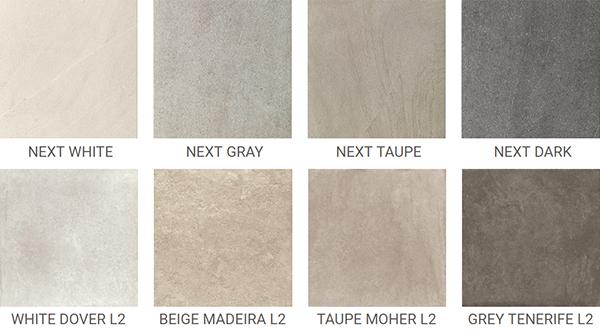
Beat , Soul , and Mito , three collections from the company Keope, are characterized precisely by the extreme versatility of the various formats, the wide color palette with both warm and cool tones inspired by native or tropical wood species, and finally by the perfect reproduction of grain, knots, and even wood defects. Various laying patterns are possible, including running bond, checkerboard, or herringbone. Class and Galaxy from [Company Name] are instead two lines of outdoor tiles in stone-effect porcelain stoneware. The first faithfully reproduces naturally veined stones like beige limestones or marbles, skillfully recreating the typical irregularly veined surface, while the second rediscovers the rustic imperfection of split quarry stone. The Ardesie tiles, clearly inspired by varieties of the namesake stone, finally present a visibly irregular surface with a three-dimensional effect, typical of the ancient roofs of slabs chipped by frost in Ligurian or Aosta Valley architecture. System L2 from [Company Name] summarizes all the characteristics described above: it is in fact a line of outdoor tiles specifically designed for this function. They are available in three large formats (planks of 30×120 cm, rectangular tiles of 45×90 cm, or square tiles with a side of 60 cm) and various textures: solid color with a slightly rough surface in classic neutral shades of gray, with wood or split quarry stone effect.
Outdoor Driveable Floors in Porcelain Stoneware
Source: Read the original article | Published: October 11, 2018