
Editor's Note
This editor’s note highlights the key facts and market implications behind “Previews for Milan Design Week 2026: The Bathroo”, with emphasis on sourcing, product fit, fabrication, logistics, or buyer impact.
Lari, designed by Studio A-ro for Alice Ceramica. With the Lari collection, developed around suspended furnishings, Alice Ceramica enters the world of bathroom furniture. Designed in collaboration with Studio A-ro, it features open and closed configurations and integrations between ceramic surfaces and natural materials like marble, lava stone, and wood (in 4 finishes). The washbasins also allow wide compositional freedom with geometric shapes.
Measured volumes, light surfaces, and careful research on proportions characterize Gisele, a collection signed by Globo and designed by Angeletti Ruzza, intertwining historical references and contemporary taste. The designer reinterprets the 'cannettato' technique, typical of the 1930s and 40s, integrating it into the project's architecture, making it a structural part of the compositional language, and ennobling it with the exclusive glossy 'Riflessi di Luce' finish that enhances the volumes. Gisele is completed with two mirror cabinets, a lacquered MDF hook, and two models of ceramic shelves that echo the proportions and formal cleanliness of the furniture.
The bathroom environment, along with all the elements dedicated to well-being that compose it, follows a significant evolution in its design path. The modularity of the entire system is refined and expanded, aimed at limitless compositional freedom that allows for millimeter-level personalization of the space. An increasingly rich universe of accessories – mirrors, shelves, hooks, holders, lamps – revolves around individual needs. But above all, what becomes visible is a coherent vision of the bathroom space structured as an increasingly articulated construction, where compositions are inspired by architectural principles brought to a domestic scale. In this way, volumes, light, and depth take on a new role, emphasized by materials and their craftsmanship, in a whole where washbasins also lend themselves to new interpretations with different shapes and footprints. Thus, the material, with its sculptural profiles, invites one first and foremost to be touched.
A modular system based on the superimposition and intersection of pure volumes. A construction in which horizontal and vertical elements generate structures that are both balanced and dynamic, alternating circular, oval, or rectangular shapes, paired with a series of mirrors and lacquered cabinets in the opaque and glossy finishes of the Alice palette.
At the fair: Hall 6 | Stand C42. In the city: via Marsala 2.
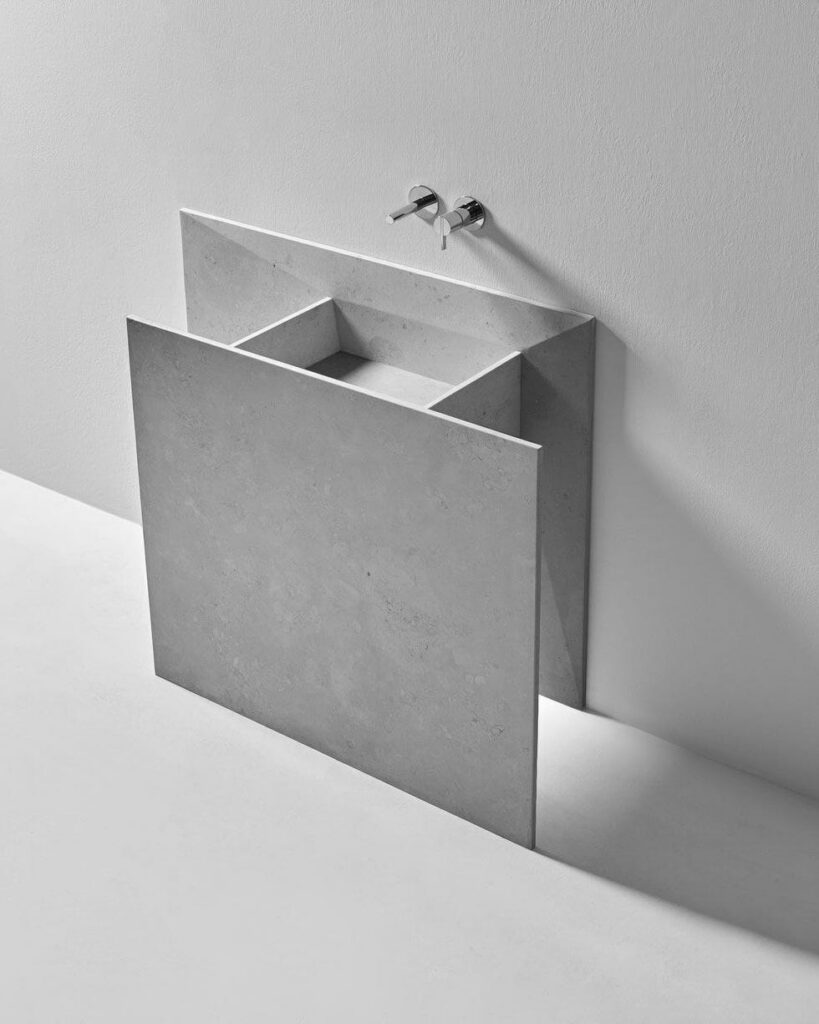
Skyline, designed by Antonio Iraci for Antoniolupi. It is a clear reference to the metropolitan horizon, the Skyline washbasin, designed by Antonio Iraci for Antoniolupi. Its extraordinary architecture does not immediately reveal the object's primary function, composed as it is of staggered planes, three-dimensional volume, the intersection of parallel and orthogonal surfaces, and the voids created in their spatial arrangement. Only afterwards does the washbasin reveal itself in its entirety, with the basin suspended between two parallel surfaces. The veining of the natural stone it is made from creates plays of reflections with the aid of water, especially on the interior, carefully hand-polished for a sophisticated sensory experience.
Gisele, designed by Angeletti Ruzza for Globo. At the fair: Hall 10–11 | Stand A02–A04.
Cubik, designed by Riccardo Gava for IdeaGroup. The Cubik collection, designed in 2012 by Riccardo Gava, designer and art director of Ideagroup, 'grows'. New elements are added to the characteristic 45° inclined edges of drawers and doors, which lack external handles. For additional storage space and greater compositional freedom, a 48.5 cm high module with a central groove, a 60.5 cm high suspended module, and open bases and wall units with the characteristic 45° edge have been introduced, maintaining aesthetic coherence. The range of finishes also expands, with tailor-worked wood materials, Unicolor HPL laminate with a marble effect, and solid dust-effect colors. And further: opaque colors and metalcolors for the fronts with a 45° aluminum frame, mixed with the new Flutes glass with three-dimensional 'cannettato' workmanship, or with glossy or acid-etched glass.
In the city: Spazio Milano, Via Alessandro Manzoni 43.
Street, design and production by Arbi Arredobagno. The historic Street collection by Arbi Arredobagno is renewed with an aesthetic that enhances its recognizability. The handle integrated into the curved hinged door becomes a distinctive sign, a detail that lightens the volumes and restores visual continuity to the fronts, enhancing surfaces and finishes. While every element is designed to offer comfort, practicality, and a harmonious visual perception. Street offers a high degree of customization, thanks to a modularity that allows for multiple configurations and tailor-made solutions. And also thanks to the 52 lacquered finishes – glossy, matte, or velvet – enriched by 4 Metal variants, alongside 7 Oak wood essences and a Special variant in natural Canaletto Walnut.
In the city: Corso Monforte corner Via San Damiano.
Manuela Di Mari
Source: Read the original article | Published: March 25, 2026