
Editor's Note
This editor’s note highlights the key facts and market implications behind “Back in Trend: These 5 Bathrooms Show How Versat”, with emphasis on sourcing, product fit, fabrication, logistics, or buyer impact.
Bathroom Tiles: 5 inspiring ideas for bathroom design.
Tile is like a silk scarf – a versatile basic that can instantly elevate any look. Not too long ago, however, tile had a rather poor reputation. It was considered cold and sterile, a purely functional floor and wall covering that dominated the bathrooms of the 1950s. But the era of classic white tiles in standard sizes is long gone. In recent years, bathroom tiles have undergone a steep evolution, presenting themselves with new patterns, exciting colors, and lively textures.
But not all tiles are created equal. Different surfaces, materials, and craftsmanship determine the suitable areas of application and purposes for the tile. The most common type of tile is ceramic tile, made from a mixture of clay, sand, and feldspar. This makes it a particularly robust and resilient material suitable for floor and wall tiles in the bathroom. Earthenware tiles, on the other hand, are characterized by a porous surface, which is why they should only be used in the bathroom with a (double) glazed surface. Much more robust are stoneware tiles, which consist of fine ceramics and are pressed at such high temperatures that they can even withstand any weather conditions outdoors. Similarly resistant are glass tiles, which are particularly in demand due to their wide range of color options. However, because they have an extremely slippery surface, they are primarily used as wall tiles.
Other well-known tile types include natural stone tiles, which have different characteristics depending on the stone – granite, marble, or travertine. For use in the bathroom, for example, water-repellent and acid-resistant properties are advantageous; slip resistance should also be considered during selection. It is indicated in slip resistance classes, which comprise a total of five (from R9 to R13), with R9 being the lowest classification.
Whether wall-to-wall or as a contrast: These bathroom tiles combine style and function – and instantly turn your bathroom into a showstopper.
Trends for 2025
In 2025, the trend is towards the individual, personal, and handmade. Particularly in demand: handcrafted tiles that carry the charm of the imperfect. These include hand-glazed Moroccan Zellige tiles or Italian Cotto tiles – even though the latter are unfortunately only conditionally suitable for bathrooms.
Of course, minimalist bathrooms with clean lines and neutral colors are still highly popular. A particularly calm and harmonious atmosphere is created by uniformly tiled rooms that follow a subdued color palette. However, to ensure the minimalist approach doesn't end in sterility and boredom, small-scale tile patterns help – this brings movement and dynamism into the bathroom without losing harmony.
Amid all the technological developments regarding tile composition, one thing remains particularly in demand: the classic checkerboard pattern. Interior designer Laura Karasinski explains this with the growing popularity of nostalgia: "The trend is moving towards preservation, away from radical total renovation towards rooms that are allowed to tell stories," she sums it up.
“The trend is moving towards preservation, away from radical total renovation towards rooms that are allowed to tell stories.”
This is precisely why tiles in the traditional checkerboard pattern are coming back into fashion, and they can gladly be combined with modern elements, such as high-tech faucets or bathtubs with smart home functions.
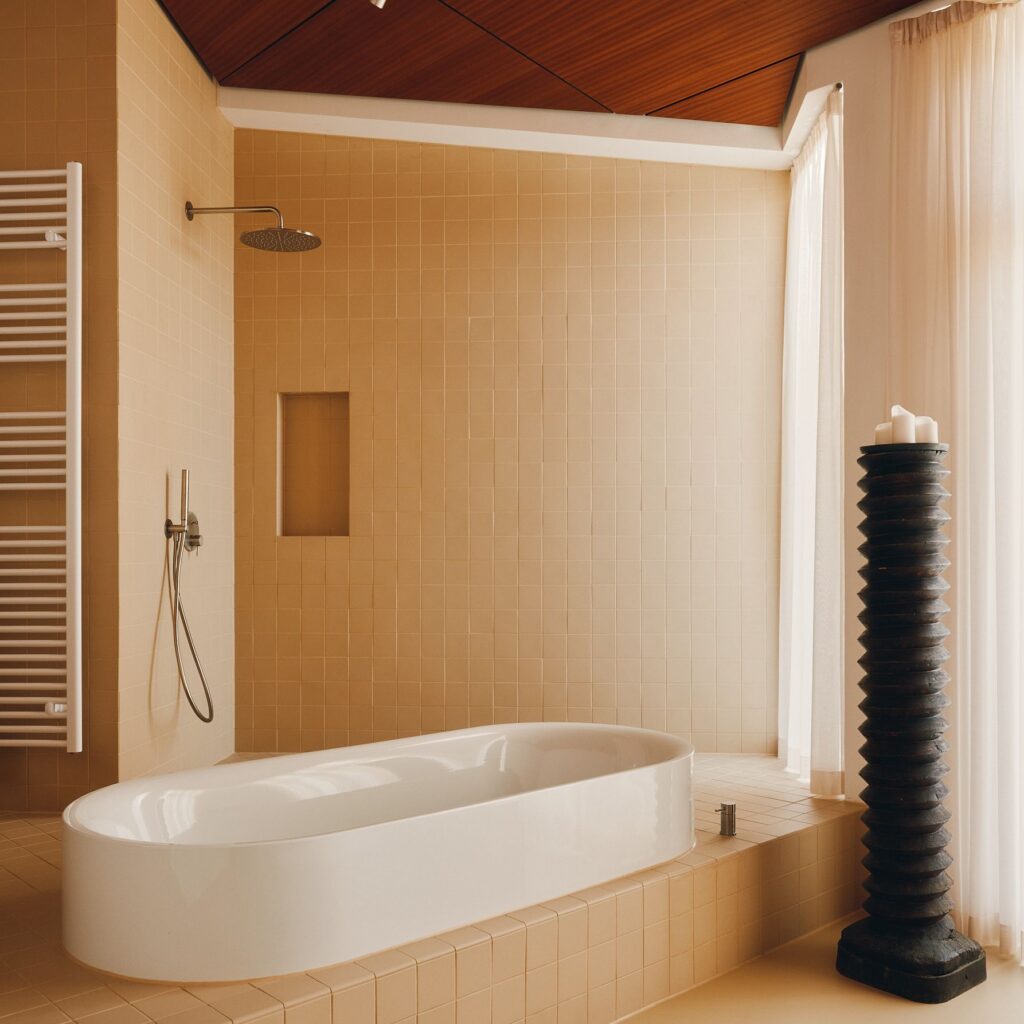
A similar approach is followed by the 70s look, which continues to make waves in current bathroom designs. Typical for the style: handcrafted tiles in rich, earthy tones, paired with shiny chrome or brass faucets. To underscore the nostalgic look, tiles – both on the floor and on the wall – can be arranged in basic geometric shapes, such as the classic checkerboard pattern.
As mentioned at the beginning, in recent years the bathroom has transformed from a functional wet room into a cozy space with a feel-good character. Indicative of this is the use of high-quality materials, such as wood, marble, or natural stone tiles, which are increasingly finding their way into the bathroom. Large-format tiles in natural tones extend over large areas. Selected color accents, like bold textiles or bathroom furniture, provide a fresh kick.
Source: Read the original article | Published: October 21, 2025