
Editor's Note
This editor’s note highlights the key facts and market implications behind “Green Building Materials Market Size, Share, Gro”, with emphasis on sourcing, product fit, fabrication, logistics, or buyer impact.
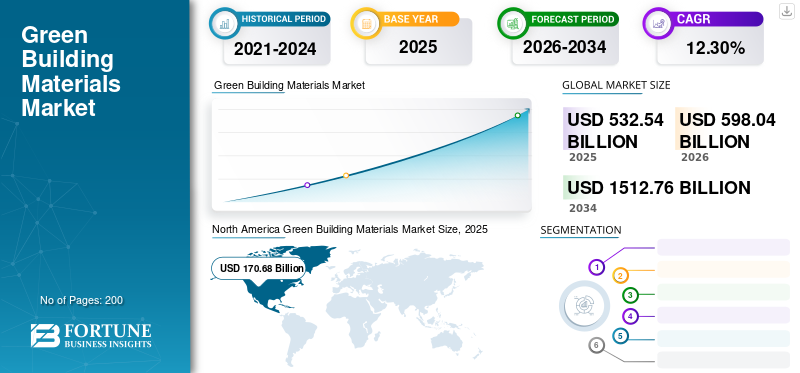
The global green building materials market was valued at USD 532.54 billion in 2025 and is expected to grow from USD 598.04 billion in 2026 to USD 1,512.76 billion by 2034, at a compound annual growth rate (CAGR) of 12.30% during the forecast period. North America dominated the green building materials market with a market share of 32.10% in 2025. Furthermore, the U.S. green building materials market size is expected to grow significantly, reaching an estimated value of USD 289.50 billion by 2032, driven by increased demand for roofing, insulation, framing, and various other residential, industrial, commercial, and infrastructure applications. Green building materials are used to construct an environmentally friendly building structure. The use of these materials supports the conservation of diminishing non-renewable resources internationally. Integrating green materials into construction projects helps reduce the environmental impacts associated with the extraction, transportation, manufacturing, processing, installation, recycling, reuse, and disposal of these source materials. These benefits make green building materials a better alternative to traditionally used construction materials. Additionally, the growing preference for green building materials over traditional construction materials will stimulate market growth. The materials benefit by reducing carbon impacts, allowing for a reduction in the greenhouse effect. Since these materials are energy-efficient and environmentally friendly, they are easy to maintain and save money. These benefits make them an ideal material of choice compared to traditional construction materials. Moreover, the growing demand for these materials has become common in many construction projects because they reduce the environmental impact of building materials related to manufacturing, installation, processing, transportation, recycling, and disposal. The increasing preference for these materials over traditional construction materials is expected to drive market growth. Furthermore, governments in developed countries have implemented policies and incentives to promote green construction, which is expected to increase the demand for green building materials during the forecast period.
“Green buildings” are not just a concept that can save the world, but they can make our world safer, healthier, and wealthier.
The COVID-19 pandemic restricted the movement of people and materials and severely impacted the supply chains of construction manufacturers in 2020. The global construction sector faced consequences such as shortages of building materials, logistical challenges, labor shortages, and uncertainty leading to the suspension or cancellation of construction activities. However, as the pandemic's impact waned and government initiatives normalized economies, the construction industry stabilized within a few years. Consequently, the market has seen an upturn since 2021.
Global Green Building Materials Market Overview
Market Size and Forecast: Market Size 2025: USD 532.54 billion Market Size 2026: USD 598.04 billion Market Size Forecast 2034: USD 1,512.76 billion Compound Annual Growth Rate (CAGR): 12.30% (2026-2034) Market Share:
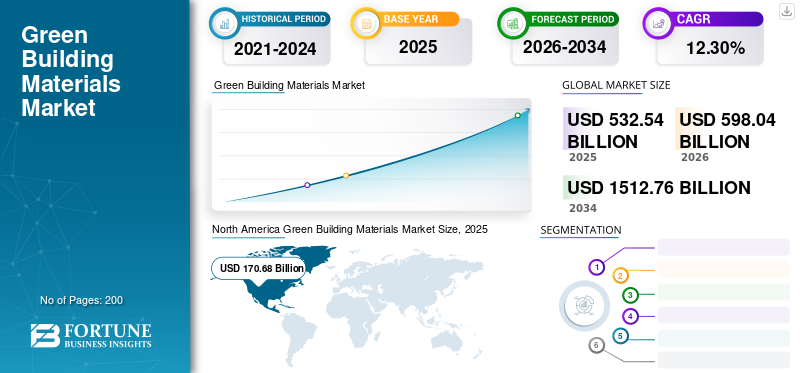
North America dominated with a market share of 32.10% in 2025. The U.S. market is expected to reach USD 289.50 billion by 2032, driven by demand for roofing, insulation, framing, and residential, industrial, commercial, and infrastructure applications. Regional Insights: North America: The largest market in 2023, driven by demand for eco-friendly roofing, insulation, and framing, and government initiatives encouraging energy-efficient buildings. Asia-Pacific: The fastest-growing market; growth is supported by residential and industrial construction, retrofitting, and the widespread use of green materials like galvanized steel sheets and fiber cement composites. Europe: Significant growth is expected, supported by initiatives such as the EU's Energy Performance of Buildings Directive (EPBD) and stringent building codes promoting green materials. Latin America, Middle East & Africa: Moderate growth driven by rising residential and commercial construction, with an increased focus on environmentally efficient building practices.
Green Building Materials Market Trends
Increasing Awareness and Adoption of Green Building Materials to Boost Market Growth Construction and building activities consume 3 billion tons of raw materials annually, or 40% of global consumption. The use of sustainable building materials and products promotes the conservation of diminishing, non-renewable resources internationally. Additionally, integrating sustainable building materials into construction and building projects can reduce the environmental impact of transporting, extracting, processing, installing, manufacturing, disposing, recycling, and reusing these raw materials in the construction industry. The growing demand for these materials in construction and building activities is likely to drive market growth. North America saw growth in the green building materials market from USD 120.84 billion in 2022 to USD 134.34 billion in 2023.
Green Building Materials Market Growth Factors
Increasing Shift Towards Green Buildings to Lead the Market According to the International Energy Agency, in 2023, operations in infrastructure accounted for 30% of global final energy consumption and 26% of global energy-related emissions. Of this, 8% were direct emissions in buildings, and 18% were indirect emissions from the production of heat and electricity used in buildings. The concept of sustainable construction involves and integrates a variety of approaches during the design, construction, and procedures of building projects. The use of green materials and products represents one of the important strategies in building design. Green materials are primarily composed of renewable resources. These materials are environmentally responsible. Therefore, the use of such materials will help reduce greenhouse gas emissions. Green building materials include wood, straw-made concrete, and recycled plastic.
Source: Read the original article | Published: March 23, 2026