
Editor's Note
This editor’s note highlights the key facts and market implications behind “Plastic Recycling: How Can It Succeed When New P”, with emphasis on sourcing, product fit, fabrication, logistics, or buyer impact.
Entrepreneur & Politics
How can the plastics industry be fully circular by 2050 when reuse is made so complicated by regulations? This is a concern for Theo and Emmelien Regeling of the family business RPP. '2050 is closer than you think.'
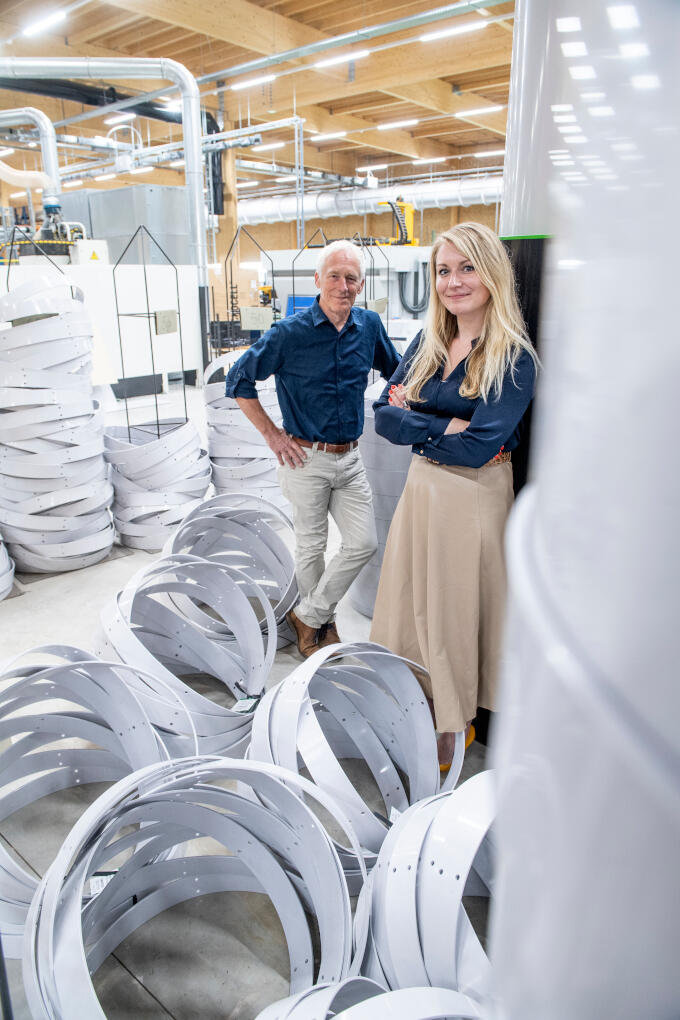
The production hall of the family business RPP Kunststofoplossingen in Nieuwleusen is constructed entirely of wood, supplemented with recycled wall panels and piping of their own manufacture. The structure stays warm in winter and cool in summer. Not only pleasant for the employees, but also for butterflies, explains Emmelien Regeling, general manager of the company. 'Apparently, butterflies settled here immediately after we built the hall. At the end of winter, they began to emerge. Together with all the plants we have here, our factory suddenly became a real butterfly garden!' Perhaps not what you'd immediately expect from a plastics producer, but Regeling and her father Theo have an explanation for it. 'Precisely because we are a family business, sustainability is in our DNA,' she states. 'If we do nothing now, I won't be able to hand over the company to a third generation later.'
RPP to be Energy Self-Sufficient by 2022
RPP is a plastics factory that produces from prototypes to small and medium-sized production series through vacuum forming, welding, milling, and assembly of plastic products. After the RPP phase, mass production often goes to an injection molder. Emmelien: 'This means we can lay the foundation here for many new products in terms of sustainability. Because we are at the beginning of the chain, we also feel the responsibility to think about sustainable design and sustainable raw material use.'
While the plastics industry is known for relatively high energy consumption, the family business RPP plans to be energy self-sufficient as early as 2022. Theo: 'Within six months, we will start installing solar panels here, which we can use to run our machines. The machines produce quite a bit of heat: we discharge it to the heat recovery unit and then use it to warm cold air from outside.'
The factory essentially has no CO2 footprint because the building is CO2-positive due to the use of wood, and RPP is increasingly using recycled plastic.
‘2050 seems far away, but it goes faster than you think.’
Recycled Plastic Is Becoming Cheaper
Sustainability and plastic: they seem contradictory. Is there even a future for plastic? Theo asks a counter-question: 'Do you think cars will be made entirely of steel again in the future? And then weigh ten, twenty times as much and get twenty miles per gallon? No, plastic is indispensable in our world.' Emmelien adds: 'We are currently converting wooden products to plastic. The problem with wood is that after three years outside in the rain, it is weathered. A plastic alternative has a much longer lifespan. If you just reuse and recycle the plastic properly after its life cycle, then in the long term it has more value and is more CO2-neutral than wood.'
The sustainability targets are tough: in the plastics sector, no virgin material (material in the raw material stage) may be used by 2050. As early as 2030, all products must contain 35 percent recyclate. In addition, the EU aims for the economy to be fully circular by 2050. Emmelien: 'That seems far away but goes faster than you think! If we don't initiate a transition now, then in thirty years we won't have any plastic left to make something from. The raw materials will simply run out.'
For a long time, virgin materials were simply cheaper than recycled material, and RPP's customer would ultimately choose that. But that trend is reversing. Recyclate streams are becoming relatively cheaper, and demand is increasing. 'That combined with CO2 pricing means the price difference between virgin material and recyclate can be maintained in the future,' thinks Emmelien. 'That you are either rewarded for using recycled plastic, or have to pay extra if you don't. Recyclate will represent a value in the future.' For the packaging industry – RPP's sector peers – it's all a bit more difficult. Theo: 'In food packaging, for example, recycled material may not be used. That's contradictory when the government simultaneously asks for 35 percent recyclate.' He believes something really must be done about that.
Using Fewer Types of Plastic Makes Recycling Easier
In plastic production, consumers and producers long pointed fingers at each other. Theo explains why plastic is complicated to recycle: 'The different types of plastics – PVC, PET, PE, Polypropylene, Polystyrene – are not compatible. You have to compare it to different blood types. If you mix them together, you can no longer reuse them.' The complicated separation system does not yield pure residual streams. By now, parties understand each other better: the consumer shows they are not too proud to collect plastic separately; and many producers simplify their design so that recovering raw materials becomes easier.
Source: Read the original article | Published: July 08, 2021