
Editor's Note
This editor’s note highlights the key facts and market implications behind “From Firefighting Robots to Transparent TVs: The”, with emphasis on sourcing, product fit, fabrication, logistics, or buyer impact.
From January 6 to 9, 2026, the Consumer Electronics Show (CES) in Las Vegas is showcasing the latest technological innovations ready to enter homes. This year, artificial intelligence is more present than ever. From anecdotal to potentially very useful, here is our selection of surprising objects that could become part of your daily life.
Smart Toilets
The Korean company Vovo has developed smart toilets. Beyond automating the lid opening and flushing system, an integrated program called "Jindo the Dog" sends an alert to a relative's phone if the owner does not use the toilet for eight to ten hours. Furthermore, an integrated urine analysis sensor allows for real-time health monitoring, with results displayed on a wall screen.
Robots
An Intelligent Firefighting Robot
To avoid putting firefighters in danger and act as quickly as possible, the Hong Kong-based company Widemount Dynamics has designed an intelligent, AI-piloted firefighting robot. Thanks to its millimeter-wave radar, it is not hindered by smoke and is capable of measuring flame intensity in real time, identifying burning materials, and selecting the appropriate type of extinguisher. It also acts as a scout by sending data to the command center.
An All-Terrain Quadruped Robot
The Lynx M20 Pro from the Chinese company Deep Robotics is a quadruped robot with wheels and articulated legs designed for dangerous environments. Its capabilities are impressive. Withstanding temperatures between -20°C and 55°C, its structure is also protected from dust and water splashes. Standing 60 cm tall, this 33 kg robot can roll at 18 km/h, overcome obstacles up to 80 cm high, and carry a 15 kg load for 2.5 hours over 12 km. Ideal for emergency response, logistics, and scientific exploration.
A Humanoid Handling Robot
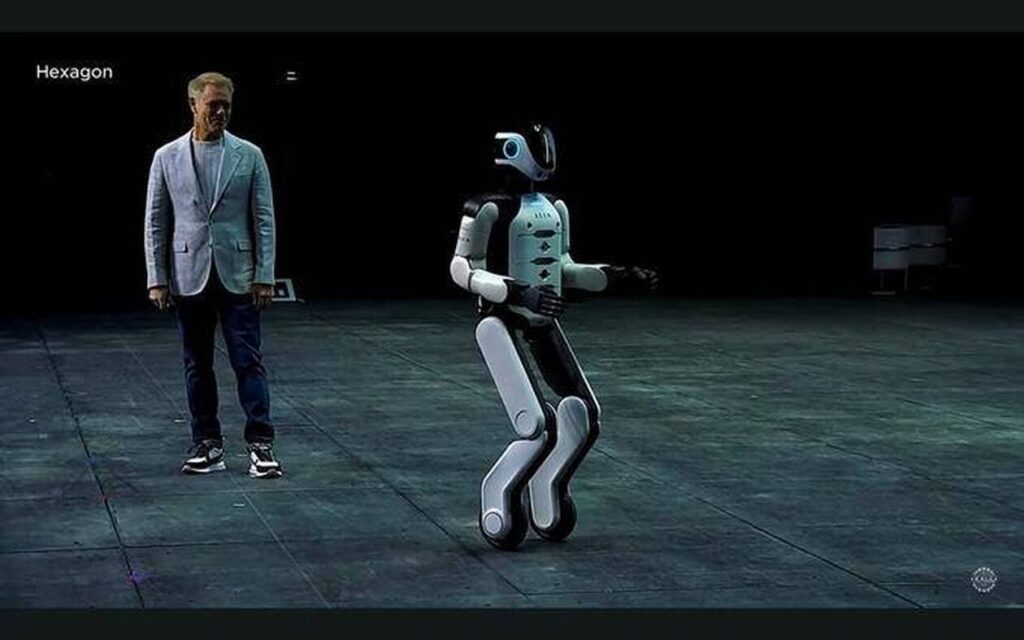
The Swedish company Hexagon designed Aeon to address labor shortages, particularly in industry. This humanoid robot, 1.65 m tall and weighing 60 kg, can move at 8.5 km/h, sort parts, detect defects on objects, and perform complex technical tasks. Its main strengths are its versatility and autonomy, which rely on physical AI. This could interest sectors such as aerospace, automotive, or logistics.
The Home
A Transparent Television Screen
Research on screens still holds good surprises. Following its competitor Samsung, the Korean LG Signature Oled T television offers a transparent, wireless screen. It reveals the environment when the screen is off but also maintains a transparency effect when it is on. Thanks to its self-illuminating pixels and lack of backlight, it not only makes the unsightly and bulky black screen disappear but does not lose image quality.
A Braille Label Printer
Nemonic Dot is an invention combining a portable braille label printer and a mobile application. Its pressure mechanism produces uniform raised dots on metal – a first for portable label makers – guaranteeing reliable braille in all environments. The mobile app allows anyone, even without knowledge of braille, to create labels from voice or text using a multilingual engine optimized by AI.
Mobility
A Transformable Residential Trailer
What if you could take your house on your travels? We know about motorhomes, but what the American company AC Future offers is a high-end experience. The transformable AI-TH trailer…
Source: Read the original article | Published: January 05, 2026