
Editor's Note
This editor’s note highlights the key facts and market implications behind “Will Mandatory Water-Saving Toilet Labels Alone “, with emphasis on sourcing, product fit, fabrication, logistics, or buyer impact.
A mandatory 'grade labeling system' for water-saving equipment, including water-saving flush toilets, has been implemented. However, industry insiders point out that this is merely a patchwork solution that fails to address the root cause of why existing laws have not been properly enforced. On the 18th, the Ministry of Environment announced that amendments to the 'Water Supply and Waterworks Installation Act' and its enforcement decrees and rules, which mandate the display of water-saving grades on water-saving equipment such as toilets and faucets, would take effect. From this day forward, water-saving equipment manufactured or imported must display a water-saving grade label, similar to the energy efficiency grade labels on home appliances, to allow verification of the equipment's performance. For example, flush toilets are graded based on water usage per flush. They are classified into three grades: Grade 1 (4 liters or less), Grade 2 (5 liters or less), and Grade 3 (6 liters or less). A fine of 3 million won will be imposed for failing to display the grade or displaying it falsely, and a fine of 5 million won for not installing a water-saving flush toilet itself. The core of this amendment includes provisions mandating grade labels on toilets and provisions for increased penalties based on the number of violations. The Ministry of Environment projected that if approximately 23 million Grade 1 toilets are installed nationwide, about 150 million tons of tap water could be saved annually. Applying the average production cost of tap water, this would save about 149 billion won per year. Furthermore, energy required for tap water production would also be saved, potentially reducing carbon dioxide emissions by about 13,700 tons annually, an effect equivalent to replacing 17,000 internal combustion engine vehicles with electric cars each year.
However, the industry questions whether this amendment will significantly increase the adoption of Grade 1 toilets. The reason the existing Water Supply Act was not followed despite being in place is the lack of follow-up supervision. Yet, this amendment only touches on aspects like mandatory labeling, omitting content addressing this core issue.
Industry insiders unanimously agree that follow-up management is far more crucial for water-saving equipment. An official from a toilet manufacturer pointed out, "When measuring a toilet's water usage, a sample is submitted to the Korea Environmental Industry & Technology Institute, and the grade is determined based on the resulting report. Even if a construction company arbitrarily uses a non-water-saving toilet, there is no way to know unless a full inspection is conducted."
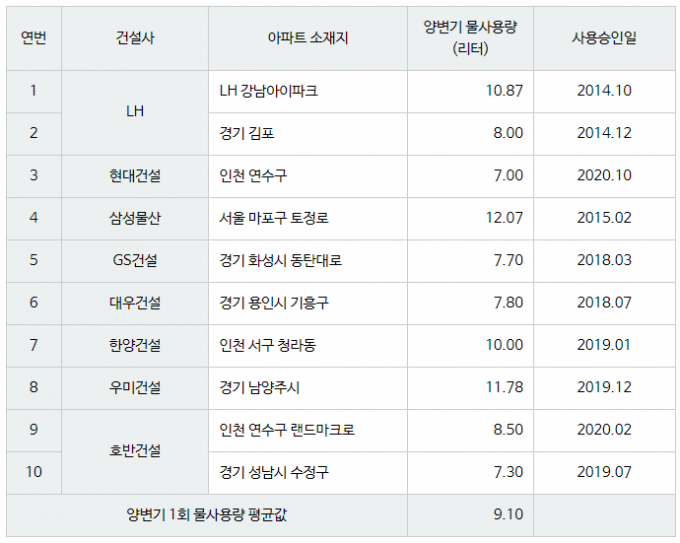
According to a survey by the Korea YMCA last month, since 2014, newly constructed buildings have been required to mandatorily install water-saving flush toilets with a water usage of 6 liters or less (Grade 3), but not a single construction company was found to have complied.

In response, the Ministry of Environment explained, "We considered that water usage can increase up to 8 liters due to water pressure differences between buildings, and there have been cases where water usage is adjusted using certified accessories after inspection. Therefore, through an amendment to the enforcement rules in May 2020, we stipulated that water usage must not exceed 6 liters even when using accessories."
However, this explanation was rendered meaningless by the fact that toilets installed in an apartment complex built by Hyundai Engineering & Construction in Yeonsu-gu, Incheon, which received its use permit in October 2020, used over 7 liters of water per flush. Moreover, the Korea YMCA survey targeted only 'water tank-type toilets,' not 'direct flush toilets' whose water usage varies with water pressure. Despite clear violations being exposed, not a single corrective order or full inspection has been conducted. The Ministry of Environment stated, "There are no separate discussions or plans regarding follow-up management." Regarding this, a toilet manufacturer official noted, "No matter how much the penalty standards are strengthened, they only have meaning if actually enforced. There have been no penalties for the past eight years, so it's questionable how sincerely this newly mandated grading system will be implemented."

Criticism has also emerged that the announcement of the Water Supply Act amendment was negligent. The Ministry of Environment stated, "A day before the enforcement date, we held a briefing session with representatives from relevant associations and organizations in the toilet and faucet industry. For other companies, we are contacting them using the list of companies registered with the Environmental Industry Technology Institute." However, an industry insider revealed, "Shouldn't the grade inspections have been completed before the system's enforcement date? The enforcement decree amendment was first announced in August last year, but the certification bodies weren't selected until a month before the enforcement date, and we still haven't received the exact testing standards."
“Only about five companies sell Grade 1 toilets using 4 liters or less, and among those, only about two properly flush without leaving residue, and they are expensive. In this situation, telling consumers they can save on water bills and energy by replacing their toilets with Grade 1 ones is deceptive and typical armchair administration.”
This was stated by a representative of a company that has sold ceramic bathroom products for 30 years at Seun Sangga in Euljiro, Seoul.
Source: Read the original article | Published: February 18, 2022