This editor’s note highlights the key facts and market implications behind “Trends and Case Studies of M&A and Business Succ”, with emphasis on sourcing, product fit, fabrication, logistics, or buyer impact.
Current Status of Daily Necessities Manufacturing and Wholesale
Daily necessities refer to items used in everyday life. This article defines "daily necessities" as the following products: daily sundries, sports goods, eyeglasses and lenses, flowers and gardening, furniture and interior fixtures, office and stationery supplies, packaging and packing materials, and other daily necessities manufacturing and sales. We will introduce M&A trends, advantages, disadvantages, and case studies for business establishments involved in the manufacturing and wholesale of these products.
Market Size and Environment
Focusing on the three sectors of "daily sundries," "packaging and packing materials," and "office and stationery supplies" within the daily necessities manufacturing and wholesale industry, we explain the market size and environment.
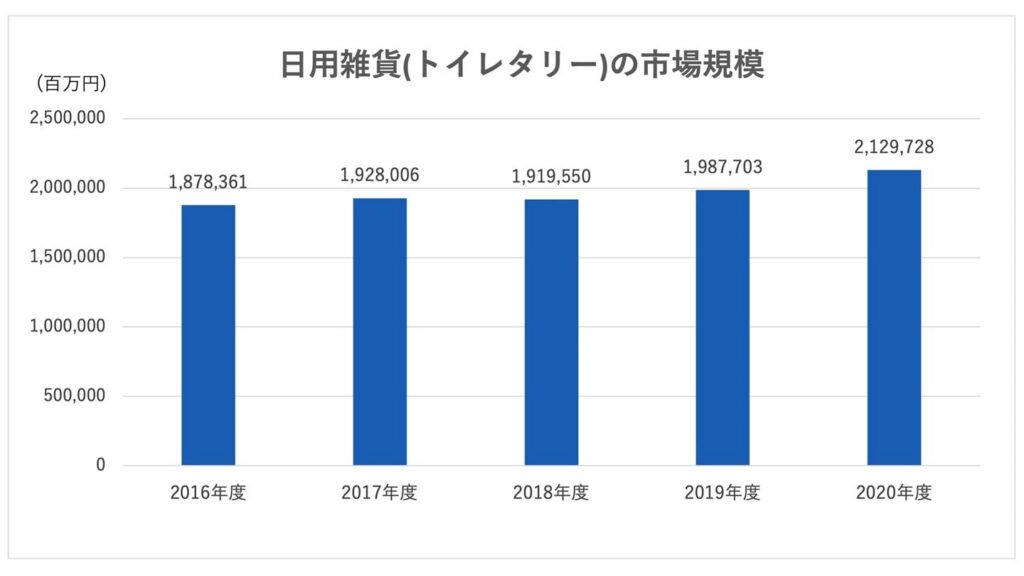
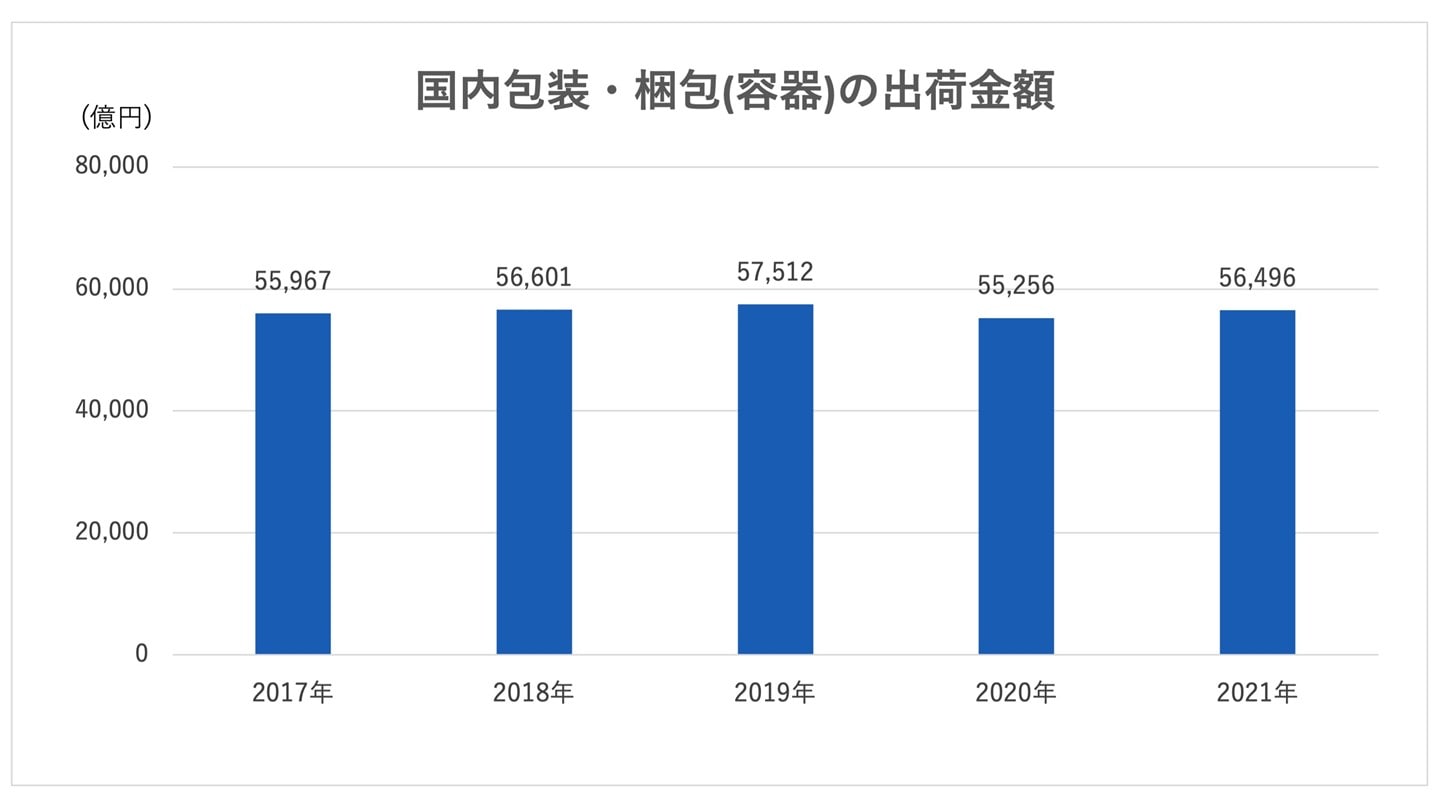
Daily Sundries (Toiletries) : The market size for the top 50 daily sundry (toiletry) items in FY2020 was 2,129.728 billion yen, 107.1% of the previous fiscal year (approximately 1,987.7 billion yen). The market size from FY2016 to FY2020 has trended as follows. The expansion of the daily sundries (toiletries) market size is presumed to be due mainly to two reasons: the widespread strategy within the industry to secure profits by strengthening sales of high value-added products, and increased demand for certain products like hygiene-related items during the COVID-19 pandemic. Packaging and Packing Materials : The domestic shipment value (market size) of packaging and packing (containers) in 2021 was 5,649.6 billion yen, 102.2% of 2020 (5,525.6 billion yen). The market size from 2017 to 2021 has remained almost flat.
Office and Stationery Supplies : The market size for stationery and office supplies in FY2020 was 407.7 billion yen, an 8.2% decrease from FY2019 (444.1 billion yen). The market size from FY2017 to FY2020 has trended as follows. Due to factors such as office digitalization, the market size has been shrinking since FY2017. In FY2020, the market size shrank particularly sharply compared to the previous year due to factors such as "cooling demand for office supplies accompanying the spread of remote work."
Industry Challenges and Outlook
In the daily necessities manufacturing and wholesale industry, the challenges for each sector are as follows: Daily Sundries : Decrease in domestic demand due to population decline from a low birthrate and aging population; low-profit-margin, high-volume sales revenue structure due to low unit prices; intensifying competition with drugstores, convenience stores, and supermarkets. Packaging and Packing Materials : Decrease in domestic demand due to population decline from a low birthrate and aging population; cost increases due to environmental considerations and rising raw material prices; business model prone to price competition (difficulty in product differentiation). Office and Stationery Supplies : Decrease in domestic demand due to population decline from a low birthrate and aging population; decrease in demand due to digitalization of corporate activities and the COVID-19 pandemic. In response to these challenges, movements to address them through the following activities are active within the industry, and these movements are expected to accelerate in the future: business expansion into emerging countries like Southeast Asia where population growth is expected; operational efficiency and cost reduction through utilization of IT systems; differentiation from competitors through development of products based on customer needs or products conscious of environmental protection; expansion of business scale and technological development through strengthened collaboration with other companies in the same industry.
M&A Trends in Daily Necessities Manufacturing and Wholesale
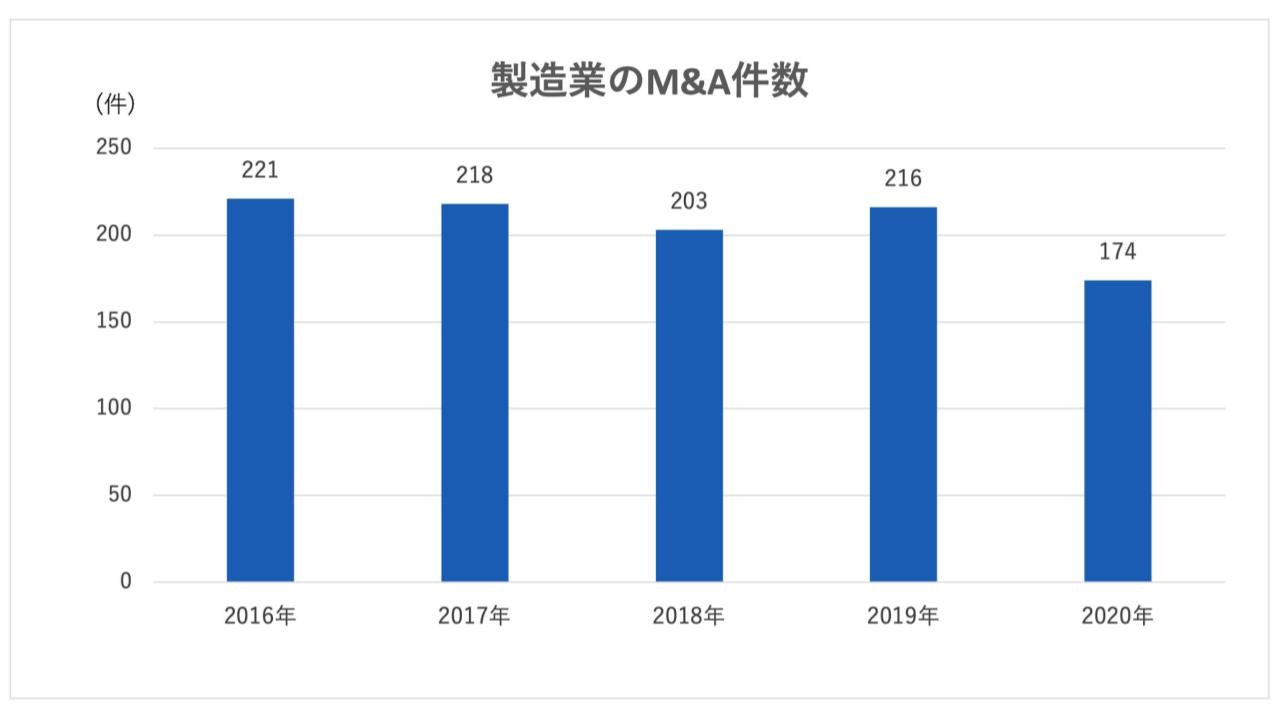
Number and Scale of M&A Deals : Clear data aggregating the number of M&A deals solely for the daily necessities manufacturing and wholesale industry does not exist. Therefore, this section introduces the total number of M&A deals for the entire "manufacturing industry" to which daily necessities manufacturers belong. According to M&A Online's aggregation, the total number of M&A deals in the manufacturing industry in 2020 was 174. The number from 2016 to 2020 has trended as follows. While the number remained flat from 2016 to 2019, in 2020 it decreased significantly compared to the previous year due to factors such as "reduction in production activities accompanying the spread of the novel coronavirus" and "prolongation of US-China trade friction." Furthermore, looking by detailed industry sector, the number of M&A deals in 2020 nearly halved compared to the previous year in the three fields of "chemicals," "machinery," and "other products." From the above, it can be seen that "the total number of M&A deals in the manufacturing industry has decreased significantly," and "there are sectors that decreased by about 50% year-on-year." Therefore, it can be inferred that the number of M&A deals for daily necessities manufacturers in 2020 also decreased significantly compared to previous years. Background of M&A Activity : In the daily necessities manufacturing and wholesale industry, M&A is utilized mainly for the following purposes/strategies: expansion of sales channels for own products; entry into overseas markets, focusing on Asia; securing manufacturing plants or research facilities for the purpose of expanding business scale; expansion of production scale; improvement of product supply capacity; acquisition of product brands that become stable revenue sources; reduction of costs related to procurement, production, and logistics; resolution of succession or manpower shortages.
Points to Increase M&A Success Probability
Common Across All Industries : For the transferring company: Clarify management resources (e.g., technology) and track records that are your strengths; enter negotiations after clarifying negotiable and non-negotiable conditions; sell during a time when performance is growing or the market is favorable; implement measures to increase corporate value in advance (e.g., improving technological capabilities). For the acquiring company: Conduct thorough due diligence and reflect the results in the acquisition price; enter negotiations with the transferring company with sincere dealings; respect employees, engineers, and business partners inherited from the transferring company; carry out post-M&A PMI (post-merger integration) in a planned manner. Daily Sundries : For the transferring company: If handling seasonal products, formulate a business plan (funding plan) considering demand fluctuations; establish a production system capable of responding to seasonal fluctuations; if there are aging facilities or machinery, update them as necessary. For the acquiring company: Scrutinize the transferring company's business plan considering seasonal sales fluctuations and trends; after acquisition, provide your own product development know-how or technology to the transferring company as necessary. Packaging and Packing Materials : For the transferring company: Establish excellent sales channels (e.g., major ordering parties or customers); reduce excessive inventory and capital investment as much as possible; shorten the period until accounts receivable are collected; prepare countermeasures for rising and fluctuating raw material costs. For the acquiring company: Scrutinize the period for accounts receivable collection and the presence of excessive inventory/capital investment; select a transferring company where economies of scale (≈ cost reduction effect) can be expected through M&A. Office and Stationery Supplies : For the transferring company: Secure ordering parties (customers) or raw material suppliers that lead to stable sales; establish know-how and systems capable of developing/manufacturing products excellent not only in quality but also design; establish sufficient working capital and production systems to handle seasonal fluctuations. For the acquiring company: When selecting an acquisition target, confirm not only the amount of profit but also its stability; select a transferring company with which mutual complementarity or synergy effects with your own business can be expected.
Advantages and Disadvantages of Conducting M&A in Daily Necessities Manufacturing and Wholesale
Advantages : For the transferring company: Can maintain employment of engineers and employees responsible for product development, and procurement relationships with major trading companies, etc.; can achieve business succession even for companies with succession shortages; can expect "stabilization of financial base" and "acceleration of business growth" by utilizing the acquiring company's sales power and financial strength; can concentrate management resources on high-profit-margin businesses or new product development by selling unprofitable businesses; can expect improvement in product development capabilities, overseas expansion, and operational process efficiency through collaboration and exchange with the acquiring company. For the acquiring company: Can acquire customers, suppliers, product development know-how, and excellent engineers possessed by the transferring company; can increase the likelihood of successful overseas expansion by acquiring overseas companies; can expand business area by acquiring competitors with bases in areas where your company has not entered; can expect expansion of business scale by acquiring factories or business offices; can expect performance improvement/ enhancement through cost reduction and productivity gains from mass production/mass procurement. Disadvantages : For the transferring company: Risk of employee turnover and contract termination with business partners due to backlash against M&A; possibility that sale cannot be made under desired conditions or an M&A partner cannot be found; if shares are transferred, loss of position as manager or shareholder. For the acquiring company: Risk of not obtaining anticipated benefits, failing to recover acquisition costs, or incurring large impairment losses; possibility of inheriting off-balance-sheet debts or contingent liabilities; risk of disruption to post-M&A business operations if customers and business partners cannot be smoothly taken over.
M&A Case Studies and Interviews in Daily Necessities Manufacturing and Wholesale
Famous M&A Case Studies : September 2018: Transferring company: DSG (Cayman) Limited; Acquiring company: Unicharm. Purpose/Background for acquiring company: Expansion of product lines in the Southeast Asia region, strengthening of market position, realization of economies of scale, cost reduction through integration of logistics functions. Method: Share transfer. Result: Unicharm acquired all shares of DSG (Cayman) Limited. Acquisition price: 530 million USD (approx. 60 billion yen). August 2021: Transferring company: Showa Denko Materials; Acquiring company: Shin-Etsu Polymer. Purpose/Background for acquiring company: Acquisition of high share in the domestic market for small-roll PVC wrap, improvement of profitability through reduction of production costs. Method: New company split, share transfer. Result: Shin-Etsu Polymer acquired all shares of the new company established by Showa Denko Materials. Acquisition price: 3.666 billion yen. November 2021: Transferring company: Life On Products; Acquiring company: King Jim. Purpose/Background for acquiring company: Expansion of manufacturing, planning, and sales business related to interior lifestyle sundries, efficiency through joint implementation of product procurement and quality control, sales expansion through mutual utilization of sales channels. Method: Share transfer. Result: King Jim acquired all shares of Life On Products. Acquisition price: 3.5 billion yen.