
Editor's Note
This editor’s note highlights the key facts and market implications behind “New Era for Solar Energy: The Arrival of Walkabl”, with emphasis on sourcing, product fit, fabrication, logistics, or buyer impact.
Anti-slip photovoltaic glass tiles combine passive elements, preventing CO2 emissions into the atmosphere, with active elements that generate energy from sunlight.
Discussing photovoltaic solar energy means discussing a type of renewable electricity obtained from solar radiation through photovoltaic cells, installed on building roofs or in photovoltaic park facilities. This technology can also be found integrated into building enclosure systems like curtain walls or skylights. However, a Spanish company has taken a further step in integrating solar energy production systems into the urban environment by developing alternative solutions, such as installing the world's first walkable photovoltaic floor at the Science and Technology Campus in Ashburn, Virginia, United States.
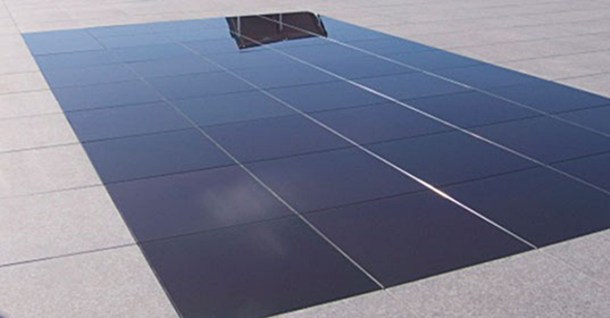
The walkable photovoltaic floor developed by the company Onyx Solar has been installed in an area between Innovation Hall and Exploration Hall known as the Solar Walk. This new application adds a novel solution to the existing market catalog of photovoltaic building materials. Onyx Solar offers well-known solutions for integrating photovoltaic technology into buildings, such as photovoltaic skylights, curtain walls, and ventilated facade systems. But until now, no one had proposed solutions applicable to the urban environment, such as using the ground plane in open spaces properly exposed to solar radiation.
The walkable photovoltaic floor is composed of anti-slip and semi-transparent tiles that convert solar radiation into energy thanks to the use of semiconductors. These tiles are made with photovoltaic glass, with an impact resistance of up to 400 kg of point load and an efficiency similar to other construction solutions with photovoltaic technology.
The photovoltaic glass used in the Solar Walk tiles meets the safety specifications required by current regulations, using systems formed by several glass sheets, bonded by an EVA or PVB type encapsulant. Depending on the required resistance and the expected traffic in the walkway area where the Solar Walk is to be installed, photovoltaic glass sheets ranging from 3 to 19 mm in thickness can be used to compose laminated safety photovoltaic glass tiles, with double or triple glazing.
Special treatments can be applied to the encapsulant material that bonds each of the sheets, providing very interesting properties to the system such as acoustic insulation, thermal insulation, transparency, UV/R radiation filters (in the case of pedestrian areas over habitable spaces), and even color treatment.
Source: Read the original article | Published: October 17, 2013