
Editor's Note
This editor’s note highlights the key facts and market implications behind “Inheritance Worries Brought to Construction Firm”, with emphasis on sourcing, product fit, fabrication, logistics, or buyer impact.
Inheritance seminars hosted by a "construction firm"—neither a tax accountant nor a lawyer—sold out immediately. About 60% of participants proceeded to individual consultations, revealing the latent demand among "inheritance consultation refugees."
LIFEFUND Co., Ltd., a construction firm in Hamamatsu City, Shizuoka Prefecture, opened its first inheritance seminar to the general public in March 2026, and it sold out immediately. Due to high demand, the company offered to transfer applicants to the following month's seminar. The April seminar also sold out quickly, resulting in two consecutive months of full attendance. Of the 15 participants in the March seminar, 9 (60%) proceeded to individual consultations, and 87% of participants rated it as "very good" or "good." Two years after the mandatory inheritance registration law took effect, it has become clear that many families in Hamamatsu City, Shizuoka, struggle with inheritance issues and lack access to appropriate consultation channels, as evidenced by the immediate sell-out of an inheritance seminar hosted by a construction firm.
From Inheritance Consultation to Real Estate and Construction Consultation
Inheritance is often a case where "thinking about it after it happens" is too late. Below are three common scenarios faced by families owning real estate.
Case 1: After inheriting and selling ancestral land, approximately ¥2 million in taxes was incurred. If the acquisition cost (the price at the time of purchase) of inherited land is unknown, only 5% of the sale price is recognized as an expense for tax purposes. The remaining 95% becomes taxable. For a sale of ¥10 million, even if the tax could be zero with known acquisition costs, approximately ¥2 million in capital gains tax may arise if costs are unknown. This loss can be prevented simply by checking purchase documents while parents are still healthy.
Case 2: The moment a father developed dementia, the family home became an "immovable" asset.
Real estate under the name of an individual who has lost decision-making capacity cannot be sold, leased, or renovated. To manage the property, a guardian must be appointed by the family court, with annual fees ranging from ¥200,000 to ¥600,000. Once started, this typically continues until death. Dementia can go unnoticed by the individual, and cerebrovascular events can occur suddenly. Case 3: Years passed without siblings reaching an agreement on inheriting the family home.
According to the Supreme Court's "Reiwa 5 Judicial Statistics," there were 13,872 annual mediation and trial cases concerning estate division, over 1.5 times the figure from 20 years ago. Of these, 77.6% involved disputes over estates valued at ¥50 million or less. Since real estate cannot be divided equally like cash, time passes without agreement on whether to "sell, keep, or have someone live in" the family home. Failure to register by the end of March 2027 also carries the risk of a non-compliance fine.
What these three cases have in common is that they cannot be solved by legal procedures alone. Tax accountants and judicial scriveners are experts in "organizing" inherited assets, but strategies for utilizing inherited real estate—rebuilding, renovating, leasing, or selling—require real estate and construction expertise. The increasing number of vacant homes in Shizuoka Prefecture is partly due to the absence of experts who can "design an exit strategy."
Why a Construction Firm is Tackling Inheritance Issues
Takuma Shirato, Representative Director of LIFEFUND Co., Ltd., acts as an inheritance consultant to help solve local inheritance problems.
Shirato founded LIFEFUND in 2015 and grew it into a top regional builder constructing 100 homes annually. Through this process, he became involved in inheritance cases firsthand, experiencing their complexity and severity. He has felt a sense of crisis about the approaching "era of mass inheritance" for five years and has pursued diversification through three business areas: housing, real estate, and inheritance.
The focus is on structural problems that licensed professionals cannot solve. Tax accountants and judicial scriveners have their respective areas of expertise but are not specialists in resolving inheritance issues. The exit strategies for real estate, which constitutes a large portion of inherited assets—rebuilding, renovating, leasing, or selling—fall outside the expertise of any licensed professional. By launching an inheritance consulting business, a construction company with real estate operations can provide one-stop solutions for inheritance and real estate problems while collaborating with licensed professionals. The inheritance consultants at the company combine real estate knowledge accumulated through involvement in clients' home construction projects with a network of partnered tax accountants, lawyers, and judicial scriveners to handle initial inheritance consultations. Specialized tax judgments and legal procedures are handed over to the partnered professionals; the construction firm does not encroach on the licensed professionals' domain alone.
Expert Comment on Inheritance and Business Succession
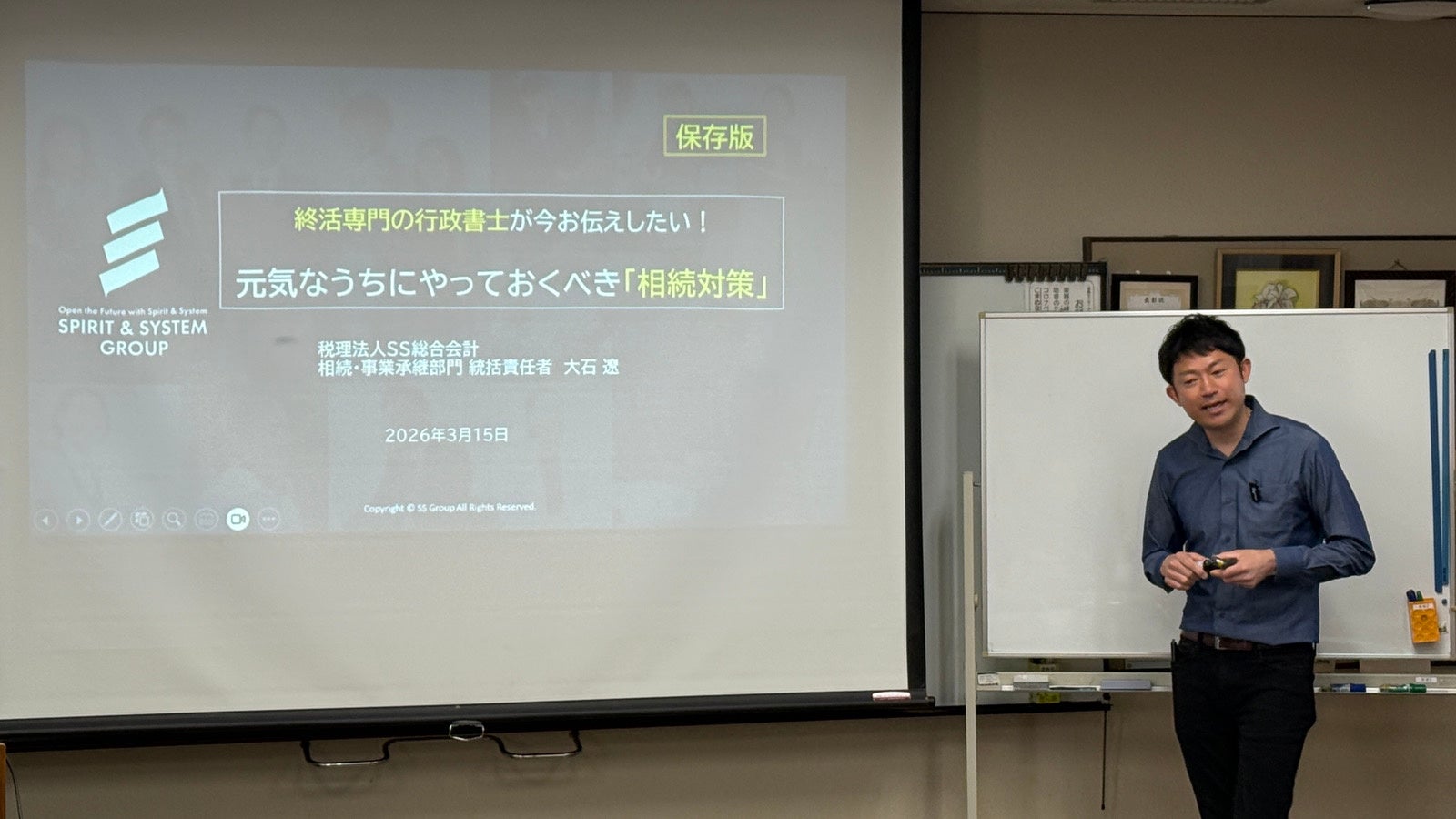
Regarding a construction firm starting an inheritance business, Ryo Oishi, an expert in inheritance and business succession (Head of Inheritance and Business Succession Department, Hamamatsu SS Sogo Kaikei Group), commented:
In the practical work of inheritance consultation, cases often stall as soon as real estate is involved. The main reason is that tax and legal experts alone cannot fully support “truly effective utilization of real estate,” including its sale or rebuilding. Having an organization with practical knowledge of construction and real estate at the forefront of inheritance consultation is an effective mechanism. If more operators like LIFEFUND, who can consistently handle “feasible exit planning,” emerge, structural changes in issues like vacant homes could become possible.
Seminar Results
First Public Seminar (March 15, 2026) Theme: 'Inheritance Measures to Take While Still Healthy'
15 participants, sold out immediately. Satisfaction rate: 87% (73% "very good" + 14% "good").
Subsequent individual consultation request rate: 60% (9 participants). April Seminar (April 12, 2026) Sold out due to transfer proposals for March seminar applicants (confirmed two consecutive months of sell-outs).
Participant feedback included: "I want to know more about real estate matters" and "The instructor gave a lecture that was easy for us to understand."
Regarding the first public seminar, Mieko Uda, in charge of marketing at the company, said:
Since it was our first time holding it for the general public, we were unsure if we could attract participants, but we did not expect such a response. I think this shows just how many people are looking for a consultation window.
Source: Read the original article | Published: April 09, 2026