
Editor's Note
This editor’s note highlights the key facts and market implications behind “Retail Engineering: 3 Strategic Pillars Redefini”, with emphasis on sourcing, product fit, fabrication, logistics, or buyer impact.
The Showroom as a Strategic Asset
In today’s competitive UK ceramic market, the showroom is no longer just a place to display tiles, it has evolved into a precision-engineered commercial asset. Faced with rising operational costs, digital disruption, and increasingly sophisticated clients, leading retailers are rethinking every square metre to drive conversion, not just aesthetics. This shift marks the rise of retail engineering: the intentional fusion of industrial design, ergonomics, and customer psychology to create spaces that perform as well as they impress.
Modern showrooms function as integrated revenue systems, not passive galleries. Every element, from layout flow to lighting angles, is calibrated to guide the customer journey, reduce friction, and accelerate decision-making. Technical infrastructure now supports both safety and storytelling: large-format panels are displayed securely, samples are accessible yet protected, and workstations enable real-time collaboration. This engineered approach transforms the showroom from a cost centre into a profitability engine, where design directly influences margins, client trust, and brand authority.
Executive Overview: From Display Space to Profitability Engine
No. 1: Risk Mitigation and Operational Efficiency in XL Formats
The dominance of 3-metre porcelain slabs has revolutionised aesthetics, but introduced significant operational challenges. These oversized panels are heavy, fragile, and difficult to manoeuvre, posing risks to staff safety, product integrity, and customer confidence. A dropped slab doesn’t just mean financial loss; it erodes trust in the brand’s ability to handle premium materials.
Engineered display systems address this head-on. Solutions like those from INSCA enable secure, low-effort handling through counterbalanced mechanisms, reinforced supports, and intuitive interfaces. Staff can rotate, tilt, or present panels with minimal strain, while customers observe stability and professionalism in action.
The business impact is profound: when clients see that a brand can manage complexity safely, psychological barriers dissolve. They focus on the material’s beauty, not its logistical risk, enabling faster decisions on high-ticket projects. In luxury ceramics, safety is not just compliance, it’s credibility.
No. 2: The Technical Workbank as the Epicentre of Specification
Today’s buyers, architects, interior designers, developers, are not shopping for tiles; they’re specifying complex, multi-material projects. Their needs have shifted from product selection to holistic coordination.
They require space to compare textures, layer samples, and visualise how finishes interact under natural light. Static displays fall short; what’s needed is a dynamic environment where ideas take shape.
The Role of Specialised Workstations
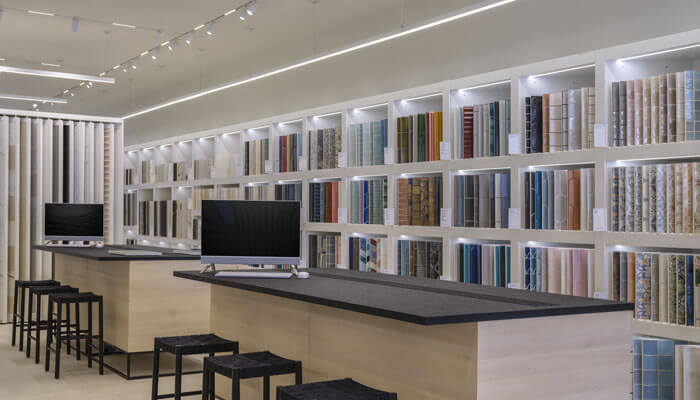
Technical workbanks, ergonomic, well-lit, and equipped with binder racks, sample trays, and digital tools, become collaborative studios. Designers can lay out full palettes, test grout combinations, and cross-reference technical data without leaving the conversation.
This fosters deeper engagement, builds professional rapport, and streamlines the specification process. The result? Stronger loyalty, higher contract values, and increased repeat business from key B2B clients who view the brand as a technical partner, not just a supplier.
No. 3: Conversion Rate Psychology and Sensory Retail
Data consistently shows that customers who physically interact with a material are up to 40% more likely to purchase. Touch creates emotional connection, and commitment.
In the UK’s premium segment, presentation equals prestige. A clean, uncluttered showroom signals control, expertise, and confidence, qualities that justify superior pricing. When the environment feels curated rather than crowded, clients perceive the brand as authoritative, not transactional.
The Competitive Advantage of Engineered Showrooms
True differentiation in the UK ceramic sector no longer lies in product alone, but in how the product is experienced. Companies that integrate industrial engineering, human-centred design, and behavioural insights create spaces that outperform competitors, even those with similar offerings. In a market where digital channels commodify products, the physical showroom becomes the ultimate differentiator: a controlled, immersive environment where value is felt, not just explained.
Forward-thinking firms no longer view showrooms as operational expenses. They treat them as strategic fixed assets, comparable to machinery or software, with measurable ROI. High-quality, industrially manufactured displays deliver long-term value through durability, adaptability, and brand consistency.
The Future of Commercial Success in the UK Ceramic Sector
The future of retail in the UK ceramic industry belongs to those who embrace retail engineering as a core competency. The three pillars, operational safety in XL formats, professional-grade specification workspaces, and sensory-driven conversion design, are not optional enhancements; they are the foundation of commercial resilience in 2026 and beyond.
As competition intensifies, success will be determined not by how much space a brand occupies, but by how intelligently that space is engineered. Companies that invest in purpose-built, high-performance showrooms won’t just survive, they’ll set the standard.
Source: Read the original article | Published: April 10, 2026