
Editor's Note
This editor’s note highlights the key facts and market implications behind “Laying Ceramic Tiles Loose: New System for Stabl”, with emphasis on sourcing, product fit, fabrication, logistics, or buyer impact.
Terrace Construction
Laying Ceramic Tiles: New System Prevents Wobbling and Shifting of Slabs
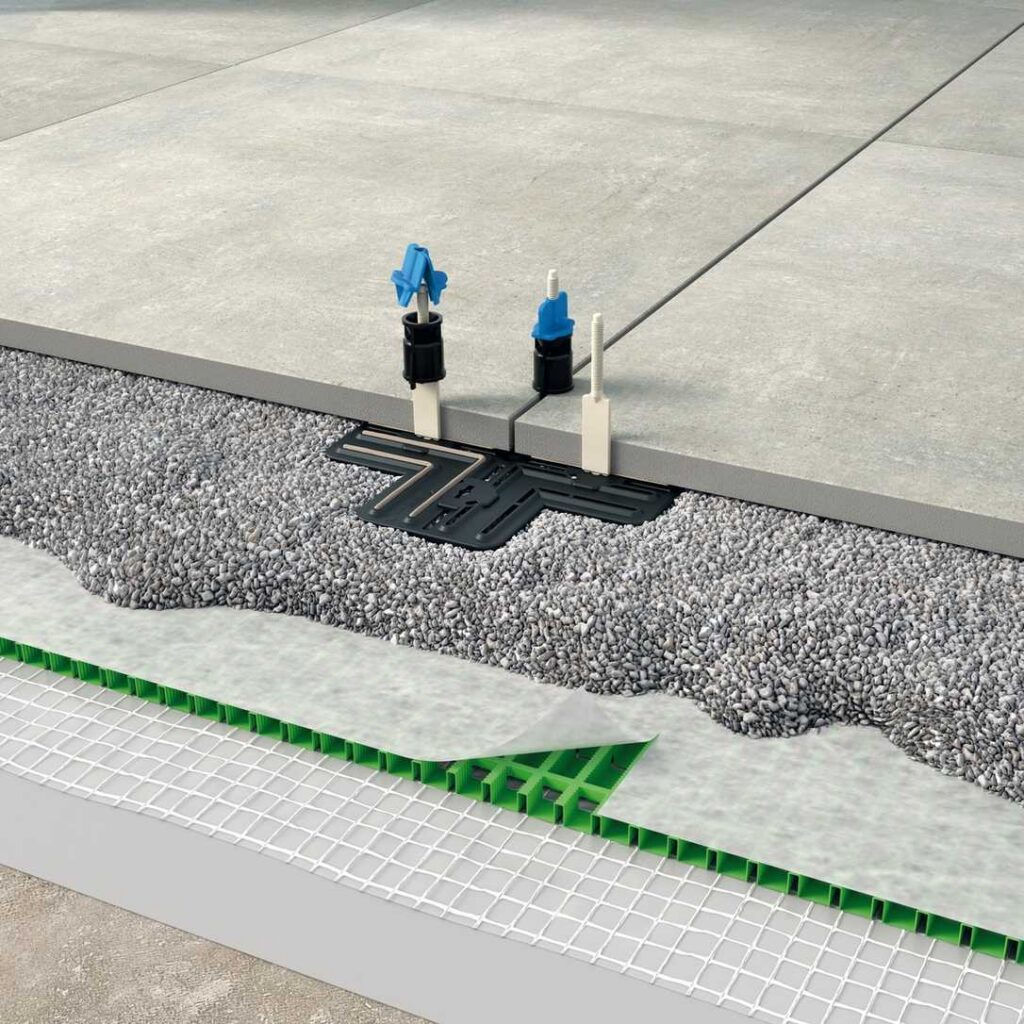
A new fixing system from Gutjahr aims to make the loose laying of thin ceramic elements in outdoor areas safer. By mechanically connecting the slabs at the joint cross on a fixing plate, stability in the gravel or chippings bed is increased and wobbling of the surface is prevented.
The fixing plate connects the slabs at the joint cross and anchors itself in the subsoil.
Lightweight ceramic slabs tend to move and become unstable when laid unbound in a chippings bed. To prevent this wobbling, Gutjahr has developed the Aqua Drain FS system. It serves the mechanical stabilization of slab surfaces. In this process, the ceramic elements are fixed in the area of the joint cross to a special fixing plate using the mounting adhesive Di-Protec FIX-MSP. The Indor-Tec FN-XT leveling system ensures precise alignment.
“The fixing plate connects the slabs at the joint cross and anchors itself in the subsoil. This ensures that the slabs lie firmly – both horizontally and vertically,” explains Gutjahr product manager Thomas Römer.
According to Römer, this creates a calmer and more stable surface, even under intensive use. This enables the safe loose laying of ceramic slabs that are only two centimeters thick.
Adapted Components for Processing
As part of the system optimization, Gutjahr has also revised the mounting adhesive Di-Protec FIX-MSP. For a less conspicuous appearance in open or reduced joints, the adhesive is now black instead of gray. Furthermore, the packaging sizes have been adjusted. The 310-ml cartridge now consists of recycled material. Additionally, the adhesive is now also available as a 580-ml sausage pack.
“Especially together with the Aqua Drain FS system, large quantities of the adhesive are consumed. That’s why craftspeople wished for a larger packaging unit,” said Römer.
Source: Read the original article | Published: April 14, 2026