
Editor's Note
This editor’s note highlights the key facts and market implications behind “The Sun in a Shard: Neolithic ‘Banks’ of Rock Cr”, with emphasis on sourcing, product fit, fabrication, logistics, or buyer impact.
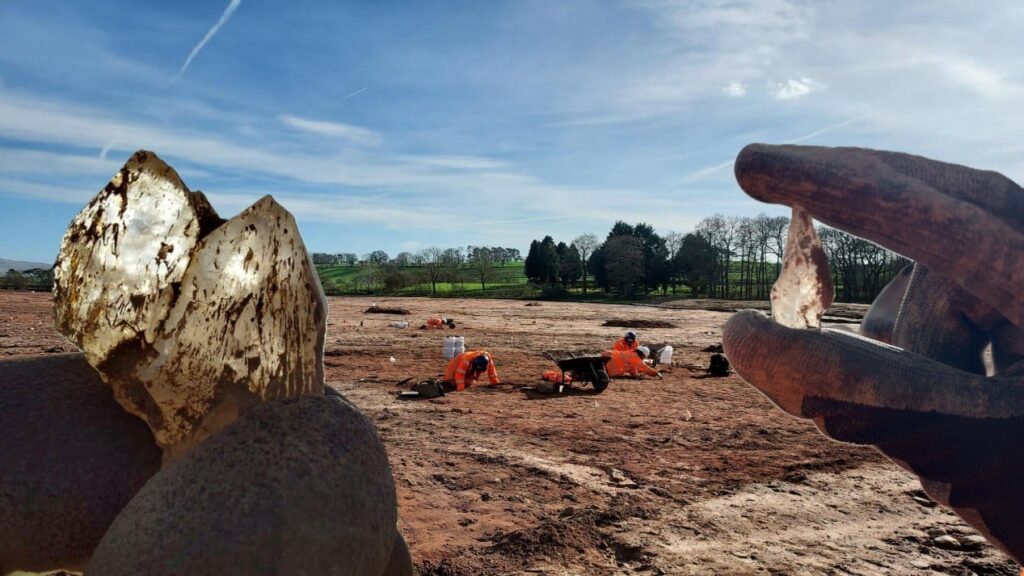
Rock crystal – so transparent and marvelous – surpasses quartz in quality and optical behavior. It is in this detail, almost invisible to a distracted glance, that one of the most significant discoveries of recent years lies along a roadway axis destined for modernization. Preventive excavations are, in fact, revealing an unexpected narrative of gestures, choices, and meanings attributed to a material that was not simply a precious raw material to be transformed into arrowheads or tools, but a form of quartz that, while belonging to a very widespread mineralogical family, is distinguished by very specific physical and geological characteristics.
"It seems that rock crystal is found in specific types of Neolithic sites, which suggests that people considered it in a particular way. Several sites are associated with the burial of the dead. We also find it in large halls or wooden structures dating to the earliest Neolithic (4000-3800 BC) that might have been important gathering places for the new communities forming in that period in the UK and Ireland," said an archaeologist.
"Some crystals are completely transparent, while others are opaque or translucent. Some pieces appear to have been derived from larger crystals, but there are also very short and stubby crystals. One possible explanation is that the high-quality material came from more distant places, while the lower-quality material came from a local source. The shape of the short crystals is very similar to that of known quartz crystals found in Cumbria. If so, this would demonstrate that Neolithic communities along the A66 were connected to a series of local and long-distance trade networks," the research notes. The discovery. But here below there is a staircase! They dig and descend the steps. Here are the tombs. Roman objects, glass, a shield boss, many ceramics, inscriptions. And on the site rain the tears of the poet Ovid, who truly wept here. Why? Archaeologists show elements of rock crystal, brought to light in Neolithic deposits excavated in the ground. A material transparent as water, luminous as the sun, rare, selective, difficult to find. A stone ice that gave strength and power. A distinctive element that could have been the prerogative of the top echelons of society. Archaeologists have discovered Neolithic centers connected to the transformation and ritual deposition of rock crystal. The announcement of a singular discovery comes in these hours from Oxford Cotswold Archaeology as part of the A66 Northern Trans-Pennine project, a corridor that passes through the Eden Valley and which, through the connected archaeological excavations, brings new elements to the study of the British Neolithic. At the center of the investigation is, precisely, rock crystal. Quartz is indeed one of the most common minerals in the United Kingdom, present in sands, milky pebbles, and rock veins. But rock crystal represents a radically different variant: transparent, clear, free of visible inclusions, it forms under very specific conditions within so-called alpine fissures, fractures in the Earth's crust traversed by hot fluids and gases that allow the growth of pure crystals. In Great Britain, sources of high-quality specimens larger than 5 centimeters are limited and concentrated in Cornwall, Wales – particularly in Snowdonia – and some areas of Scotland.

This rarity is directly reflected in the archaeological record. In the UK and Ireland, about 40 sites with traces of rock crystal collection and working are known, of which about 25 are attributable to the Neolithic (4000-2400 BC). Working was done through knapping, the technique of striking stone to derive tools. However, the distribution of sites suggests broader dynamics.
Archaeologist Nick Overton clarifies: "These sites are concentrated mainly along the western coast of Wales, England, Scotland, and Ireland. The Irish Sea is a focal point. The sites are located along this coast, like those on Anglesey. Others are situated inland, near rivers that flow into the western coast. This pattern suggests possible connections between the communities living around and across the Irish Sea."
The presence of rock crystal in sites far from sources confirms these connections. At Dorstone Hill in Herefordshire, hundreds of fragments have been found despite a distance of 80-100 km from supply areas. The material, therefore, circulated, was transported, and probably traded, indicating a value that exceeded mere utility.
Nick Overton observes: "In this context, rock crystal assumes a dimension that exceeds the functional. In an era without glass, it constituted the only completely transparent solid material, endowed with a unique visual quality. This characteristic, combined with its rarity, could have conferred upon it a symbolic value, perhaps linked to the idea of distance, provenance, and otherness."
The excavations along the A66 are now significantly expanding this scenario. The investigations have yielded a quantity of material that could represent a major addition to our understanding.
Source: Read the original article | Published: April 17, 2026