
Editor's Note
This editor’s note highlights the key facts and market implications behind “Have You Ever Thought of Wearing a Dress Made Li”, with emphasis on sourcing, product fit, fabrication, logistics, or buyer impact.
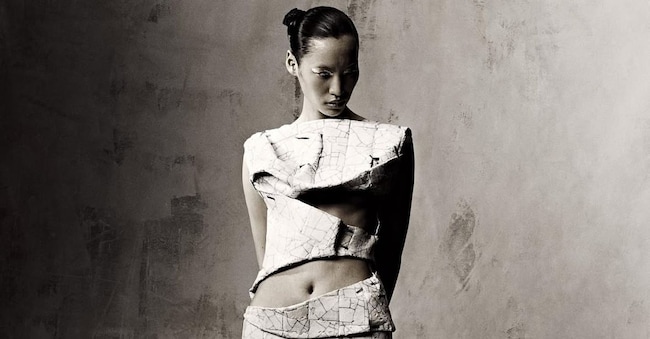
Have you ever thought of wearing a dress made like a porcelain vase? Liwen Liang, a designer originally from Jingdezhen, China, has. She transforms ceramics into thin sheets that she then sews like a second skin.
Ultra-thin ceramic sheets, 0.3 millimeters thick, fused with fabrics: an invention of a weave of shattered shards that, almost like enameled sequins, crumble light into a sparkling dust that envelops the body and radiates from it, defining solids and voids, volumes and décor.
Liwen Liang embodies a new generation of designers for whom fashion is not just an aesthetic exercise, but an act of cultural and productive responsibility. Her work stems from years of research on lost trades and artisanal traditions that time and industrialization have progressively relegated to the margins. Each collection of her brand, founded in 2020, takes shape through a slow process of listening in which the material is respected, studied, and transformed without force, and the manual gesture is an integral part of the narrative.
“Be brave, be fragile.”
The synthesis of her creativity lies in this oscillating balance between two extremes, temporal and physical: ancestral roots and hi-tech experimentation, soft and rigid, Jingdezhen, her birthplace, and London, her chosen city. For Liwen Liang, ceramics is a material loaded with meaning, intimately linked to personal history. Her family has worked in this sector in China since the 1950s, and the designer has transformed traditional knowledge into contemporary practice: she studied the technique of thin-shell porcelain, a delicate and resistant, imperfect and durable element, capable of encapsulating memory, time, and human gesture in a highly personal language. Here, craftsmanship is not a heritage of nostalgia, but a way of questioning the present and imagining new productive possibilities.
After many experiments, developing manual skill with poetic sensitivity, she devised a technique for firing mixtures of clay and glue into very thin sheets, as if they were paper, then composes them on fabrics, grinding them to make them very soft, flexible, and wearable. The ceramic is thus reinterpreted and integrated into the garment. Its surface, hand-modeled, retains the trace of manual making and its variations, including imperfection. Inserted as a structural or decorative element, it transforms into a second skin.
Liwen Liang, in this dialogue between fashion and applied arts, crosses disciplinary boundaries, restoring visibility to a cultural heritage at risk of disappearing. It is an act of continuity and responsibility, in which the recovery of her grandfather's craft – who worked in a kiln at the National Porcelain Factory – translates into a broader reflection on the role of fashion as a custodian of memory and identity.
Parallelly, her work has, from the beginning, developed a strong focus on productive responsibility. From material selection to the production chain, she promotes an ethical model in which respect for the creator is inseparable from respect for what is created. A form of resistance to the standardization and speed of the fashion system, reaffirming the priority of human value. A vision that addresses a conscious audience, capable of recognizing in fashion not just a product, but a heritage of care and transmission of knowledge.
Source: Read the original article | Published: April 17, 2026