
Editor's Note
This editor’s note highlights the key facts and market implications behind “”Escarres”: On the Road to a Fantasized Abitibi”, with emphasis on sourcing, product fit, fabrication, logistics, or buyer impact.
Book Review
"Escarres": On the Road to a Fantasized Abitibi
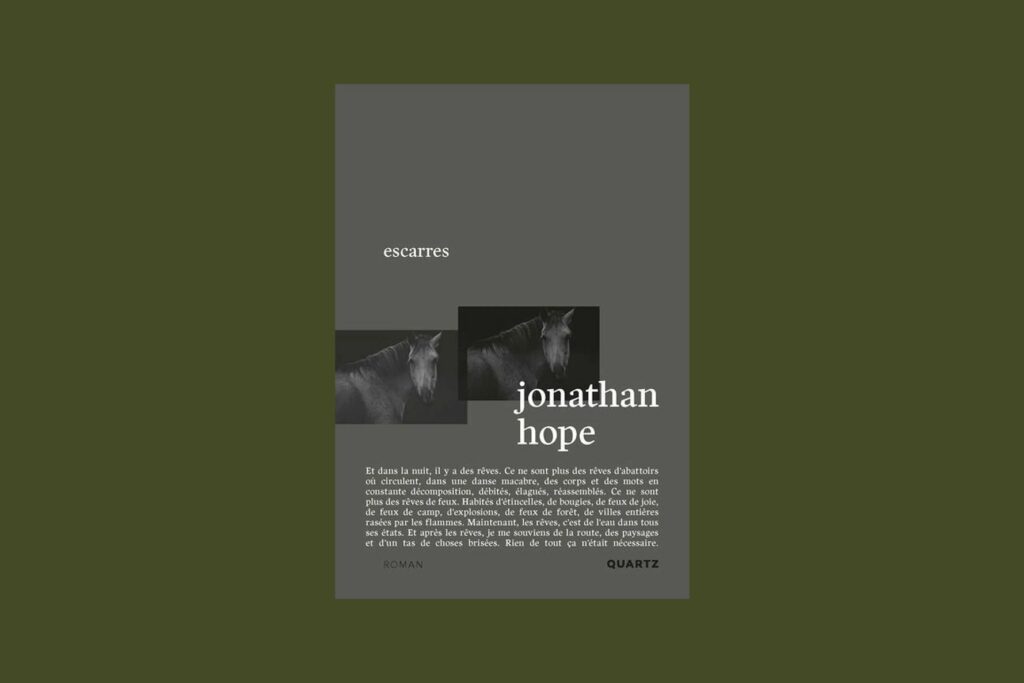
Anne-Frédérique Hébert-Dolbec Continuing a literary work at the intersection of fiction and ecology begun in his first novel, Ce lac (Quartz, 2024), which will soon be published in France by Éditions du Seuil, Jonathan Hope continues to question our relationship with words and the living world, as well as the ties that bind or separate them, in Escarres . This narrative recounts a road trip to a dystopian Abitibi where mining companies reign supreme, contaminating the air and rivers, maiming and killing workers, and punctuating the day with explosions meant to enable metal extraction and the creation of the world's largest land art bas-relief.
In a second-hand bookstore, a narrator accidentally finds a copy of the Practical Guide to Identifying Surface Deposits in Quebec . Reading it carefully, he discovers that while the legal deposit dates back to 1996 — the year of the Fugees' "Killing Me Softly With His Song," the film Fargo , and the death of Marguerite Duras — the printing itself is dated October 1997 — the year of Daft Punk's "Around the World," the film Titanic , and the death of William Burroughs. "After all, 96 and 97 are not the same."
After a meticulous study of the original and amended versions of the guide, the narrator discovers that the only modification concerns the credits accompanying a photo of an esker, a sinuous ridge of sand and gravel deposited by subglacial rivers during the retreat of glaciers. And since eskers are not ordinary things — if they were, we would know — the beginnings of a problem emerge somewhere between "the sediments, the erosions, the details, the dust of information, the accumulation of scraps and rubbish, all the scrap, the waste, the dregs, the rags, the less-than-nothings, the paratext…", which forces the narrator and his friend River to pack their bags and head north.

From truck stops to remote motels, to the rhythm of hits from their youth sorted by year, the two companions traverse a world in disarray on the border of dream, populated by ghosts appearing and disappearing without warning, lives reduced to their last defenses, returns to earth and dust, and sufferings never sufficiently shortened. In a very cinematic style of writing, Jonathan Hope strives above all to build an atmosphere tinged with the uncanny strangeness of the end of the world; a world in slow erosion from which the codes increasingly escape us, which keeps the reader at a distance as much as it seizes and jostles them. The fragmented narrative thread, traversed by surges of dreaminess and shattering freeze-frames, recalls, as aptly noted by the publisher, the work of David Lynch and his exploration of the tipping point between daily banality and psychological horror — and the acceptance of surrealism until it no longer is. The author, also a professor in the Department of Literary Studies at the Université du Québec à Montréal, exploits as much as he subverts the literary codes of the road novel, nature writing, and the nouveau roman to make us feel the disconnect between the cycle of biodiversity and the land and our increasingly artificial way of inhabiting it, which sows destruction and desolation where community and exchange should emerge.
A novel whose every page haunts and disrupts "our most intimate experiences of time and our daily habits of matter."
Escarres ★★★ 1/2 Jonathan Hope, Éditions du Quartz, Rouyn-Noranda, 2026, 154 pages
Source: Read the original article | Published: April 18, 2026