
Editor's Note
This editor’s note highlights the key facts and market implications behind “Shopping at Leclerc or Carrefour: Stop Buying Th”, with emphasis on sourcing, product fit, fabrication, logistics, or buyer impact.
Shopping at Leclerc or Carrefour: Stop Buying These 3 Brand-Name Products to Save 40%
Between inflation and tight budgets, the distributor brands Leclerc and Carrefour are shaking things up on the shelves. But for three everyday products, the difference goes well beyond price.
Leclerc and Carrefour: Why Distributor Brands Change Everything
The next time you fill your cart at Leclerc or Carrefour, forget the "brand-name" reflex. In many aisles, paying for the brand means mainly paying for the packaging and advertising. Consumer surveys have hammered this home, and the in-store experience confirms it: switching to distributor brands lowers the bill by 20 to 40%, without sacrificing quality. The key is knowing how to read the label.
The legal framework helps. Regulation (EU) No 1169/2011, enforced by the DGCCRF (French Directorate General for Competition, Consumer Affairs and Fraud Control), requires visible, legible, and fair labeling, including the sales name, the list of ingredients in descending order, the net quantity, the nutrition declaration, and, on a voluntary basis, the Nutri-Score. A batch number and an establishment approval number (code EMB) for traceability are also included. In short, everything is there for objective comparison. The proof is already on the label.
Stop for These 3 Products: Yogurts, Biscuits, Deli Meats
First winning switch: plain yogurts and fromage blanc (fresh cheese). Short recipe, little room for maneuver. Compare the oval stamp on dairy products, the famous sanitary stamp of the type "FR XX.XXX.XX CE": if it is identical between a major brand and a distributor brand (MDD), it's the same factory. If the first 2 or 3 ingredients are the same (milk, cultures), you are only paying for a packaging difference. Expected result: very similar texture and taste, lighter bill.
Second obvious choice for snack time: shortbread and chocolate biscuits. A textbook example on the shelf, a distributor brand pack sometimes displays the same establishment approval number (code EMB) as the major brand, for a price about 30% lower. And the label holds pleasant surprises: butter on the distributor brand side, vegetable fats on the brand side.
Third category to watch closely: sliced deli meats. Compare the precise name (e.g., superior cooked ham), the stamp, the percentage of meat highlighted, and the first 3 ingredients. Here again, some distributor brands align on the manufacturing and recipe.
How-To Guide on the Shelf: Code EMB, Ingredients, Nutri-Score
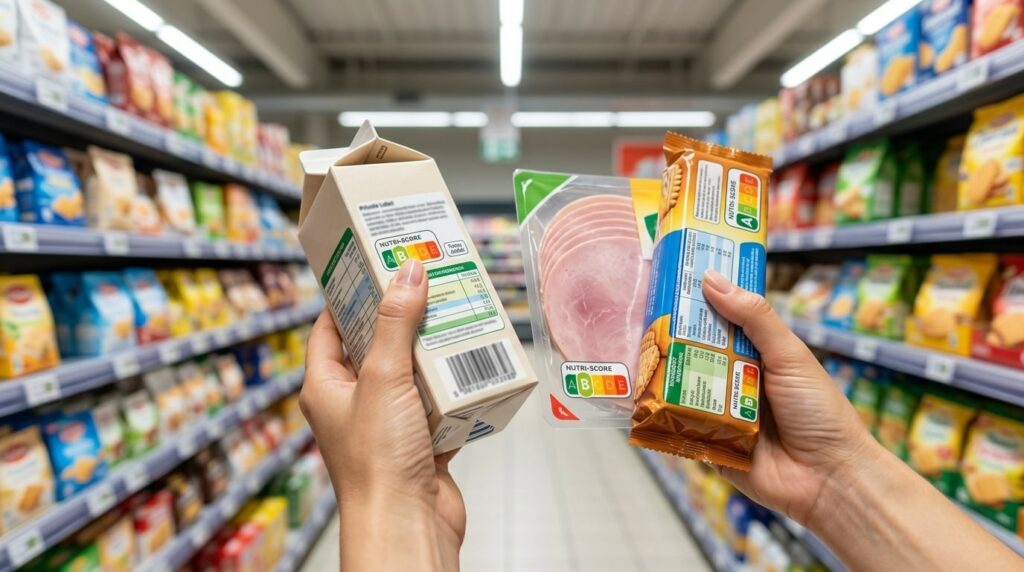
Start with the sales name to verify the products are comparable. Read the ingredient list, ranked from most to least present, with allergens highlighted. Look at the percentages of highlighted ingredients on the pack, the net weight (and drained weight if there is a liquid), then the nutrition declaration. The Nutri-Score provides a quick reference when present. A useful bonus, but not mandatory.
Then locate the establishment approval number (code EMB) on the biscuit or grocery product packaging: it refers to the factory (department and municipality). For products of animal origin, rely on the oval sanitary stamp, the identity card of the production site. When the codes are identical, the production lines are shared and the distributor brand often uses "about 95%" the same recipe. The last legal filter that matters, the "origin of the primary ingredient" must be indicated if it differs from the origin highlighted since April 1, 2020.
How Much Do You Save and When to Keep the Brand Name?
By switching a typical basket to distributor equivalents, savings frequently reach 20 to 40%. To sort quickly, follow this simple reflex on the shelf: same sales name, same first 3 ingredients, identical factory codes, percentage of highlighted ingredient at least as high, and lower price per kilo. Beware of marketing claims ("natural", "no preservatives") which add nothing if the entire category already meets these characteristics, reminds the DGCCRF.
Keeping a major brand makes sense when the distributor brand shows a longer recipe, lower quality ingredients, or an unfavorable Nutri-Score. Ranges vary from one reference to another, even within the same retailer. The right reflex always remains the same: read the label and check the factory code. For plain yogurts, shortbread biscuits, and sliced deli meats, this decoding very often shifts the choice to the distributor brand side.
Source: Read the original article | Published: April 18, 2026