This editor’s note highlights the key facts and market implications behind “Preserving the Golden Heritage of Hue”, with emphasis on sourcing, product fit, fabrication, logistics, or buyer impact.
In the serene atmosphere of the Imperial Citadel of Hue, the shimmering layers of red lacquer and gold leaf, the ceramic and porcelain mosaics on ancient horizontal plaques and screens, and the exquisite sculptures… are not merely remnants of a golden age, but also the culmination of the work, intellect, and perseverance of quiet artisans. In the serene atmosphere of the Imperial Citadel of Hue – once the center of power for the kings of the Nguyen Dynasty – the shimmering reflections of red lacquer and gold leaf, the ceramic and porcelain mosaics adorning ancient horizontal and vertical screens, and the exquisite sculptures… are not only the vestiges of a golden age, but also the culmination of the work, ingenuity, and perseverance of discreet artisans. They do not just restore the buildings; they also rekindle the memory of history.
One of the most important principles of these artisans' work is "restore, not create." This requires a deep understanding of history, art, and the philosophy of preservation.
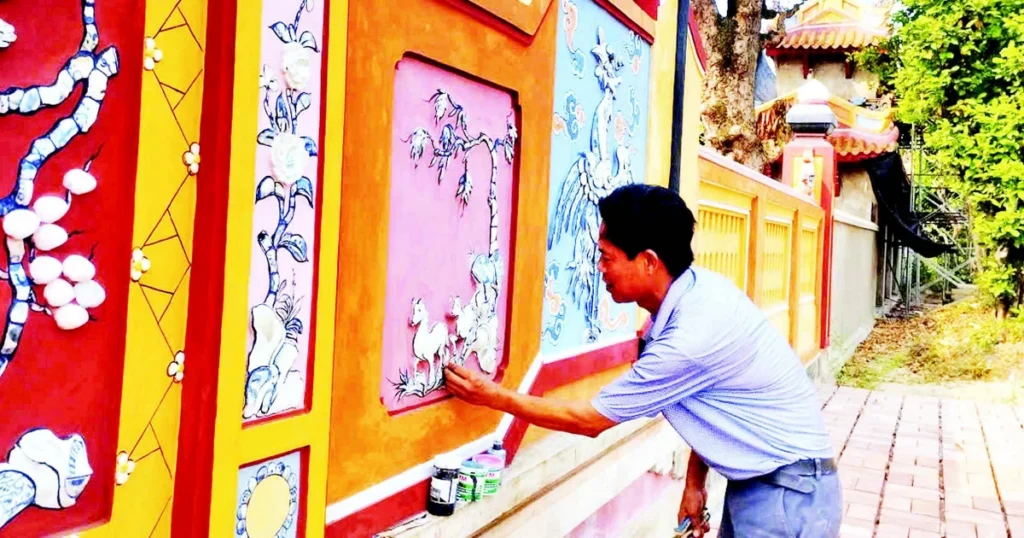
The restoration of the screens at the Imperial Citadel of Hue bears witness to this. These screens did not only have a protective function; they also held feng shui importance, reflecting the authority and aesthetics of the imperial court. Artisan Khien explains: "Some details had completely disappeared. We therefore had to search for documents, compare them to contemporary works, and even consult old paintings and photographs to reconstruct them." This work was not only technical but also a true work of "deciphering" history. Each motif, each color palette had to respect the spirit of the Nguyen Dynasty. "We did not create according to our own ideas, but had to respect what existed," emphasizes Mr. Khien. Artisan Dao Huu Khien performs ceramic mosaic work on a screen at the Imperial Citadel of Hue.
Hands That Bring Heritage Back to Life
We discovered a small workshop nestled in a quiet alley on the outskirts of Hue. The scent of traditional lacquer floated in the air, and golden reflections sparkled under the morning sun. There, artisans busied themselves discreetly with their simple work, yet contributing to preserving a part of the soul and essence of the Nguyen Dynasty heritage: the art of lacquer and gold leaf gilding. The first person to welcome us was artisan Ngo Dinh Trong, who has dedicated himself to this art for over 25 years. His hands were calloused and covered with a fine layer of golden dust, his eyes were thoughtful but lit up every time he mentioned the details of ancient motifs. Mr. Trong recounted his beginnings in the craft, when he was a young apprentice under his elder, Mr. Do Ky Hoang, former rector of the Hue University of Fine Arts. During those years, he had to learn to identify different types of lacquer, work with wood, and apply gold leaf so that it adhered perfectly while retaining its natural shine.
For him, his first participation in restoring a detail of a building in the Nguyen Dynasty historical complex remains an unforgettable moment. "My hands trembled a lot at the time, because I knew this was not something new, but something that touched history, the heritage of our ancestors," confided Mr. Trong.
According to Mr. Trong, sculpture is the "structure," while gilding and painting are its "skin." For example, during the reconstruction of the Thai Hoa Palace, the largest palace in the Imperial Citadel of Hue, all the wooden columns underwent many treatment steps: priming, sanding, painting, hand finishing, and gilding… Some dragon and phoenix motifs required weeks of work. The "rattan sieve" technique is particularly remarkable; each carved stroke must be both delicate and precise, to respect the authentic style of Hue imperial court art.
“One incorrect stroke and you have to start all over,” explains Mr. Trong.
Not far from Mr. Trong's workshop, artisan Bui Van Trinh was also diligently working on complex sculptures. Mr. Trinh is renowned in his field for his talent in restoring ancient motifs with near-perfect accuracy. We found him absorbed in creating a horizontal plaque that had just been primed. Each carved dragon, with its sinuous contours, was visible under the shiny black paint, awaiting the final layer of gold.