
Editor's Note
This editor’s note highlights the key facts and market implications behind “As Worker Silicosis Deaths Mount, GOP Moves to S”, with emphasis on sourcing, product fit, fabrication, logistics, or buyer impact.
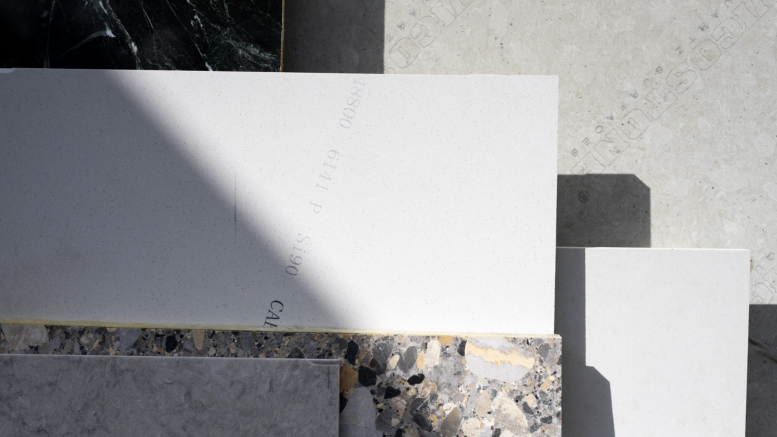
Engineered stone slabs stacked outside a fabrication shop in Los Angeles.
Republicans in Congress want to ban lawsuits against quartz manufacturers, including a company whose CEO is a major Trump donor, in an effort to protect the industry from liability.
Silicosis cases are rapidly rising among workers who cut, grind and polish engineered stone for kitchen and bathroom countertops. This incurable lung disease develops when workers breathe in crystalline silica dust, which scars and constricts their lungs. In extreme cases, only a lung transplant, an intensive and risky procedure, can prolong their lives. In California alone, engineered stone-related silicosis has killed at least 29 people and sickened more than 500.
Mounting silicosis lawsuits threaten quartz manufacturers financially, including a company whose CEO is a major donor to President Donald Trump. The companies have lobbied for federal legislation to shield them from liability while preventing workers from seeking compensation for irreversible health damage.
A worker uses a hand tool to wet cut an engineered stone countertop at a fabrication shop.
While lawmakers debate, medical professionals are calling for swift action to address the growing silicosis epidemic, saying time is running out to protect thousands of vulnerable stone fabrication workers.
Michaels said he fears that the level of national outrage needed to protect fabricators is not being generated because they are an overlooked population of mostly immigrant workers.
At the hearing, McClintock said “no one opposes health and safety regulations” and accused California officials of “turning a blind eye to lawbreaking by sweatshops that are breaking our immigration laws, labor, health and safety laws, exposing their employees to the dust that causes silicosis.”
Product liability lawsuits filed on behalf of consumers or workers have for decades played an important role in holding companies accountable for defective or harmful products. And the piling up of civil judgments has often pushed manufacturers to be more conscientious in developing and labeling products or to switch to safer alternatives, advocates said.
Hundreds of product liability lawsuits have been filed against companies on behalf of workers who claim that engineered stone manufacturers sold a product that cannot be safely fabricated or failed to warn them of the dangers of working with it. Some of the same companies are now urging Congress to grant their industry immunity and shield them from potentially large judgments and payouts.
Cambria, the largest domestic producer of engineered stone, is a defendant in many of these lawsuits.
Representatives of Cambria and other quartz manufacturers and distributors have argued that the wrong parties are being sued and that workers should instead be filing workplace injury lawsuits against employers. They blame rising silicosis cases on “bad actor” fabrication shops down the production chain that do not follow OSHA requirements for wet cutting, ventilation, exposure monitoring, training and personal protective equipment.
Wet cutting engineered stone produces a slurry of water and ultra-fine silica dust. The wastewater can be hazardous if inhaled or allowed to dry.
In testimony to Congress, Cambria CEO Marty Shult claimed that Cambria has successfully fabricated its quartz slabs for 20 years without a single reported case of silicosis among its workers.
California has identified 1,300 fabrication shops with workers diagnosed with silicosis related to engineered stone, according to the state Department of Public Health.
But James Nevin, an attorney representing more than 500 stone fabrication workers in California and another 200 nationally, claimed that this is a severe undercount and said his law firm’s own data suggests the actual number of silicosis cases are much higher.
“It’s not a few bad actors. It’s a majority of the shops, including the very sophisticated shops,” Nevin added, pointing to clients in Colorado who contracted silicosis after working in a fabrication shop with “state-of-the-art equipment.”
Public health experts agreed that the official tally of silicosis cases in California is likely an undercount. The state Department of Public Health said it does not have an estimate of the percentage of fabrication shops where people with reported silicosis cases have worked.
Industry representatives and Republican lawmakers have suggested that these lawsuits, or a complete ban on engineered stone, would kill American jobs.
But public health officials have said the industry could continue to thrive if it substituted engineered stone with recycled glass slabs.
Australia has banned engineered stone containing more than 1% crystalline silica. That forced the country’s stone fabrication industry to switch to a safer amorphous silica product, made from recycled glass, Michaels said. So far, there’s no evidence its industry is shedding jobs.
Because amorphous silica slabs can be made on the same machines used to make crystalline silica stone slabs, Nevin said, American manufacturers could easily make the same switch that they have in Australia.
Dust from cutting stone slabs coats the surfaces of a fabrication shop.
But Cambria may have good reason to fight a ban, he added, because it has invested a lot in extracting the raw quartz materials, making a transition to safer alternatives a threat to its bottom line.
Cambria owns three quartz mines in Canada and spent $100 million to expand its slab production plant in Le Sueur, Minn. In August, the company announced that it invested $80 million to build a quartz processing plant and rail center in Dakota County, Minn., with plans to invest another $40 million in rail services.
The company has argued it is difficult to compete with foreign quartz manufacturers flooding the domestic market and is among the domestic manufacturing companies that have lobbied for tariffs on imported engineered stone. Foreign producers such as Caesarstone are major competitors.
Source: Read the original article | Published: April 19, 2026