
Editor's Note
This editor’s note highlights the key facts and market implications behind “Design Beyond Form: Rethinking the Bathroom Expe”, with emphasis on sourcing, product fit, fabrication, logistics, or buyer impact.
Design Continuum translates this vision into a spatial narrative. Through five interconnected environments, the installation explores different dimensions of design—from material innovation to timeless form, from perception to interaction, and finally to craftsmanship. Light, projections, textures, and scent transform the shared showroom of the two brands into an experimental context, defining how each space is perceived and expressing a design approach that unites heritage and innovation.
The exhibition presents a series of novelties developed in the brands' German innovation centers, dedicated to ceramics and faucetry: from the 3D-printed ceramic study made with 100% recycled internal material with Antao 3D, to surface solutions like the reactive glazing of Antao Earth or the tactile relief structure of Artis Sense. Alongside timeless designs like the Atelier Collections, next-generation technologies such as the Vea faucetry collection are also presented. These innovations take shape thanks to collaboration with leading designers, including Ludovica Serafini and Roberto Palomba, Christian Haas, Design Studio KASCHKASCH, and Gesa Hansen.
Ceramics is one of the oldest natural materials, continuously perfected over the centuries. The first environment of the installation explores this constant evolution—not only in form and technology, but in the material itself, where production waste becomes a resource.
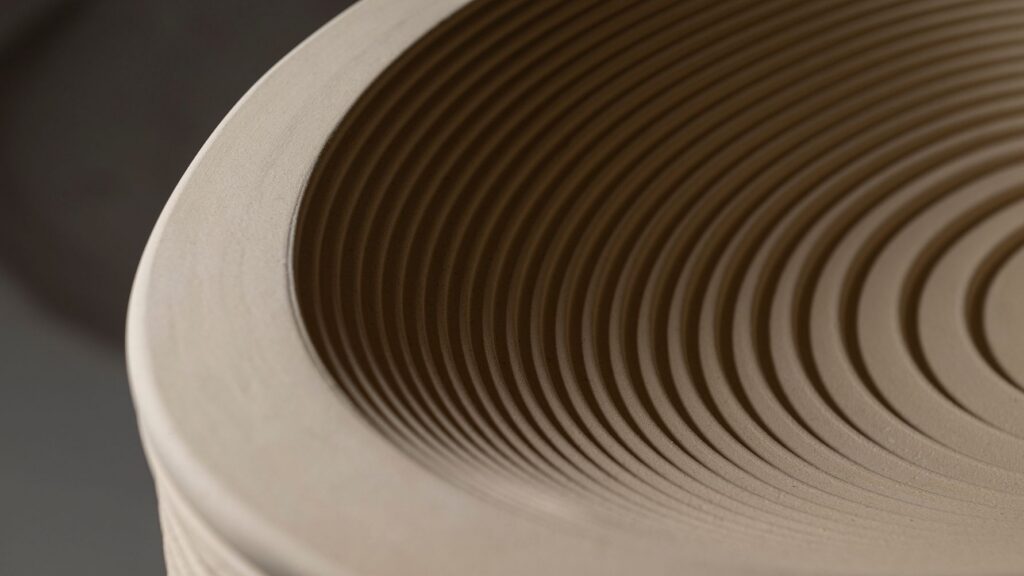
At its center is the prototype of the monolithic Antao 3D washbasin, a material study developed by Design Studio KASCHKASCH. Made through advanced 3D printing using 100% recycled internal ceramic, it is built layer by layer, preserving traces of the original material and creating a surface that is both precise and naturally imperfect.
This process reflects a new material logic: circular by definition, where waste is not an endpoint but the beginning of a transformation. The subtle variations in surface and structure reveal the dialogue between digital production and ceramic tradition.
“Ceramics is one of the oldest materials, and yet 3D printing opens completely new possibilities, not only in production but also in design. Antao 3D is presented here as a material study that explores how technology can expand the possibilities of ceramics—in forms, textures, and its materiality—while respecting sustainability and craftsmanship,” says Design Studio KASCHKASCH.
Antao 3D expresses the very evolution of ceramics, where heritage, innovation, and circular thinking come together to shape new approaches to design.
Strong geometry allows design to evolve over time without losing identity. In this space, light and shadow trace the evolution of form, showing how what endures in bathroom design is not an ephemeral style, but a foundation based on proportion, balance, and clarity.
with a color palette by Gesa Hansen. The structured surfaces of the washbasins demonstrate how the tactile dimension influences the perception of space, introducing a new sensory dimension in design. Artis Sense is a new and refined interpretation of the iconic Artis washbasin, characterized by a delicate relief structure and a lighter, more precise form.
“Once, design focused mainly on form, but lately surfaces have gained the same importance: not just finishes, but also textures and structures. These add a sensory dimension that invites interaction and enriches the experience,” says Christian Haas.
This installation transforms interaction into a moment of attention, distilled into a simple sequence of gestures: press, turn, release. With the Vea faucetry by Villeroy & Boch, inspired by the elegance of classic perfume bottles, the space introduces a carefully selected fragrance that extends the experience beyond function, adding a subtle and immersive sensory dimension.
“Water is a sensory element, and thanks to ViPush technology, we can add a new perceptual dimension. By uniting precise control with tactile and sensory experience, we create gestures that are both functional and emotionally engaging,” says Christian Haas.
Reactive glazing technology—a completely new approach in ceramics for the bathroom—unites material innovation and artisanal expression, combining Villeroy & Boch's ceramic expertise with a new level of surface experimentation.
Design Continuum is visitable at the Villeroy & Boch and Ideal Standard showroom, Foro Buonaparte 70, Milan.
Source: Read the original article | Published: April 20, 2026