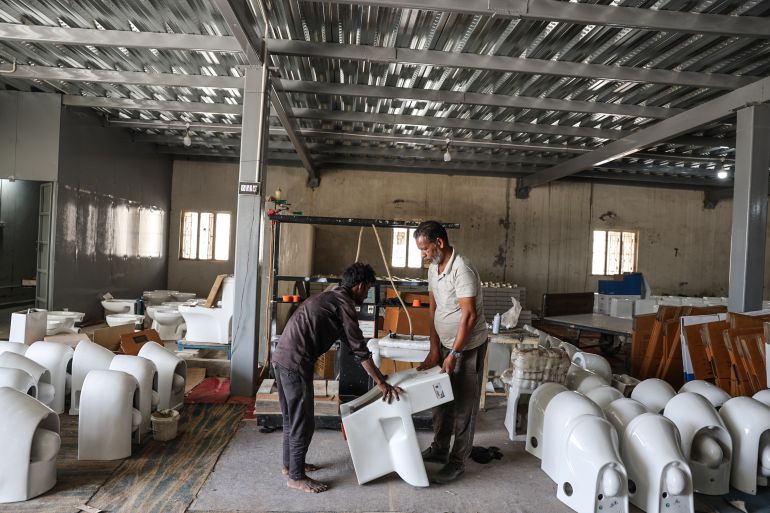
Con più di 600 aziende, Morbi produce circa l’80% della ceramica indiana (Jigyasa Mishra/Al Jazeera)
Editor's Note
This editor’s note highlights the key facts and market implications behind “War with Iran Causes Job Losses and Reverse Migr”, with emphasis on sourcing, product fit, fabrication, logistics, or buyer impact.
For seven years, Pradeep Kumar would enter a ceramic factory in western India at 9 a.m., load raw materials – clay, quartz, and sand – into the kiln, and spend his day amidst the heat and dust of the furnaces. Just two weeks after the war began, the ceramic company where he worked shut down due to a shortage of propane and natural gas. The company, in Morbi, in the state of Gujarat, like all its peers in the ceramic sector, depends on these fundamental ingredients. Morbi is the center of India's ceramic industry, employing more than 400,000 people. More than half of these workers, like Kumar, are migrants from poorer Indian states like Uttar Pradesh and Bihar. With over 600 companies, Morbi produces about 80% of India's ceramics in the form of tiles, toilets, bathtubs, and sinks. But at least 450 of these companies have been forced to close due to the ongoing stalemate in the Strait of Hormuz, a lifeline for India's gas imports. Meanwhile, the war continues, with the United States capturing an Iranian merchant ship on Sunday, although Washington states it is willing to hold another round of talks with Tehran in Pakistan to reach an agreement. Tehran has refused to engage in peace talks after the seizure of its ship. Manoj Arvadiya, president of the Morbi Ceramic Manufacturers Association, stated that the plants will be closed until April 15, hoping that by that date the crisis in the Middle East will be resolved. The Indian ceramic industry is worth $6 billion.
“About 25% of Morbi’s ceramics are exported to countries in the Middle East, Africa, and Europe, with a net value of $1.5 billion. But exports are now delayed and, in some cases, completely blocked, especially to Middle Eastern countries, due to the production slowdown over the last month,” Arvadiya told Al Jazeera.
Chirag Chavda, a Gujarat-based workers' rights activist, says the disease is "widespread in Morbi because workers are regularly exposed to the fine silica dust generated during ceramic production."
Lavoratori all’interno di una fabbrica di ceramica nel Morbi (Jigyasa Mishra/Al Jazeera)
Chavda stated that most ceramic companies do not follow government regulations regarding worker safety. Harish Zala, 40, had worked in several ceramic companies in Morbi for two decades before falling ill with silicosis two years ago. He said he received no help from his employer, who allegedly abused and threatened his father when he visited the company after the diagnosis. He handled clay at various stages, sometimes feeding it into machines, sometimes moving semi-finished pieces for firing. The work was repetitive and demanding, without protective devices, like gloves and masks, against the high temperatures.
“It would be very demanding in summer as the heat would be at its peak,” he told Al Jazeera.
But on March 15 he lost his job, not because of something he or the company behind his factory had done, but because the United States and Israel attacked Iran, triggering another war in the Middle East and a global fuel crisis. Five days after Kumar lost his job, the 29-year-old took his wife and their three children back to their home in Hardoi district, Uttar Pradesh.
“I will stay here until every other migrant worker who came home with us goes back,” he told Al Jazeera.
Harish Zala ha la silicosi e fatica a camminare a causa della grave mancanza di respiro (Jigyasa Mishra/Al Jazeera)
“We don’t want to suffer like dogs, as we did during the COVID-19 pandemic,” he added, referring to the 2020 and 2021 exodus of migrant workers from India’s more industrialized western states to the poorer east, with millions of starving families, including children, walking for days and sometimes weeks to reach their homes amid the coronavirus lockdown.
About 450 out of 600 Companies Close
The developments came as the fragile ceasefire agreed between Iran and the United States after a month of fighting expired last Wednesday. But a resurgence of hostilities saw Iran close Hormuz to traffic, disrupt global fuel supplies, and drive up oil prices.
“All of Morbi’s production units rely on propane and natural gas to fire the high-temperature kilns. While propane is supplied by private companies, natural gas is supplied by the state to those who have the connections. About 60% of manufacturers use propane because it is relatively cheaper,” Siddharth Bopaliya, a 27-year-old third-generation Morbi manufacturer and trader, told Al Jazeera.
“But even today, only about 100 units have been opened, and most have not yet started the production process. For at least another 15 days, it is likely to remain the same,” he told Al Jazeera.
Arvadiya stated that the closure has impacted 200,000 workers, of whom over a quarter are forced to return to their homes in other states.