
Editor's Note
This editor’s note highlights the key facts and market implications behind “This Vatican Detail (of Spanish Origin) Has Surv”, with emphasis on sourcing, product fit, fabrication, logistics, or buyer impact.
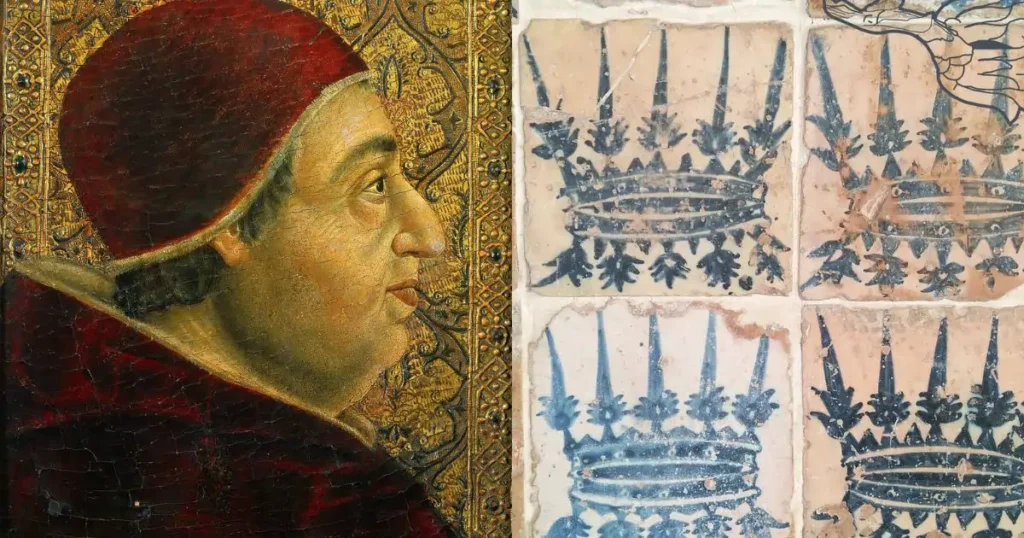
In the Hall of the Liberal Arts in the Vatican, there is a fragment of a tile over five hundred years old. That small piece of floor is all that remains of the tiles that Alexander VI (Pope Rodrigo de Borja) commissioned from the workshops of Manises to pave his residence in Rome.
Born in Xàtiva and raised between Gandía and Valencia, the pope ascended to the throne of Saint Peter at the end of the 15th century, a time when the Crown of Aragon dominated much of Mediterranean politics. Among the many things he brought from Valencia to Rome (artists, customs, family loyalties) were the tiles from Manises.
A Town Rich in Craftsmanship
Manises, a few kilometers from Valencia, had been producing pottery since the first quarter of the 14th century. The potteries in the area had inherited techniques from Mudejar potters and learned to imitate the golden Nasrid pottery that arrived from Málaga: metallic reflections on a white tin-glazed background, decoration in cobalt blue, and exceptional quality.
This pottery was called, in other territories of the Crown of Aragon, "obra de Màlica," due to its connection with Málaga of the Nasrid kingdom. In Italy, it would eventually be called "maiolica," probably because it was re-shipped from Mallorca, the port that redistributed it towards the central Mediterranean.
Earlier, the Neapolitan court of Alfonso the Magnanimous had turned Valencian pottery into a symbol of distinction. Hugo van der Goes painted it around 1475 in the Portinari Altarpiece (today in the Uffizi) with the same precision with which he portrayed the faces of his patrons. Appearing in a Flemish painting of that caliber was, in the 15th century, the equivalent of a luxury certification.
Between 1440 and 1530, Manises consolidated itself as one of the main ceramic producers in Europe. Its pieces reached France, the Italian principalities, Flanders, and the Baltic countries, packed in large jars (the "cossis") that sailed from the Grao of Valencia. The Vatican was one of those destinations.
Calixtus III, the first Borgia pope, had already incorporated Valencian pottery into the halls of the Holy See. His nephew Alexander wanted that same ceramic on the floor of his private rooms. The Borgia Apartments were six rooms decorated with frescoes by Pinturicchio: a display of visual power that the pope completed, literally, from below. The tiles he commissioned from the Valencian workshops incorporated papal heraldry, the arms of the Borgias, motifs typical of late Gothic with influences from the Mudejar repertoire.
The End of Valencian Tiles in Rome
During his pontificate, Alexander VI ordered the paving of several churches and palaces in Rome with Valencian tiles. Today, almost none of that survives. This is because in those times, when a pope died, the people were allowed to freely loot for a few days. It was a way to compensate for the excesses of the previous pontificate. The tiles, pieces easy to pry up and sell, did not survive such transitions well.
Furthermore, Giuliano della Rovere assumed the papacy in 1503, becoming Julius II. It is worth noting that the della Rovere and Borgia families intensely detested each other. Julius II was convinced that Alexander VI had blocked his path to the papacy for years, and when he came to power, he dedicated himself to erasing any artistic trace of his predecessor. The Borgia Apartments were closed and the tiles were torn out. Much of the historical bad reputation of Alexander VI was a campaign promoted by Julius II.
The rooms remained closed until Leo XIII, who reopened them as a museum at the end of the 19th century. He ordered the floors to be rebuilt, but he did so with tiles in the style of the period, not with the original tiles.
In 1912, Manuel González Martí and José Benlliure, then director of the Academy of Spain in Rome, detected the discrepancy. After a search, they found that fragment in the Hall of the Liberal Arts: a few small-format blue and white tiles that had escaped Julius II, the looters, and the centuries.
Fortunately, Manises pottery continued to be produced after the Borgias. In the 18th century, the Royal Factory of Alcora revived the Valencian ceramic tradition with new techniques. And in 2021, UNESCO recognized Manises as a Creative City in the category of Crafts and Folk Arts: the first Spanish city to obtain that distinction.
It is still curious that this fragment of floor survives in the Hall of the Liberal Arts. A historical nod that allows us to reconstruct an important story of Valencian craftsmanship.
Source: Read the original article | Published: April 21, 2026