
Editor's Note
This editor’s note highlights the key facts and market implications behind “A Feature Watch Brands Are Very Proud Of: What I”, with emphasis on sourcing, product fit, fabrication, logistics, or buyer impact.
Basically, we tend to simply differentiate between quartz watches and mechanical watches. Then, within this second category, there are those with an automatic winding movement and those requiring manual winding. But to complicate things (a little), another element has been increasingly talked about recently: the micro-rotor. Far from being a novelty, it appears in timepieces from very diverse horizons, from the most affordable to the most luxurious. But it always comes with a sense of pride from the brand that showcases it, as a guarantee of unique know-how. So, what makes the micro-rotor so desirable in contemporary watchmaking?
A “Normal” Rotor… But Better Integrated
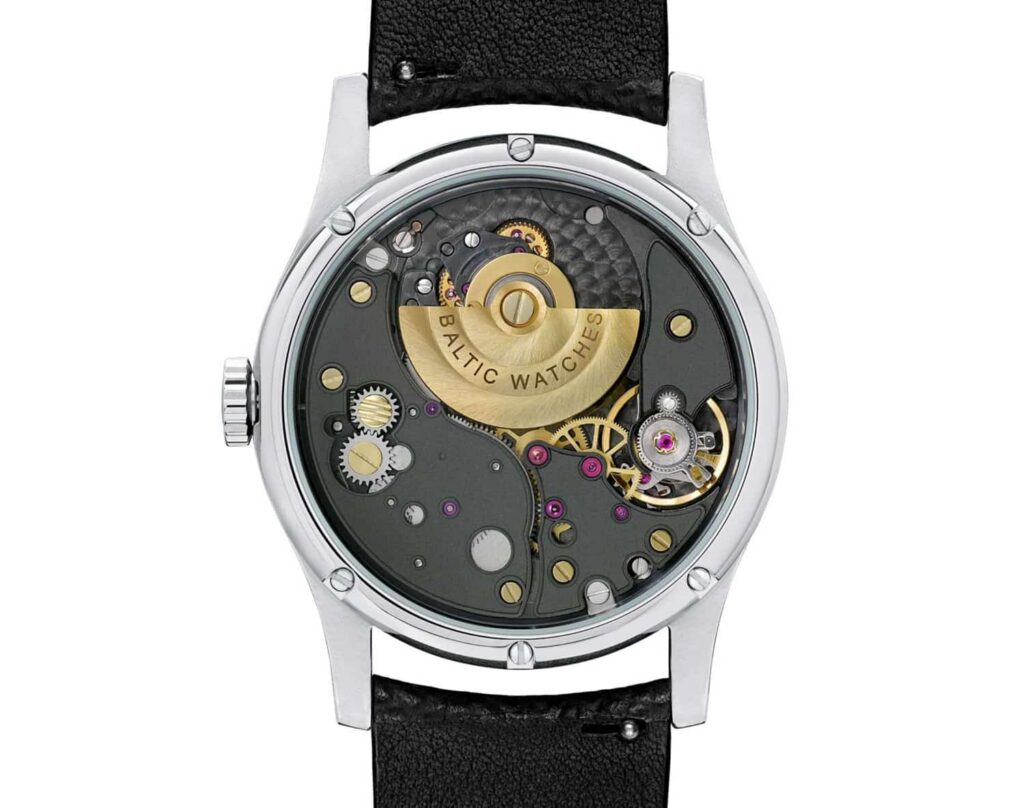
In a classic automatic watch, winding the mainspring relies on an oscillating mass, the other name for this semi-circular rotor that pivots freely above the movement. With every movement of the wrist, it turns and stores energy. Efficient, simple, but visually intrusive. The micro-rotor, on the other hand, changes the game. Rather than being placed on top of the caliber, it is integrated directly into the thickness of the movement. Result: it no longer covers the bridges, frees the view of the mechanics, and above all allows for the design of thinner watches. This is, for example, what Bell & Ross highlights with its BR-X3 Micro-Rotor unveiled this spring 2026, whose architecture reveals the entire movement thanks to this mastered integration. However, this idea is not recent. The first micro-rotor appeared at the end of the 1950s, generally attributed to Büren Watch Company, with its caliber 1000 (1954-1957 according to sources). Universal Genève, with its famous Polerouter designed by Gérald Genta, also helped popularize this architecture. Very quickly, houses like Patek Philippe adopted it, notably with the caliber 240 launched in 1977, which became an absolute reference.

Why this innovation? A quest for thinness above all. At a time when the ultra-thin watch became a field of expression for manufacturers, the micro-rotor established itself as an elegant solution. But it presents a challenge: being smaller, it must be denser (hence a design in gold or platinum) to maintain equivalent winding efficiency. In practice, this often results in slightly slower winding than a central rotor, but also in a more stable and better-balanced architecture over time, provided it is perfectly adjusted. Some manufacturers even see an advantage in terms of precision, thanks to a better distribution of masses and a reduction in mechanical stresses. Long reserved for a watchmaking elite, the micro-rotor experienced periods of obscurity, notably during the quartz crisis. Its comeback today is part of a rediscovery of historical technical solutions, reinterpreted with contemporary means. And it's true that this tiny rotor is not lacking in charm… and efficiency!
From Baltic to Speake-Marin, a New Lease on Life for the Micro-Rotor
If the micro-rotor is so appealing today, it's because it meets several modern expectations. First, a quest for mechanical transparency: enthusiasts want to see the movement, understand its operation, admire its finishes. However, a classic rotor often hides half the spectacle. The micro-rotor, on the other hand, almost disappears into the background. This is the approach found in recent creations like the Speake-Marin Ripples Skeleton or some more confidential proposals like the Elyor by L. Leroy (rediscovered during Geneva Watch Week). The same logic applies at Carl Suchy, where the complexity of the dial dialogues with a movement architecture designed to remain legible.

More interesting still: the micro-rotor is stepping out of its comfort zone. It is now found in more accessible or unexpected watches. And in this game, the French scene has brilliantly seized it. Starting with Yema, which can boast of having developed a micro-rotor movement made in France, and Baltic, which subtly honors this mechanism even in the name of its MR collection. And then, some contemporary houses also make it an aesthetic manifesto: ArtyA, Konstantin Chaykin, Trilobe… At Bell & Ross, as mentioned, it's the new iteration of the BR-X3 that illustrates the point: here, the micro-rotor is not only used to thin the movement, it participates in a global architecture, where the case and the caliber merge into one. Finally, in general, the micro-rotor remains a strong marker in high-end watchmaking. Patek Philippe, Vacheron Constantin, Parmigiani Fleurier, or even Chopard (with its L.U.C calibers) continue to use it to combine elegance, thinness, and performance.
But regardless of how brands envision it, this "little piece of metal" tells a broader story. That of a watchmaking that no longer seeks only raw performance, but a form of coherence between technique and design. Less visible than other complications, it is nonetheless a signature of fine watchmaking.
Source: Read the original article | Published: April 24, 2026