
Editor's Note
This editor’s note highlights the key facts and market implications behind “Engineered Stone Market Size, Share | Industry R”, with emphasis on sourcing, product fit, fabrication, logistics, or buyer impact.
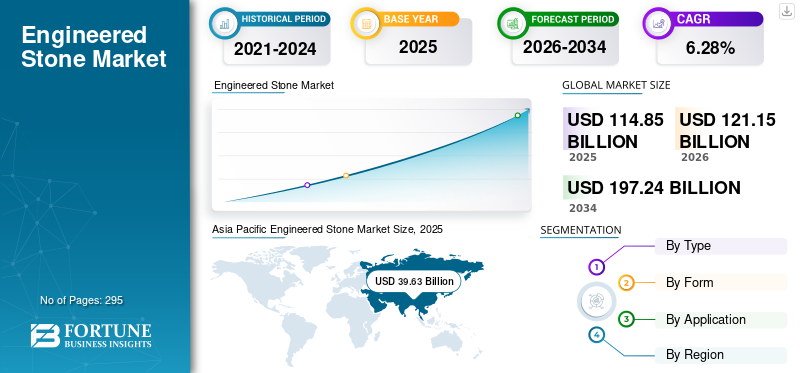
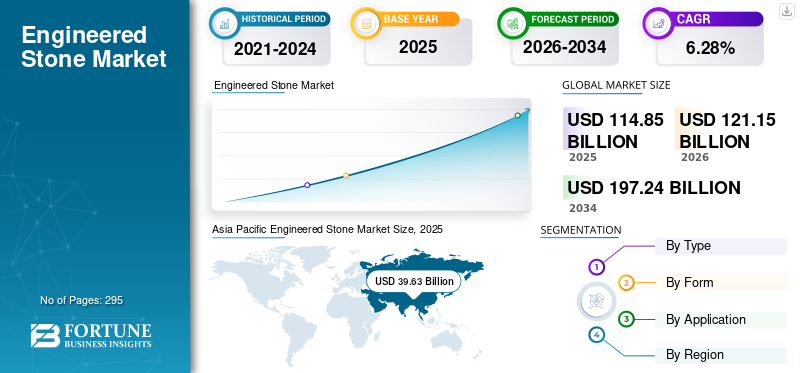
The global engineered stone market size was valued at USD 114.85 billion in 2025. The market is projected to grow from USD 121.15 billion in 2026 to USD 197.24 billion by 2034, exhibiting a CAGR of 6.28% during the forecast period. Asia Pacific dominated the engineered stone market with a market share of 34.50% in 2025. Engineered stone is a manufactured composite material made by binding crushed natural stone, most commonly quartz or marble, with polymer resins, pigments, and additives under high pressure and vibration to form slabs, tiles, or custom shapes used in architectural applications. Typically composed of 85–95% stone aggregates (in quartz-based products) and 5–15% resins and pigments, these stones are designed to replicate the appearance of natural stone while offering improved consistency, durability, and lower porosity. Furthermore, many key industry players, including Cosentino S.A., Caesarstone Ltd., LX Hausys, and VICOSTONE, operating in the market, are focusing on developing innovative engineered stone products to meet the increasing demand.
Engineered Stone Market Trends
A key market trend shaping the industry today is the shift toward premium, design-driven solid surfaces paired with sustainability and health-focused innovation. Buyers, especially in residential renovation and high-end commercial segments, are increasingly choosing engineered stone not just for durability and consistency, but for aesthetic variety (marble-looks, large veining, ultra-thin formats, jumbo slabs) that rival natural stone. At the same time, regulatory and health concerns around crystalline silica exposure in fabrication have pushed manufacturers to develop low-silica or silica-free composite alternatives, driving R&D investment and new product lines. This trend toward design diversity, safer, environmentally considerate materials is accelerating adoption across mature markets (North America, Europe) and expanding appeal in fast-growing regions (Asia Pacific, Middle East & Africa), influencing pricing, branding, and competitive positioning industry-wide. The primary driver of the market is the steady expansion of residential construction and renovation, particularly in kitchens and bathrooms. Such stones, especially quartz-based slabs, are widely used for countertops and vanities, two of the most frequently upgraded elements in a home. As housing starts increase and homeowners invest in remodeling projects, demand for durable, aesthetically appealing surface materials rises. In mature markets such as North America and Western Europe, a strong remodeling culture plays a major role. Homeowners regularly upgrade kitchens to enhance property value, functionality, and design appeal, thereby driving demand for quartz surfaces. At the same time, rapid urbanization in regions such as Asia Pacific and parts of the Middle East is fueling large-scale apartment construction, further boosting demand for interior finishing materials. Beyond construction activities, consumer preferences are shifting from natural stone to engineered quartz. Buyers favor quartz as it is non-porous, stain- and scratch-resistant, easy to maintain, and offers consistent color and pattern compared to natural stone.
As disposable incomes increase, particularly in emerging economies, consumers are placing greater emphasis on the visual appeal and perceived luxury of their living spaces. Kitchens and bathrooms are no longer viewed purely as functional areas but as central design features of modern homes. Engineered stone, especially quartz-based surfaces, offers a wide range of colors, patterns, and marble-look finishes that align with contemporary interior design trends. The ability to replicate high-end natural stone aesthetics with improved durability and uniformity makes it an attractive and popular choice for both homeowners and developers. Real estate developers are also incorporating engineered stone into mid- to high-end residential projects to differentiate properties and command higher selling prices. Premium finishes help position apartments and villas as modern, upscale offerings, increasing the adoption of quartz surfaces in new developments. Social media influence, home improvement shows, and digital design platforms have amplified consumer awareness of surface materials and design trends. This growing aspiration for stylish, durable, and low-maintenance interiors continues to drive demand for engineered stone, supporting long-term market expansion.
Growing Health and Regulatory Concerns Related to Crystalline Silica Exposure to Hamper Market Growth
A key restraint in the market is the growing health and regulatory concerns related to crystalline silica exposure. Quartz-based engineered stone typically contains a high percentage of crystalline silica (often 85–95%). During cutting, grinding, and fabrication, fine silica dust can be released. Prolonged exposure to this dust has been linked to serious respiratory diseases such as silicosis. As awareness of these health risks has increased, several countries have strengthened workplace safety regulations, imposed stricter dust-control standards, and, in some cases, proposed or implemented restrictions on high-silica products.
Source: Read the original article | Published: April 06, 2026