
Editor's Note
This editor’s note highlights the key facts and market implications behind “Marble Fragments Everywhere: Magnitude 7 Earthqu”, with emphasis on sourcing, product fit, fabrication, logistics, or buyer impact.
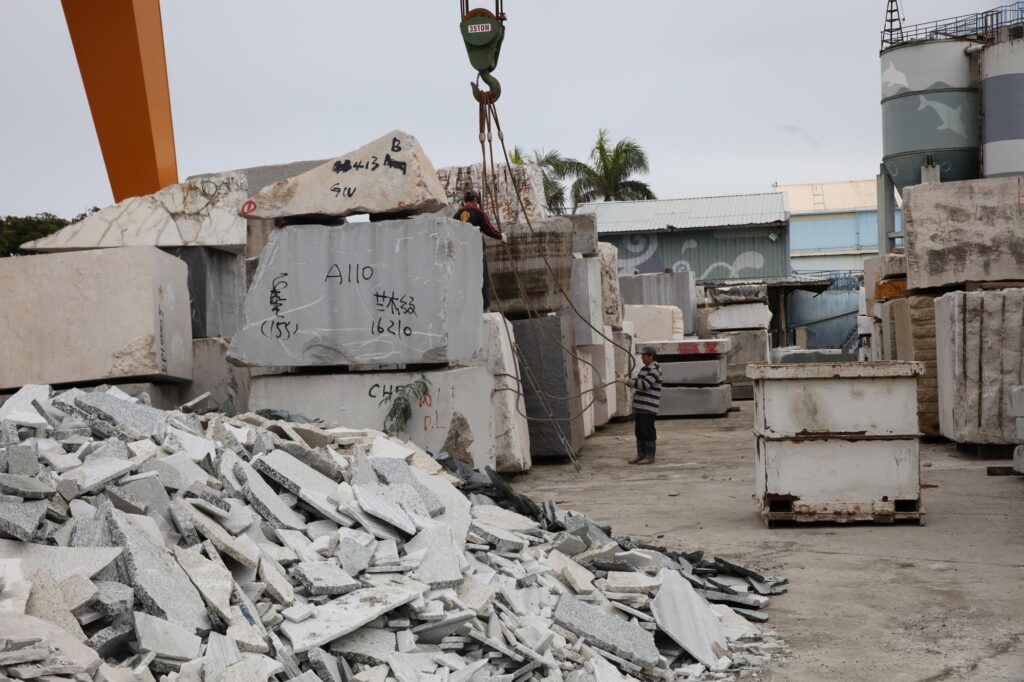
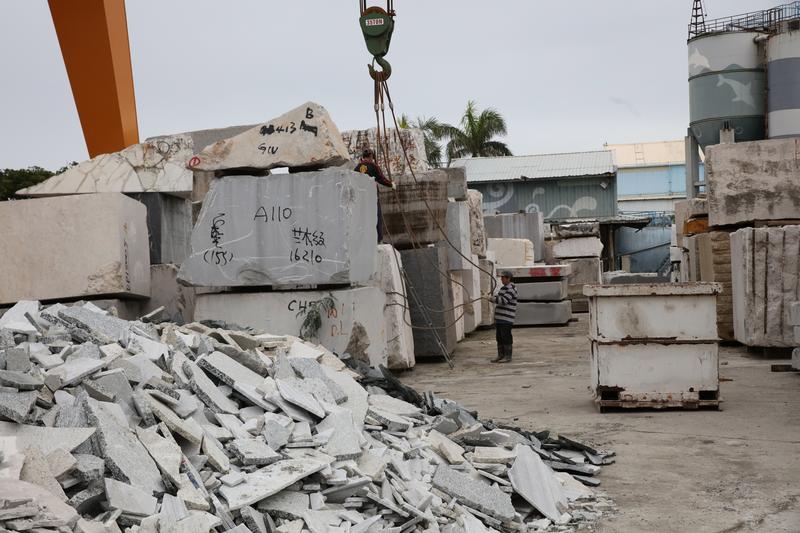
On February 6, an earthquake measuring 6.0 on the Richter scale struck Hualien, with intensity reaching level 7 in the county and city. The quake not only toppled four buildings, killing 16 people and injuring nearly 300, but also devastated the stone industry, a key economic pillar of Hualien. In the Meilun and Guanghua industrial zones, piles of broken stone fragments have plunged this already struggling sector into a deep winter, leaving employees worried about their livelihoods. Walking into a stone factory in the Guanghua Industrial Zone feels like entering a giant Lego factory. Past the massive stacked raw stones at the entrance, one sees stacks of stone slabs collapsed on the floor, many shattered into irregular pieces. Several foreign workers are carrying broken fragments and piling them up in one area.
“We rushed over immediately, and with so many aftershocks, we had to call the workers out first… At night, there were fewer people. If it had been daytime, the casualties could have been worse than those two collapsed buildings… Each of these stones weighs several tons, and any one could easily kill someone.”
Huang Junxiang, a fourth-generation member of Donghong Stone Industry, recalled the moment the earthquake struck. Most business owners drove to their factories right after the quake to assess the damage and ensure the safety of local and foreign workers living in factory dormitories. Fortunately, the earthquake occurred late at night, and no casualties were reported at the factories. However, the piles of rubble remain a nightmare for the industry.
“People in Hualien are very earthquake-resistant! We can generally withstand quakes up to magnitude 6, but this one was magnitude 7… It’s never been this severe before.”
Huang Huihong, chairman of Donghong Stone Industry, pointed to the broken stones on the ground and explained that each "stack" of slabs comes from a single raw stone. Typically, one raw stone can be cut into 40 slabs, each worth about NT$10,000. Thus, a stack of rubble represents a loss of NT$300,000 to NT$400,000. For most businesses, losses start in the tens of millions. From clearing the debris to resuming shipments, it will take three to six months. During this period, factories cannot collect payments and must compensate clients for losses, resulting in heavy financial damage. Hualien is rich in marble resources. The stone industry began developing in the 1950s and, after decades of growth, became a major industry in the county. It has faced challenges such as low-cost competition from Chinese stone, labor shortages, and environmental protests. Even though mining of the two types of stone in Hualien is now limited, businesses have shifted from mining to importing and processing. Despite these ups and downs, the stone industry remains one of Hualien's two economic pillars, alongside tourism. According to estimates from the Taiwan Stone Industry Association, the annual output value of stone processing is between NT$21 billion and NT$31 billion. The industry employs about 15,000 people in Hualien, including upstream and downstream workers, accounting for 10% of the county's total workforce. Wang Chunfu, chairman of the Taiwan Stone Industry Association, said that the estimated damage to stone alone has reached NT$2 billion. When including subsequent inspection and repair of related equipment, the total loss could reach NT$3 billion. Although this is unlikely to trigger a wave of closures, an estimated 3% to 5% of companies may go bankrupt, affecting the livelihoods of their employees.
“Of course, employees are worried about the boss’s losses. With this economy, we’re afraid of losing our jobs!”
Chen Meihui, who has worked as an accountant in the stone industry for over 30 years, said she entered the field at age 20. Although there have been small fluctuations due to seasons or economic conditions, the situation has never been this serious. Even in recent years, with fewer construction projects and a sluggish economy, her company's revenue dropped by 70% to 80%, but she had never been this worried before. Another stone industry employee, Ms. Jin, a local of Hualien, said her father worked in the mining area, so she has always felt a deep connection to stones. Seeing the rubble everywhere made her feel very "unwilling" (in Taiwanese, meaning reluctant or sad). She entered the stone industry right after graduation through a referral and has been working there for 13 years. In recent years, due to the poor economy and rising statutory operating costs, many stone companies have found it increasingly difficult to operate. Although her company has a long history, she fears that if it cannot weather this storm, she and her colleagues may lose their jobs. The plight of the stone industry has drawn central government attention. Four days after the earthquake, President Tsai Ing-wen visited the Meilun Industrial Zone with ministry heads to hear the concerns of business owners and instructed relevant departments to provide assistance. Business owners believe the top priority at this stage is "clearing waste." Reporters visited several upstream factories and found severe damage. One subcontractor estimated losses of over NT$100 million. Piles of broken stones blocked walkways, making it difficult even to walk. Weng Yiwen, owner of Xinsheng Industrial, said that broken stones cannot be sold and must be disposed of at a cost. Hualien has only one recycling plant that processes stone waste into mud cakes and other construction materials. However, with only one plant, it cannot handle the current surge in broken stones in a short time. He hopes the government can help with waste removal and finding sites for temporary storage. Huang Huihong said that each piece of waste must be photographed as evidence for subsequent disaster assessment. Until all waste is cleared, production cannot resume, and machine damage cannot be fully inspected. It will take one to two months to clear the waste before production can restart. Once production begins, new damage will likely be discovered. After repairing the machines, production may be delayed by up to six months. The most troublesome issue is that many raw stones were purchased on letters of credit. Since the stones cannot be sold now, the credit cannot be repaid. For companies with weaker capital, the biggest fear is that banks will "withdraw their umbrellas in the rain" and call in loans, potentially forcing the company into bankruptcy due to cash flow problems. They hope the government can provide assistance similar to agricultural disaster subsidies. In response to the concerns of stone industry businesses and employees, the government has offered support by providing waste disposal sites, assisting with removal, and requiring financial institutions to extend loan terms. On February 11, the Executive Yuan's "0206 Hualien Earthquake Relief and Reconstruction Task Force" held a meeting and made relevant decisions. For waste removal, the port company will provide land free of charge for three years for temporary storage, with site surveys and preparation work starting immediately to facilitate removal. The Hualien-Taitung Fund will cover part of the removal costs. For loans, the Financial Supervisory Commission has been instructed to convene financial institutions to offer relief plans, including loan extensions and reconstruction loans. The National Development Fund or the Hualien-Taitung Fund will provide NT$2 billion for credit guarantees, with a total of NT$20 billion available for special project financing. For disaster loss compensation, tax deductions for disaster losses and income tax relief for disaster-related impairments will be provided. To revitalize the industry, the Ministry of Economic Affairs has been asked to propose a "0206 Hualien Earthquake Post-Disaster Industrial Recovery Action Plan," with funding from the Hualien-Taitung Fund. To prevent similar situations in the future, the Financial Supervisory Commission has been asked to work with financial insurers and industry associations to design earthquake insurance products tailored to the stone industry's needs, thereby transferring the risk of earthquakes and other disasters. Wang Chunfu expressed gratitude for these measures, noting that tax relief for disaster losses, assistance from the Small and Medium Enterprise Administration in extending loans, and credit guarantees have provided timely help that directly meets the industry's needs. However, when asked if there are any shortcomings, he believes that a very small number of companies face immediate bankruptcy risk. If the government could allocate a small portion of the relief or recovery plan funds to subsidize these businesses, it would provide even more timely assistance.
“So people in Hualien often say that life here is good, but working here is tough! Although the air is great and it’s nice for retirement, the employment rate is poor!”
Lin Zhongyou, factory manager at Donghong, sighed. As a Hualien native, he is proud of the city but laments that if the stone industry faces further problems, it will be difficult to find work in the future.
Source: Read the original article | Published: February 12, 2018