
Editor's Note
This editor’s note highlights the key facts and market implications behind “Home Butler: Hong Kong Man Regrets Using Solid S”, with emphasis on sourcing, product fit, fabrication, logistics, or buyer impact.
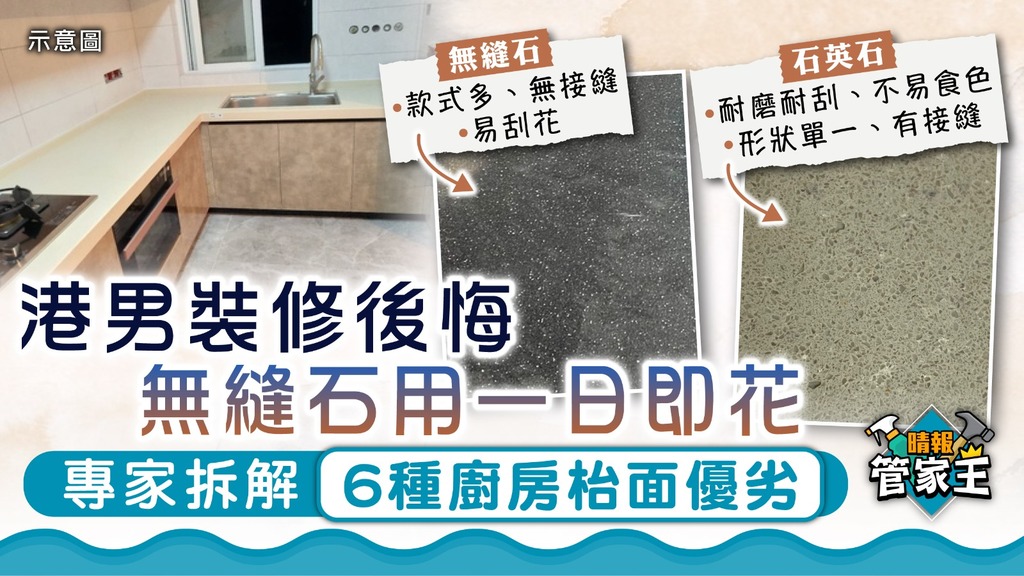
Kitchen countertops come in many materials, and the key is to choose one that suits your cooking habits. A Hong Kong man recently shared online that after renovating his kitchen, he switched to a dark-colored solid surface countertop, only to find it scratched within a day of normal use. After some time, it even showed signs of cracking, forcing him to replace it with quartz. Experts point out that solid surface, also known as artificial stone, can achieve seamless joints but is prone to scratching. They analyze the pros and cons of six common countertop materials.
Case Study: A Hong Kong Man’s Regret
The netizen posted on LIHKG (a Hong Kong forum) saying his kitchen countertop was originally quartz. After a major renovation, everything was nearly complete except for the solid surface countertop, which caused problems. He noted that under normal use, it scratched within a day: "It's so easy to scratch that even dropping a coin leaves a mark."
He contacted the contractor, who explained that dark-colored stone scratches more easily than light-colored stone, and many customers regret choosing dark colors. The contractor tried polishing the surface, which, though losing its original luster, was better than being covered in scratches.
Just when he thought the issue was resolved, he noticed cracks near the stove. The contractor explained that this type of stone cannot withstand heat and would eventually crack from high temperatures. The homeowner ultimately decided to hire another company to reinstall the quartz countertop he had used before. "Now I feel quartz is much more durable. Dropping things on it doesn't leave marks," he said, questioning whether solid surface is truly unusable: "So I want to ask all you brothers: Is solid surface really so useless that it's only for looking at, not for using?"
The post sparked heated discussion. Some netizens pointed out that the quality of solid surface or artificial stone varies greatly, with different grades. Others recommended light-colored stone, not only because dark stone scratches easily, but also because light colors are easier to clean and allow you to see dirt at a glance.
6 Types of Kitchen Countertops: Pros and Cons
Most Hong Kong households choose solid surface (artificial stone) or quartz for countertops, both of which are man-made. Natural stones like granite and marble are becoming rare. The "Good Master Decoration Design Platform" analyzes five common kitchen countertop materials in terms of heat resistance, scratch resistance, crack resistance, and stain resistance, along with their characteristics and pros and cons during use.
1. Solid Surface (Artificial Stone)
Price: Approximately HK$300 to 1,000 per linear foot
Advantages: High plasticity, seamless joints, wide variety of styles
Disadvantages: Prone to scratching, potential for staining, significant quality differences between brands
Solid surface is the most commonly used countertop material today. It is made by pressing mineral fillers (usually aluminum hydroxide powder) with acrylic resin or polyester. Originally developed as an alternative luxury to natural stone, it has now evolved into a mid-priced, popular option.
Its biggest selling point is ease of shaping. Using the same material for joints allows seamless connections, and it can also create integrated sinks or curved backsplashes.
Many people worry about staining, but quality varies greatly between brands. High-end solid surface generally performs better in this regard. Due to its low hardness, it is easily scratched by sharp objects, and very hot pots can leave marks.
Popular brands in Hong Kong include Corian, LG, and Staron (formerly under Samsung, now under Lotte). Corian is an American brand, costing more than half as much as the Korean-made ones. Formica, known for laminate, also produces solid surface, offering another major brand choice. There are also many cheap Chinese-made countertops, but quality is highly inconsistent.
2. Quartz
Price: Approximately HK$700 to 1,400 per linear foot
Advantages: Wear-resistant, scratch-resistant, heat-resistant, stain-resistant
Disadvantages: Limited shapes, visible joints
Quartz is a popular choice for kitchen countertops in Hong Kong. It is a newer man-made stone, primarily made from quartz sand mixed with resin and a small amount of glass or minerals. Quartz countertops are more expensive than solid surface, harder, more heat-resistant, and less prone to staining. However, they are limited in shape—cannot be curved—and cannot achieve seamless joints.
Due to its durability, daily cleaning only requires water. Stains can be scraped off with a blade. Even after long use, the surface remains smooth without special maintenance.
3. Granite
Price: Approximately HK$600 to 1,600 per linear foot
Advantages: Natural texture, wear-resistant, scratch-resistant, heat-resistant
Disadvantages: Potential for staining, visible joints, heavy, may have radiation
Unlike man-made stones, granite is a natural stone, quarried from rock and cut into shapes. It is very hard, wear-resistant, scratch-resistant, and heat-resistant. However, natural stone has pores, requiring regular waxing for maintenance. These pores can lead to staining. Additionally, natural stone cannot achieve seamless joints. If the kitchen is humid, water can accumulate in joints and pores, promoting bacterial growth.
Natural stone countertops are becoming less common in Hong Kong. While they offer natural textures and can be cut and polished into various shapes, they require significant processing and maintenance. Their weight also demands sturdy cabinet structures.
4. Marble
Price: Approximately HK$800 to 2,000 per linear foot
Advantages: Natural texture, elegant appearance
Disadvantages: Prone to staining, scratching, heat damage, cracking, visible joints, heavy, may have radiation
Marble is another natural stone countertop material, but it has almost disappeared from kitchens. It is one of the most expensive options. It has many practical drawbacks: it stains more easily than granite, is less hard, scratches and cracks easily, requires significant processing, needs sturdy cabinets, and demands regular waxing.
However, its elegant appearance is unmatched by other materials, with rich, natural colors and textures.
5. Stainless Steel
Price: Approximately HK$700 to 1,400 per linear foot
Advantages: Heat-resistant, stain-resistant, easy to clean, very durable
Disadvantages: Scratches are very visible, limited style, visible joints
Stainless steel countertops are the top choice for professional kitchens but are rare in home kitchens and custom cabinets. They are heat-resistant, stain-resistant, easy to clean, and extremely durable. The main drawback is the cold, industrial feel, which not everyone likes.
Scratches on stainless steel are very noticeable. Brushed or matte finishes are better in this regard and are more common for kitchen countertops due to their softer appearance.
6. Alternative: Laminate
Price: Approximately HK$400 to 600 per linear foot
Advantages: Cheap, stain-resistant, wide variety of styles
Disadvantages: Shorter lifespan, average scratch and heat resistance, visible joints, significant quality differences between brands
Laminate is commonly used for furniture and cabinet surfaces. In foreign countries, it is also used for countertops, but it is rare in Hong Kong due to concerns about durability. Besides being cheap, its biggest advantage is the wide range of colors and textures available, including wood grain, stone, and metallic finishes.
Quality varies greatly between brands, similar to solid surface. Major brands include Formica, West German board, and Deli board.
Laminate is more prone to aging issues like fading and water seepage. Generally, it is stain-resistant, but high-temperature objects can cause discoloration.
Content and images provided by "Good Master Decoration Design Platform" with permission.
Source: Read the original article | Published: September 02, 2022