
Editor's Note
This editor’s note highlights the key facts and market implications behind “Engineered Stone Market Size, Share & Industry F”, with emphasis on sourcing, product fit, fabrication, logistics, or buyer impact.
The engineered stone market was valued at over USD 28.01 billion in 2025 and is projected to exceed USD 55.62 billion by 2035, growing at a compound annual growth rate (CAGR) of over 7.1% during the forecast period (2026–2035). The industry is expected to reach USD 29.8 billion in 2026.
Key Market Trends and Growth Opportunities
The primary driver of the engineered stone market is the increasing global demand for these materials. Quartz, one of the most abundant minerals on Earth, is a key component. The quartz stone market, recognized as part of the engineered stone market, is rapidly expanding. Quartz slabs are typically composed of approximately 90% natural quartz powder and 10% resin binders, though these ratios vary slightly by brand. Another factor driving market growth is the superior durability of engineered stone compared to natural stone. Quartz is flexible, resistant to cracking, and easy to install. Because quartz contains about 93% quartz and 7% resin, it is stronger than natural stones like granite or marble. Natural stones are more prone to staining as they absorb liquids, whereas resin-containing quartz is naturally waterproof. Spills on natural stone must be cleaned quickly to prevent long-term damage. Quartz requires no sealing, unlike natural stone which needs sealing every 1–2 years. Quartz is also easier to maintain; spills or debris can be cleaned with a sponge or water. It is impermeable and resistant to acids from juice spills, coffee stains, and burns. While durable and scratch-resistant, quartz countertops are not heat-proof.
Market Insights Summary
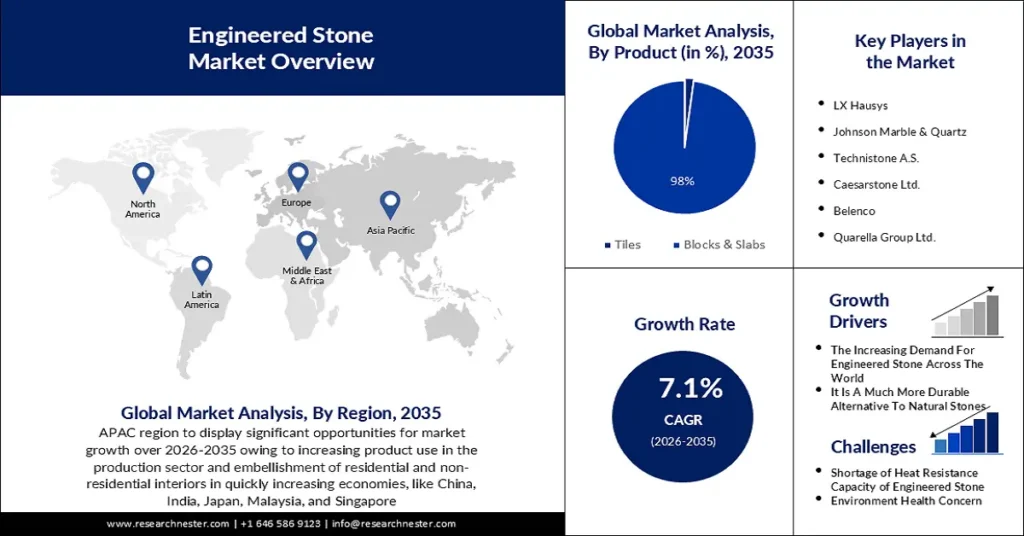
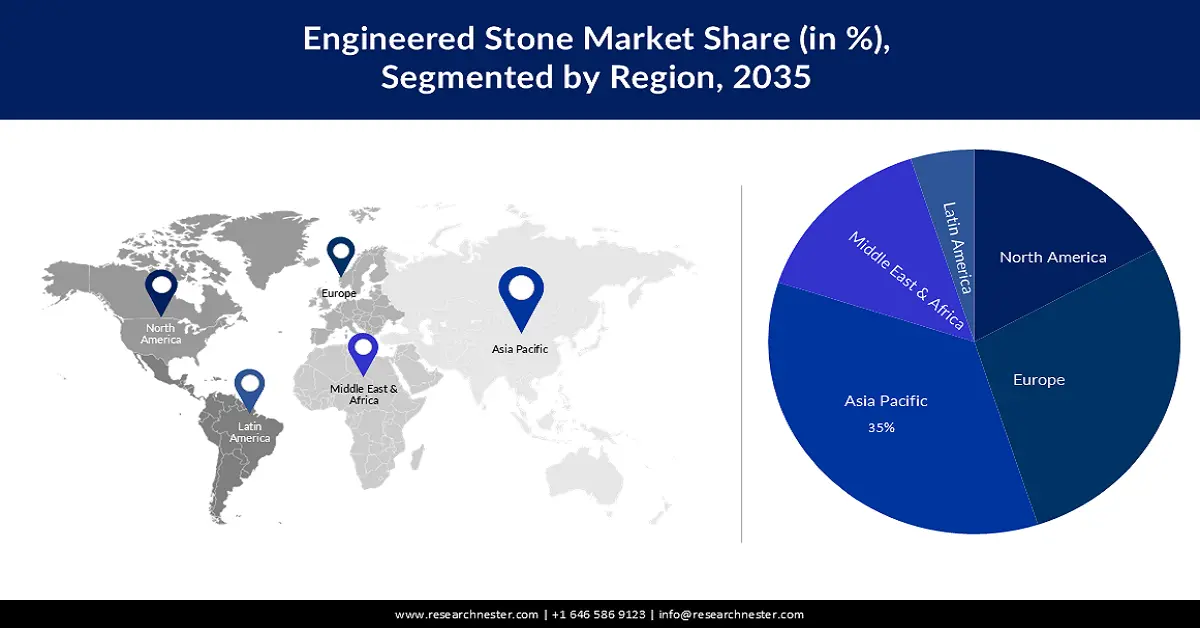
Regional Highlights The Asia-Pacific region is expected to hold over 35% of the engineered stone market share by 2035, driven by increasing use of engineered stone products in construction and residential and non-residential interior decoration in rapidly growing economies. The European market is projected to see significant growth during the forecast period, supported by improving mining regulations and policies aimed at strengthening the extraction and supply of critical raw materials for green and digital transformation. Segment Insights Within the engineered stone market, the blocks and slabs segment is expected to account for 98% of the share by 2035, due to cost-effectiveness, ease of installation, and suitability for kitchen applications. The countertops segment is projected to hold 79% of the market share by 2035, driven by stain resistance and lower cost compared to natural stone countertops. Key Growth Trends Growing demand for aesthetically pleasing countertops Accelerating urbanization and increasing residential investment Key Challenges Insufficient heat resistance of engineered stone Environmental and health concerns Key Players LX Hausys, Johnson Marble & Quartz, Technistone A.S., Caesarstone Ltd., Belenco, Quarella Group Ltd., Quartzforms, Stone Italiana S.p.A., Cosentino S.A., VICOSTONE, Shimizu S.p.A., Taketo Shoten Co., Ltd.
Market Size and Growth Forecast
2025 Market Size: USD 28.01 billion 2026 Market Size: USD 29.8 billion 2035 Projected Market Size: USD 55.62 billion Growth Forecast: CAGR of 7.1% (2026–2035) Key Regional Dynamics Largest Region: Asia-Pacific (35% by 2035) Fastest Growing Region: Asia-Pacific Key Countries: United States, China, Germany, Japan, Italy Emerging Countries: China, India, Japan, South Korea, Thailand Last updated: September 16, 2025
Growth Drivers and Challenges
Growth Drivers Growing demand for visually appealing countertops — Quartz offers a wide variety of colors and patterns due to impurities during production. For example, amethyst quartz appears purple due to trace iron, while rose quartz is pink from titanium or manganese contaminants. This natural beauty makes quartz an attractive choice for architectural decoration. Architects can choose from timeless white tones for sophistication or bold colors for visual impact. Quartz can also replicate complex veining patterns found in natural stone like marble or granite, offering a luxurious look without maintenance concerns. Accelerating urbanization and increased residential investment — In developing economies, population growth drives housing demand, often fueled by rural-to-urban migration. Urban centers attract growing populations, and rising unemployment impacts housing expansion. Urbanization also spurs growth in commercial and residential real estate, leading to construction of towers, shopping malls, hotels, and other properties. Real estate developers are investing heavily in urban areas to meet housing and commercial space demand. Growing preference for green building materials — Recycled building components enhance energy efficiency, reduce waste, and lower carbon emissions in green construction. Prioritizing recycled materials supports a more regenerative future and drives industry transformation toward eco-friendly practices. Global certifications like LEED and local ones like GRIHA are in high demand for planning, creating, operating, and managing cost- and resource-efficient, high-performance, and safe building structures. Challenges Insufficient heat resistance of engineered stone — Quartz countertops are made from about 90% quartz powder mixed with 8–10% resin, polymers, and pigments under high heat and pressure. While quartz does not burn, exposing its surface to high heat can cause damage. Placing hot objects like pans or kettles on quartz countertops can lead to burn marks and discoloration because high heat melts the resin used on the surface. Environmental and health concerns
High cost and lack of awareness
Market Size and Forecast
Report Attribute Details Base Year 2025 Forecast Period 2026–2035 CAGR 7.1% Base Year Market Size (2025) USD 28.01 billion Forecast Year Market Size (2035) USD 55.62 billion Regional Scope North America (US, Canada), Asia-Pacific (Japan, China, India, Indonesia, Malaysia, Australia, South Korea, Rest of Asia-Pacific), Europe (UK, Germany, France, Italy, Spain, Russia, Nordic, Rest of Europe), Latin America (Mexico, Argentina, Brazil, Rest of Latin America), Middle East & Africa (Israel, GCC, North Africa, South Africa, Rest of Middle East & Africa)
Market Segmentation
Product Segment Analysis The blocks and slabs segment is expected to achieve the largest share of 98% by 2035, driven by ease of installation, low maintenance, and cost-effectiveness. Standard concrete slabs typically have densities of 4 or 6 inches, adjustable per project requirements. Density is a key cost factor: thicker slabs cost more. For example, a 4-inch slab is USD 0.50 to USD 1.00 cheaper than a 6-inch slab. Unlike natural stone, engineered blocks and slabs are less prone to staining from common food substances like oil, wine, and juice, making them ideal for kitchens. They can be produced in large sizes and are impermeable, suitable for wet areas like bathrooms, pools, showers, and bathtubs. Demand for aesthetically pleasing countertops is expected to continue growing to enhance interior design. Application Segment Analysis The countertops segment is projected to dominate with a 79% profit share by 2035, driven by stain resistance. Quartz countertop costs range from USD 45 to USD 200 per square foot, depending on grade, color, and edge treatment. Engineered stone slabs are generally less expensive than natural alternatives and offer more variety in shape, design, color, and texture. However, engineered stone contains polymer resins that are not UV-resistant, which can cause discoloration and cracking of the resin binder. Our in-depth analysis of the global engineered stone market covers the following segments: Type: Engineered quartz, Polymer concrete, Engineered marble Application: Flooring, Countertops, Wall cladding, Cut-to-size items Product: Tiles, Blocks and slabs End-use industry: Residential, Commercial, Infrastructure
Asia-Pacific Market Insights
By 2035, the Asia-Pacific region is expected to dominate the engineered stone market, holding a 35% profit share. This is due to increasing use of engineered stone in residential and non-residential interior construction and decoration in rapidly growing economies such as China, India, Japan, Malaysia, and Singapore. The Chinese government plans to invest CNY 92.4 trillion (USD 13.7 trillion) in green energy transition by 2060, aiming for net-zero greenhouse gas emissions by 2060. China also targets 33% of electricity from sustainable sources by 2025. Infrastructure investment is a key policy tool for the Chinese government to address economic crises or recessions, though it comes at a cost.
Europe Market Insights
By 2035, the European engineered stone market is also expected to see significant growth due to improving mining regulations. For example, on December 15, 2023, the European Parliament approved new regulations to strengthen the extraction and supply of critical raw materials. The law simplifies the extraction process for new mines or projects deemed particularly important, ensuring Europe's supply of key raw materials essential for green and digital transformation.
Key Market Players
LX Hausys Johnson Marble & Quartz Technistone A.S. Caesarstone Ltd. Belenco Quarella Group Ltd. Quartzforms Stone Italiana S.p.A. Cosentino S.A. VICOSTONE Recent Developments December 27, 2023: LX Hausys announced participation in DOMOTEX 2024, a global trade fair focused on flooring technology, held January 11–14, 2024, in Hanover, Germany. As a key participant, LX Hausys showcased its innovations and engaged with industry professionals. HFLOR, committed to leading flooring technology, offered selected luxury vinyl tile (LVT) flooring solutions for the European market. April 13, 2023: LX Hausys SMR® launched a creative material solution with an ultra-matte surface achieved through special coating and advanced coating technology. This unique material offers fingerprint resistance, stain resistance, scratch resistance, and chemical resistance, suitable for projects requiring a clean, stylish finish or exceptional durability.
Frequently Asked Questions (FAQ)
What is the value of the engineered stone market? The industry is expected to reach USD 29.8 billion in 2026. What is the demand in the engineered stone industry? The global engineered stone market was valued at over USD 28.01 billion in 2025 and is projected to exceed USD 55.62 billion by 2035, with a CAGR of over 7.1%. Which region holds the largest share of the engineered stone industry? Asia-Pacific is expected to hold over 35% of the market share by 2035, driven by increasing use in construction and interior decoration in rapidly growing economies. Who are the top engineered stone companies? Key players include LX Hausys, Johnson Marble & Quartz, Technistone A.S., Caesarstone Ltd., Belenco, Quarella Group Ltd., Quartzforms, Stone Italiana S.p.A., Cosentino S.A., VICOSTONE, Shimizu S.p.A., and Taketo Shoten Co., Ltd.
Source: Read the original article | Published: September 16, 2025