
Editor's Note
This editor’s note highlights the key facts and market implications behind “Scientific Research – Japan Develops New Anisotr”, with emphasis on sourcing, product fit, fabrication, logistics, or buyer impact.
A joint research team led by Associate Professor Yusho Furusawa of Kitami Institute of Technology, Group Leader Kazuo Kan of the National Institute for Materials Science (NIMS), and Assistant Professor Naoki Horiguchi of Tokyo Medical and Dental University has successfully achieved, for the first time, the transparency of a new type of anisotropic ceramic and verified its laser oscillation effect. Compared with single crystals, polycrystalline ceramics offer many advantages, such as large-scale production and compositing. However, generally speaking, polycrystalline ceramics composed of numerous grains can only achieve laser-quality transparency in cubic crystal system materials with uniform refractive index relative to crystal orientation. In this study, non-cubic crystal system materials (sapphire and apatite) achieved this performance as single crystals. Nevertheless, this research found that even for non-cubic crystal system materials, by controlling the grain size to about one-tenth of the light wavelength, grain boundary scattering can be reduced, enabling the production of extremely high-quality transparent ceramics that can generate laser oscillation. Researchers in Japan and abroad had previously attempted the same method, but this study is the first to achieve laser oscillation. Non-cubic crystal system materials are severely affected by grain boundary scattering because their refractive index varies with crystal orientation (birefringence). The magnitude of grain boundary scattering can be expressed by the following formula.
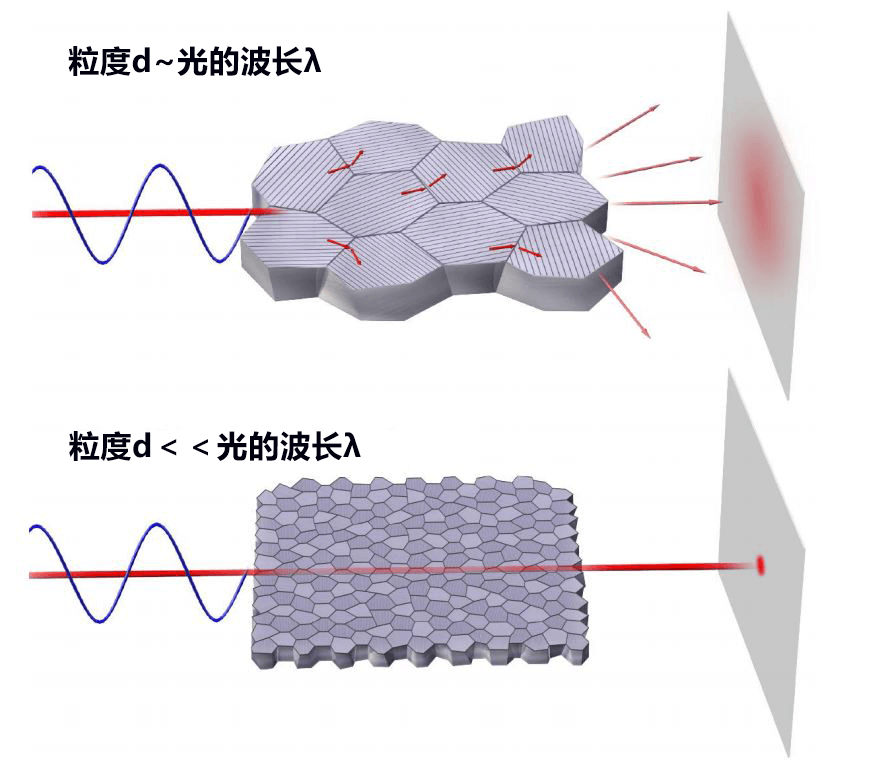
Here, d represents grain size, Δn represents refractive index anisotropy, λ represents light wavelength, and V represents the effective volume fraction of anisotropic grains. From this formula, it can be seen that since Δn is an intrinsic physical property value of the material, grain boundary scattering can be suppressed by minimizing the grain size d (Figure 1). Figure 1: Conceptual diagram of grain boundary scattering in non-cubic crystal system ceramics. (Top) When the grain size is on the same order as the light wavelength, slight differences in refractive index due to different crystal orientations cause light to scatter when passing through grain boundaries. (Bottom) When the grain size is much smaller than the light wavelength, grain boundary scattering is reduced, and the linear transmittance of the laser improves. This time, the research team solved the above challenge with the assistance of experts in different fields such as powder engineering, powder metallurgy, and laser engineering. The material selected was neodymium-doped apatite, a material also widely studied as a biomaterial.
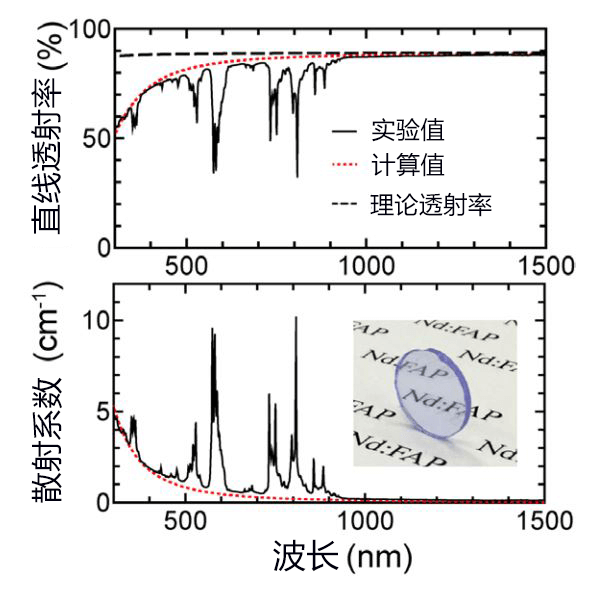
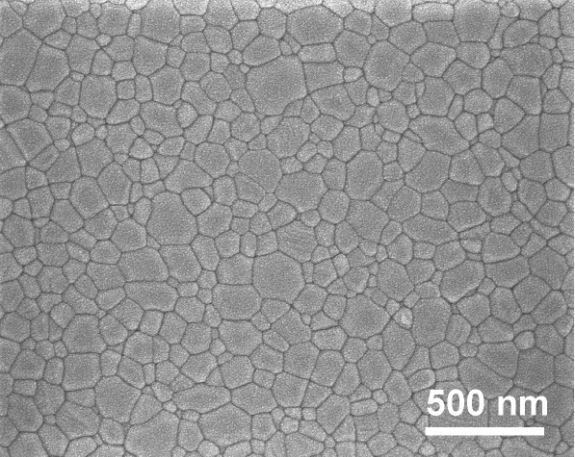
First, to obtain transparent ceramics, the team synthesized an ideal initial powder using a liquid-phase synthesis method. As shown in Figure 2, spherical primary particles with a grain size of 50 nm were synthesized at Tokyo Medical and Dental University. Next, at the National Institute for Materials Science, the obtained powder was sintered to become dense and transparent. Typically, densification is easily achieved at high temperatures, but this leads to grain growth; at low temperatures, densification is difficult. This time, the team employed spark plasma sintering (SPS), which can achieve densification at relatively low temperatures by utilizing an electric current effect. By precisely controlling the sintering process, they successfully fabricated a ceramic with an average grain size of 140 nm (Figure 3) and very few scattering sources (Figure 4). Finally, at Kitami Institute of Technology, for the first time globally, laser oscillation was achieved in non-cubic crystal system ceramics with randomly distributed crystal orientations, and the laser oscillation output and spectrum were evaluated (Figure 5). Figure 2: Microstructure photograph of the initial fine powder of Nd-doped apatite. It shows spherical primary particles with a grain size of approximately 50 nm. Figure 3: Microstructure photograph of the sintered body of Nd-doped apatite. The photograph shows no residual pores or other phase precipitates, achieving a dense sintered body composed of a fine microstructure. The estimated average grain size is only 140 nm.
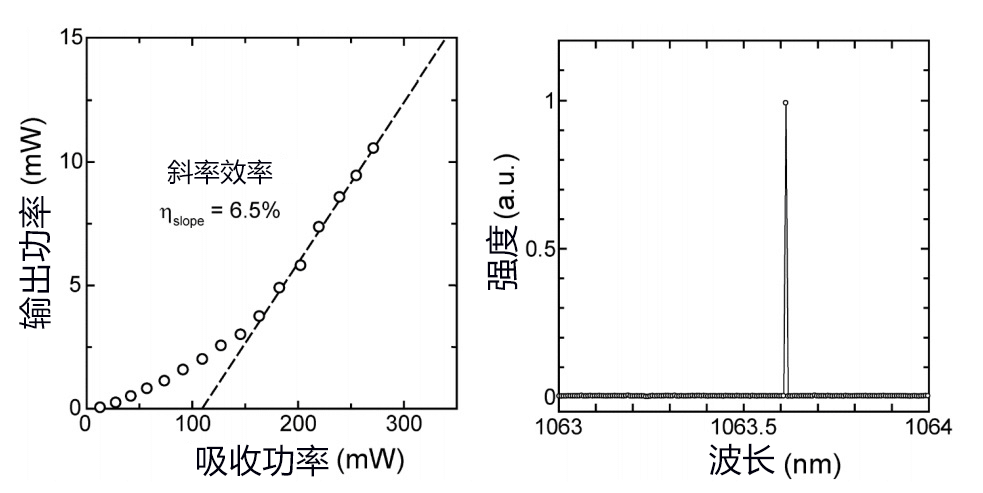
Figure 4: Linear transmittance spectrum (top) and scattering spectrum (bottom) of Nd-doped apatite. It can be seen that in the region above 1000 nm wavelength, there is almost no scattering, achieving high quality. The scattering coefficient on the long-wavelength side is considered to be small. Figure 5: (Left) Laser input-output characteristics of Nd-doped apatite. The laser output efficiency relative to absorbed power is approximately 6.5%. (Right) Laser oscillation spectrum. Japanese news release full text: Translated and organized by JST Objective Japan Editorial Department
Source: Read the original article | Published: August 07, 2019