
Editor's Note
This editor’s note highlights the key facts and market implications behind “Ceramic Masterpieces at the Seikado Bunko Art Mu”, with emphasis on sourcing, product fit, fabrication, logistics, or buyer impact.
Since the Heian period, artifacts transported to Japan by Chinese ships have been called "Tang wu" (Chinese treasures), cherished in Japanese culture, and passed down through generations. After the Tang dynasty, through the flourishing maritime ceramic trade, Chinese ceramics were exported not only to neighboring countries like Japan and the Korean Peninsula but also as far as West Asia and Africa. During the Song dynasty, the main players in the ceramic trade were celadon from the Longquan kilns, bluish-white porcelain from Jingdezhen, and black-glazed Tenmoku wares from Fujian, all produced in coastal regions such as Zhejiang and Fujian. These Song ceramics were imported and consumed in Japan from the Kamakura to the Muromachi periods, with some fine pieces treasured by temples, shrines, feudal lords, or wealthy merchants, preserved to this day.
Chinese ceramics boast a history of over 8,000 years, embodying the essence of ceramic artistry. Looking back at this history, Song dynasty (960–1279) ceramics and Qing dynasty (1616–1912) imperial ware represent two peaks of craftsmanship. During the Song, industry, commerce, and technology flourished under a civil administration where literati and scholar-officials were highly active. Diverse and exquisite ceramic works emerged across regions, including celadon, white porcelain, and black glaze, later revered as "Song ceramics" and regarded as "classics" that continue to influence the present.
In the last imperial dynasty, the Qing, the court established government-run workshops called "official kilns" in the porcelain capital of Jingdezhen, dedicated to producing palace wares using the finest techniques and materials. During the early Qing, the Kangxi, Yongzheng, and Qianlong emperors all showed great interest in ceramics, sending imperial supervisors to the official kilns, which led to the creation of technically and design-wise superlative ceramic works.
Among the Qing imperial ware in the Seikado collection are pieces collected by Iwasaki Yanosuke (second president of Mitsubishi, 1851–1908) as early as the Meiji 20s (1887–1896), before the Qing dynasty began to collapse. Additionally, in the early 20th century, Yanosuke's successor, Koyata (fourth president of Mitsubishi, 1879–1945), gathered fine Song ceramics that had been passed down in Japan, as well as newly excavated Song pieces and renowned Qing imperial ware, creating a world-class collection of Chinese ceramics.
In this exhibition, we present the highlights of the Seikado Chinese ceramic collection through four chapters, featuring masterpieces of Song ceramics and famous Qing imperial ware.
Chapter I: Yearning for “Tang Wu” – Song Ceramics Passed Down in Japan
Since the Heian period, artifacts transported to Japan by Chinese ships have been called "Tang wu," cherished in Japanese culture, and passed down through generations. After the Tang dynasty, through the flourishing maritime ceramic trade, Chinese ceramics were exported not only to neighboring countries like Japan and the Korean Peninsula but also as far as West Asia and Africa. During the Song dynasty, the main players in the ceramic trade were celadon from the Longquan kilns, bluish-white porcelain from Jingdezhen, and black-glazed Tenmoku wares from Fujian, all produced in coastal regions such as Zhejiang and Fujian. These Song ceramics were imported and consumed in Japan from the Kamakura to the Muromachi periods, with some fine pieces treasured by temples, shrines, feudal lords, or wealthy merchants, preserved to this day.
The "White Porcelain Carved Lotus Flower Bowl" (Fig. 1) is a vessel from the Ding kiln (Hebei Province), the premier white porcelain kiln in northern China. The flower-shaped vessel is carved with smooth lotus patterns on both the interior and exterior. It is believed that this piece was brought to Japan before the Edo period and was passed down as a water jar (mizusashi) for tea ceremony by the Maeda family, lords of the Kaga domain.
Fig. 1 Important Cultural Property, Northern Song to Jin, Ding kiln, "White Porcelain Carved Lotus Flower Bowl," Seikado Bunko Art Museum collection.
The Longquan kiln in southern Zhejiang Province produced a beautiful translucent bluish-green glaze known as "powder blue" during the Southern Song. Longquan celadon was not only popular domestically but also in high demand overseas, with many masterpieces exported to Japan. The Longquan kiln "Celadon Appliqué Peony Scroll Deep Bowl" (Fig. 2) was passed down as a water jar by the Konoi family, wealthy merchants of Osaka.
Fig. 2 Important Cultural Property, Southern Song to Yuan, Longquan kiln, "Celadon Appliqué Peony Scroll Deep Bowl," Seikado Bunko Art Museum collection.
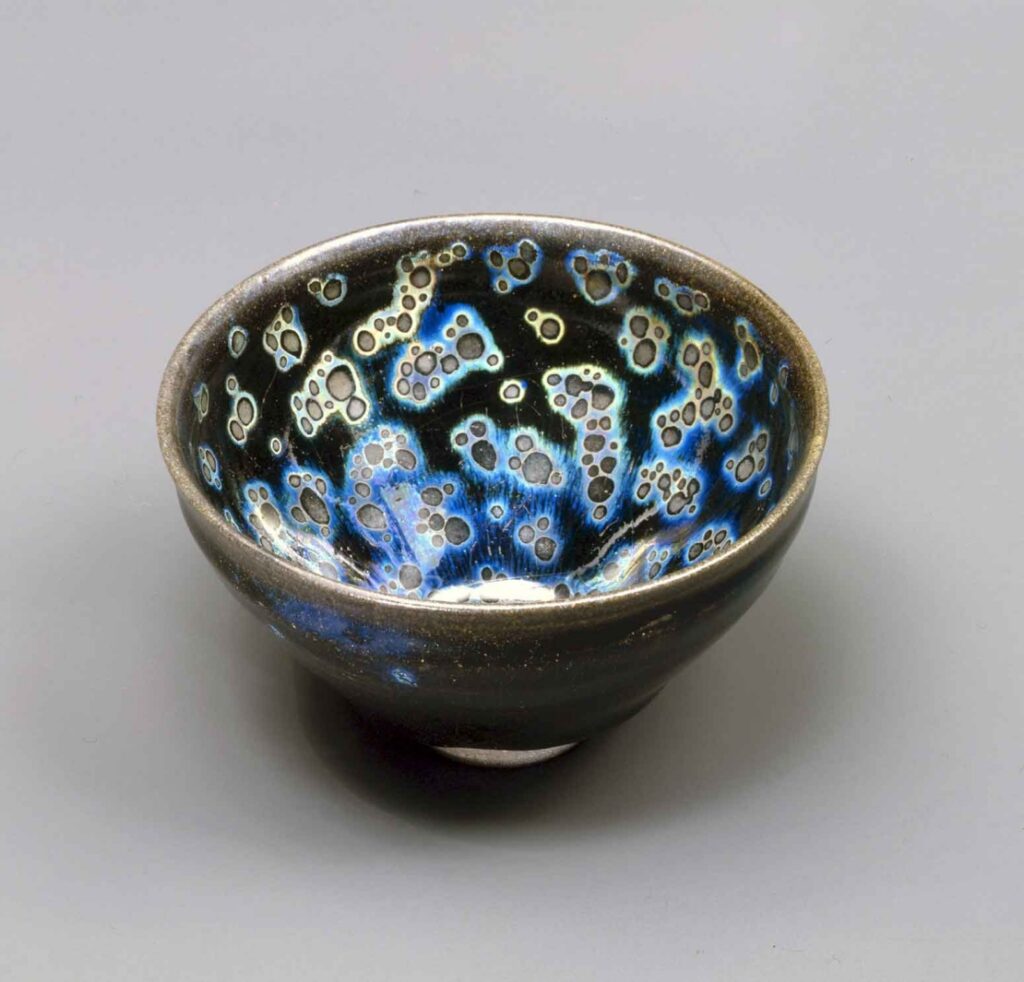
The Jian kiln in Fujian Province, near tea-producing areas, produced black-glazed tea bowls suitable for the "diancha" (whisked tea) method, a tea preparation technique that originated in the Song dynasty and later became the source of Japanese tea ceremony. The iron content in the black glaze changes during firing, creating rare effects like "yohen" (kiln change) and "yuteki" (oil spots), making such pieces extremely valuable. This beautiful large oil-spot bowl, Jian kiln "Oil Spot Tenmoku" (Fig. 3), originally preserved by the Fujita family of Osaka, is believed to have been brought to Japan from China long ago.
Fig. 3 Important Cultural Property, Southern Song, Jian kiln, "Oil Spot Tenmoku," Seikado Bunko Art Museum collection.
Chapter II: The Era of “Song Ceramics”
In the early 20th century, as Western powers entered China, various excavation projects began, including the tombs of princes and nobles near cities, unearthing many previously unknown ancient artifacts and historical relics. Some sites became famous for yielding large quantities of Song ceramics, especially Cizhou kiln wares. One such site was the ancient city of Julu (Julu County, Hebei Province), which was buried overnight under silt during a great flood at the end of the Northern Song. Cizhou kiln ceramics, characterized by their bold color contrasts in decoration, were popular among common people. In Japan, these ceramics were also beloved for their approachability, favored by artists and collectors from the Taisho to early Showa periods, and regarded as representative of "Song ceramics."
On the other hand, the collapse of the last Chinese dynasty, the Qing, provided an opportunity for rare ancient ceramics from the collections of Chinese imperial families and nobles to flow to collectors in Europe, America, and Japan. These collections included many Song monochrome ceramics, such as celadon and white porcelain, which had long been cherished and supported by educated literati, emphasizing the beauty of upright forms and clear glazes. In this chapter, we can see the two aspects of Song ceramics that later became the "classics" pursued by subsequent potters.
Cizhou kiln used a "white slip" technique, covering colored clay with white slip to produce various decorated wares. The Cizhou kiln "White Ground Black Sgraffito Peony Ruyi Head Pillow" (Fig. 4) uses repeated layers of white and black slip, then thinly scrapes away the black slip outside the decorative pattern, creating a strong color contrast to reveal the design. The peony symbolizes "wealth and honor," while the ruyi head shape of the pillow signifies good fortune.
Fig. 4 Northern Song, Cizhou kiln, "White Ground Black Sgraffito Peony Ruyi Head Pillow," Seikado Bunko Art Museum collection.
"Official kilns" were kilns dedicated to producing ceramics for the palace. During the Southern Song, an official kiln was established in the capital Hangzhou (Zhejiang Province), producing clear celadon. The Southern Song official kiln "Celadon Ding-shaped Incense Burner" (Fig. 5) imitates the heavy form of the ancient bronze vessel "ding," with characteristic crackle patterns (kan'nyu) on the bright bluish-green glaze.
Fig. 5 Southern Song, Official kiln, "Celadon Ding-shaped Incense Burner," Seikado Bunko Art Museum collection.
Chapter III: The Essence of Qing Imperial Ware
In the last Qing dynasty (1616–1912), many personnel and techniques related to ceramic production were concentrated in Jingdezhen, Jiangxi, where palace porcelain was made… (excerpt)
(For the full text and images, see Artifacts & Antiques Issue 373, "Ceramic Masterpieces at the Seikado Bunko Art Museum: Special Exhibition 'Two Peaks – Song Ceramics and Qing Imperial Ware'," by author Yamada Masaki (Curator, Seikado Bunko Art Museum).)
Two Peaks – Song Ceramics and Qing Imperial Ware Exhibition Period: October 7 – December 10, 2023 Venue: Seikado Bunko Art Museum, Japan
Source: Read the original article | Published: October 11, 2023