
Editor's Note
This editor’s note highlights the key facts and market implications behind “Tea, Porcelain, and Incense Lead Fashionable Liv”, with emphasis on sourcing, product fit, fabrication, logistics, or buyer impact.
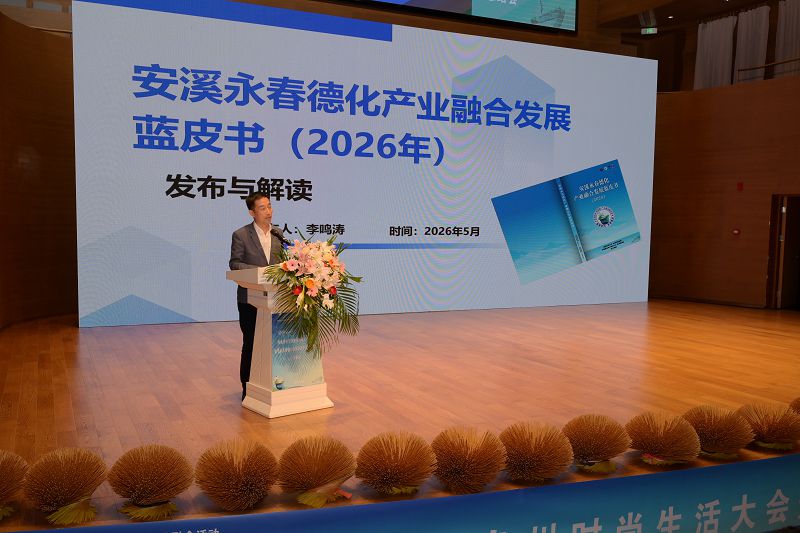
Release and Interpretation of the "Anxi, Yongchun, Dehua Industrial Integration Development Blue Paper (2026)" (Photo by Zheng Zhide)
On May 9, the "Tea, Porcelain, and Incense Accompany Fashionable Living in Quanzhou" Conference and the Summary Meeting of the Anxi, Yongchun, and Dehua County Collaboration for Industrial Integration were held in Quanzhou. Anxi, Yongchun, and Dehua have evolved from "one county, one product" to "multiple counties, one cluster," from "selling single products" to "selling Eastern lifestyle aesthetics," and then to the tri-county linkage of the "Tea, Porcelain, and Incense" full-chain collaboration. The three regions have forged a distinctive path that breaks down administrative barriers and achieves regional coordinated development.
From Selling Tea Sets to Selling “Tea Space Solutions”
Dehua He Bai Cultural Creativity Co., Ltd., founded in 2024, is one of the participating enterprises in this integration. Project manager Jiang Kaixuan admitted that from its very first day, the brand actively embedded itself into the industrial collaboration system of "Anxi tea, Dehua porcelain, and Yongchun incense."
This is not just a slogan. After nearly two years of effort, its core team has successfully incubated the "He Bai Long Kiln" ceramic brand. Their zero-to-one operational experience made them realize: pure ceramic products are facing homogenized competition, while consumer demands have changed. "Consumers are no longer just buying a tea set; they want to build a complete tea space experience," said Jiang Kaixuan.
This insight is directly reflected in product design. Take the "Reunion Elegant Collection" set as an example: it collaborates with provincial-level masters to replicate the Ming Dynasty "Child Red" glaze, insists on firing with raw ore clay and raw ore glaze, and features the Inviting Moon Teapot, Deep Autumn Cup, and Jade Rabbit Incense Holder, all showcasing ancient craftsmanship. Paired with Yongchun's intangible cultural heritage "Laosan" sandalwood's elegant smoke and the rich tea flavor from Anxi's core production areas, the set has sold over 600,000 yuan, becoming a benchmark gift for "Tea, Porcelain, and Incense." What "Tea, Porcelain, and Incense" sells is not utensils, but an immersive experience scene for the Mid-Autumn reunion. Another product, the "Galloping Horse" incense holder, sold over 1,000 units in less than a month, validating the daily consumption potential of the "porcelain + incense" combination.
He Bai project manager Jiang Kaixuan introduces the "Reunion Elegant Collection" to clients (Photo by Zheng Zhide)
He Bai's practice reveals a deeper shift: brands are moving from "selling tea sets" to "providing solutions for tea drinking." Jiang Kaixuan observed that discerning tea drinkers will deduce the capacity and shape of tea utensils based on the type of tea. For example, drinking high-aroma rock tea requires a pot that concentrates fragrance, with a tea-to-water ratio of 1:30 corresponding to a 110 ml pot. This means the brand must understand tea to make good porcelain.
This is precisely the challenge of integration. Currently, He Bai's collaboration within "Tea, Porcelain, and Incense" is mainly achieved through online live streaming, promoting tea and incense products alongside porcelain, which has yielded good results, with several tea and incense items becoming minor hits in the live stream. However, deep offline integration is still being explored. Jiang Kaixuan stated that future plans include outputting complete "tea space" solutions through offline showrooms, deeply binding tea, porcelain, and incense with consumers' need for tranquility.
From Production-End Exploration to Supply-Side Support
If He Bai represents exploration on the production end, then the "iCeramic" industrial internet platform demonstrates how the supply chain can provide offline selection centers and online digital platforms for the integrated development of "Tea, Porcelain, and Incense."
This platform was created and operated by Fujian Zhongci Network Technology Co., Ltd. in 2018, dedicated to empowering the transformation and development of China's ceramic industry with digital technology. According to Tu Rongbiao, General Manager of the iCeramic platform, the platform has served over 3,000 enterprises, displayed over 100,000 products, and provided one-stop services for buyers, including source goods, live-streaming training, shared cloud warehouses, and flexible customization. This system has significantly reduced the transaction costs of cross-border cooperation within "Tea, Porcelain, and Incense." "Last year, the platform collaborated with the government to invite top streamers for origin-tracing live streams," Tu Rongbiao said. Streamers from Taobao's top accounts, such as Bee Surprise Club and Lie'er Baby, visited the production areas of Dehua, Yongchun, and Anxi. In the live rooms, streamers simultaneously recommended ceramic tea sets, Anxi tea leaves, and Yongchun incense, shaping a lifestyle of "brewing tea, lighting incense, and appreciating porcelain." Among these, Lie'er Baby's special live stream achieved a total transaction volume exceeding 4 million yuan.
Tu Rongbiao also admitted that the current integration of "Tea, Porcelain, and Incense" remains mostly at the marketing activity level. "It's not about rigidly packaging three products into one gift box, but naturally matching them in a live-streaming scenario." He gave an example: the "Shadowy Blue Relief Tea Set," with Song Dynasty shadowy blue glaze as its soul and three-dimensional relief peony petals visible through the body, paired with a porcelain-carved zodiac horse incense holder, Yongchun incense, and Anxi tea, at least quadruples the average order value—this is real incremental growth. However, deeper integration is still anticipated. Tu Rongbiao believes that enterprises from the three regions can embed each other in the product design stage, such as reserving a spot for incense in ceramic ornaments, using Dehua porcelain as standard ware in Anxi tea shops, and reflecting tri-county co-branding in packaging design. "The government has already built the basic platform; the next act needs to be played out among enterprises."
Another value of iCeramic lies in data feedback. The platform feeds back market hot-seller information and trend data to factories, helping them precisely develop products. This is particularly crucial in developing integrated "Tea, Porcelain, and Incense" products; enterprises need to know what combinations of tea sets, teas, and incense are more popular in the market, rather than blindly matching them.
Tu Rongbiao pointed out that the brand awareness of Dehua ceramics as a production area still has significant room for improvement, which objectively limits the market recognition of integrated products. To this end, he suggested continuously inviting top influencers and celebrities to visit the production areas for origin-tracing promotions, thereby strengthening the production area's brand image and promoting the Dehua ceramic industry and "Chinese White" culture to become stronger and better through the internet.
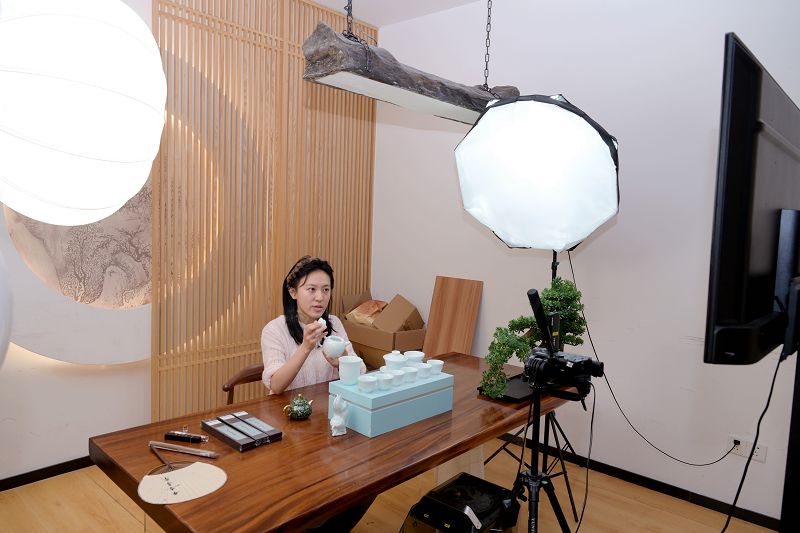
The "Tea, Porcelain, and Incense" live-streaming scene gains market favor (Photo by Zheng Zhide)
From Event Momentum to Building a “Six-Link” Mechanism
From the government perspective, "Tea, Porcelain, and Incense" is no longer just a series of events; it is a highly anticipated path for regional coordinated development.
Data shows that since 2024, the three counties have organized over 210 high-quality enterprises, integrated more than 2,300 fusion products, and driven cumulative sales exceeding 2.7 billion yuan, achieving a synergistic effect of "1+1+1>3." Behind this figure lies the operation of the "Six-Link" mechanism: "county alliance, industry linkage, brand co-branding, master collaboration, enterprise joint operation, and e-commerce joint broadcasting."
The three county governments jointly signed the "Memorandum of Understanding on Industrial Integration and Collaboration," established a joint working group, and set up a regular consultation mechanism. They advance work around six key tasks: co-building brands, sharing channels, co-creating products, co-cultivating talent, co-establishing standards, and co-expanding markets. This mechanism ensures that integration is not a fleeting trend but a sustained institutional arrangement.
However, the "Tea, Porcelain, and Incense" integration is still in its early stages. The Dehua ceramic industry is mainly constrained by the fragmentation of enterprises and homogenized competition, a lack of deep product and channel integration, and a shortage of composite talent. The future key lies in whether market mechanisms can drive enterprises to truly play their roles.
The "Anxi, Yongchun, Dehua Industrial Integration Development Blue Paper (2026)" released by the Research Institute of the China International Electronic Commerce Center attempts to answer the question of "how to integrate in the future." The Blue Paper suggests shifting from traditional manufacturing to value creation, promoting design R&D and the transformation of cultural symbols. Jiang Yaoping, former Vice Minister of Commerce, emphasized in his keynote speech that the highest level of business model is to supply a lifestyle that people aspire to.
The industrial integration and upgrading of the three counties under "Tea, Porcelain, and Incense" is not simply about selling a few more products; it is about packaging Anxi tea, Yongchun incense, and Dehua porcelain into a holistic output of Eastern lifestyle aesthetics. (Photo by Zheng Zhide)
Source: Read the original article | Published: May 21, 2026