
Editor's Note
This editor’s note highlights the key facts and market implications behind “Latest Forecast: Multi-Layer Cutting Machine Mar”, with emphasis on sourcing, product fit, fabrication, logistics, or buyer impact.
What is a Multi-Layer Cutting Machine?
A multi-layer cutting machine is positioned as a core piece of equipment for high-precision, simultaneous cutting of multi-layer materials in fields such as apparel, composites, interior furnishings, and automotive trim. The multi-layer cutting machine market was formed in 2025 at a scale of approximately 4,148 units with an average price of USD 96,000, maintaining steady growth against the backdrop of manufacturing automation and the advancement of made-to-order production. Regionally, China is rapidly increasing its presence and is projected to reach a 37.71% global market share by 2032, clarifying the Asia-led industrial structure.
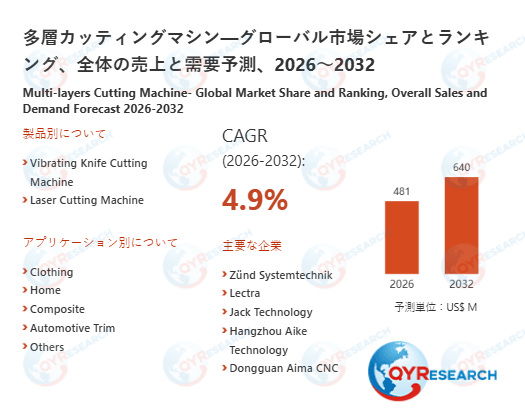
According to the latest report from the QYResearch survey team, "Multi-Layer Cutting Machine – Global Market Share and Ranking, Overall Sales and Demand Forecast, 2026-2032," the global market for multi-layer cutting machines is estimated at USD 441 million in 2025 and is forecast to reach USD 481 million in 2026. Subsequently, it is expected to progress at a Compound Annual Growth Rate (CAGR) of 4.9% from 2026 to 2032, expanding to USD 640 million by 2032.
Market Structure and Regional Growth Trends
In the multi-layer cutting machine market, the Chinese market is projected to expand from USD 155.71 million in 2025 to USD 239.24 million by 2032, growing at a CAGR of 5.80%. China has become the center of consumption in the global market for multi-layer cutting machines, holding a 35.43% share as of 2025. Europe and North America constitute 26.17% and 18.30% respectively, maintaining stable demand as mature markets.
On the production side, China and Europe are the main hubs, holding shares of 37.61% and 25.70% respectively. Particularly in China, the expansion of manufacturing capacity and growth in domestic demand are strengthening its central position on the supply side in the long term.
Technical Structure and Precision Control Mechanisms
A multi-layer cutting machine is an advanced automated cutting device centered on a precision mechanical structure, CNC control, and an integrated sensor system. These machines ensure structural stability through double-beam frames and high-rigidity drive mechanisms, controlling cutting accuracy to within ±0.05mm.
Furthermore, negative pressure adsorption systems and secondary coating technologies suppress slippage of multi-layer materials, maintaining uniformity in cutting quality. Over the past six months, the introduction of dynamic path correction systems equipped with AI correction algorithms has progressed, confirming improvements in yield for complex pattern cutting. The advancement of automatic loading devices and pressing mechanisms has also improved the efficiency of continuous processing for large materials.
Competitive Structure and Key Companies
The multi-layer cutting machine market is highly concentrated internationally, with European and American companies such as Zünd Systemtechnik, Lectra, and Eastman Machine leading the high-precision segment. In the Asian market, companies like Jack Technology and Hangzhou Aike Technology are expanding their share by leveraging high efficiency and cost competitiveness.
The market structure as of 2025 forms a dual structure: a technology-led model in Europe, the US, and Japan, and a mass-production/cost-optimization model in China. Particularly in the high-end market, the technological superiority of European manufacturers is maintained, with AI control and integrated laser cutting technology being key differentiating factors.
Expanding Applications and Changes in Industrial Demand
Multi-layer cutting machines hold approximately a 41.59% market share in the apparel field, making it the largest application area. Furthermore, adoption is progressing in automotive interiors, composite materials, and household goods sectors, with stable growth at a CAGR of about 5.03%.
Particularly due to the expansion of customized production, demand for on-demand cutting systems is increasing. For processing EV interior materials and lightweight composites, simultaneous cutting of multiple layers is essential, accelerating the adoption of multi-layer cutting machines. As a recent example, in an Asian apparel OEM factory, the introduction of a production line-integrated cutting cell reportedly reduced work time by approximately 20%.
Technology Trends and Innovation Directions
Multi-layer cutting machines are evolving around the axes of intelligence, high precision, and environmental responsiveness. AI-optimized cutting paths, operational monitoring via IoT connectivity, and process simulation using digital twins are being introduced.
Additionally, the adoption of green cutting technologies aimed at improving energy efficiency and reducing waste is expanding. The advancement of nesting algorithms to maximize material utilization is progressing in reducing raw material loss. Furthermore, the hybridization of laser cutting and knife cutting is expanding the range of adaptable materials.
This article explains the market trends and competitive analysis overview based on the QY Research report "Multi-Layer Cutting Machine – Global Market Share and Ranking, Overall Sales and Demand Forecast, 2026-2032."
Source: Read the original article | Published: April 09, 2026