
Editor's Note
This editor’s note highlights the key facts and market implications behind “Self-Reliance: China ‘Strikes Gold’ with Discove”, with emphasis on sourcing, product fit, fabrication, logistics, or buyer impact.
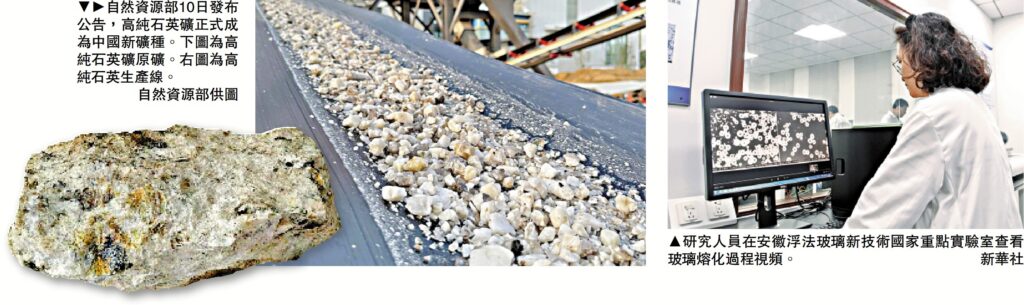
Left: The Ministry of Natural Resources announced on the 10th that high-purity quartz ore has officially become a new mineral species in China. Below: Raw high-purity quartz ore. Right: High-purity quartz production line. / Photo courtesy of the Ministry of Natural Resources; Right: Researchers at the Anhui State Key Laboratory of Float Glass New Technology observe the glass melting process video. / Xinhua
A new round of mineral exploration has 'struck gold.' The Ministry of Natural Resources announced on the 10th that, with State Council approval, high-purity quartz ore has officially become a new mineral species in China, marking the country's 174th mineral species.
Experts point out that high-purity quartz ore features high-temperature resistance, corrosion resistance, low thermal expansion, high insulation, and light transmittance, with a silicon dioxide purity of no less than 99.995%. It is an indispensable key basic material for strategic emerging industries such as semiconductors and photovoltaics. China, which once heavily relied on imports of high-purity quartz ore, faced a true 'bottleneck' in mineral resources. The emergence of this new mineral species will change the previous situation of high import dependence, helping to cultivate new quality productive forces and promote the high-quality development of related strategic emerging industries. / Dazhong News reporter Wang Jue reports from Beijing
Listed as a New Mineral Species in China, Boosting Industrialization of Local Resources
Quartz, primarily composed of silicon dioxide, is ubiquitous around us. River sand, pebbles on beaches, sand used in home decoration, quartz countertops in kitchens, and crystals used in jewelry are all quartz. However, in nature, high-purity quartz ore is extremely rare, making it a super 'silicon' family member.
The Ministry of Natural Resources stated that the newly established mineral species, called high-purity quartz ore, refers to rock that, after beneficiation and purification, can achieve a silicon dioxide purity of no less than 99.995%, with impurity and inclusion content meeting the application requirements of high-tech fields such as semiconductors and photovoltaics.
The U.S. Once Supplied Over 90% of the World’s High-Purity Quartz Sand
In recent years, through a new round of strategic mineral exploration breakthroughs, China has discovered multiple high-purity quartz deposits in areas such as East Qinling in Henan and Altay in Xinjiang. Numerous enterprises and research institutions across the country have conducted technical research, successfully obtaining pilot products with a purity of 99.995% (4N5 grade) or higher, with some samples reaching 99.998% (4N8 grade). Significant breakthroughs have been made in high-purity quartz ore survey evaluation, resource exploration, deep purification, and targeted impurity removal, marking a key step in advancing the industrialization of domestic resources for producing high-purity quartz sand.
According to reports, as a globally scarce strategic resource, high-purity quartz ore features high-temperature resistance, corrosion resistance, low thermal expansion, high insulation, and light transmittance. It is an indispensable key basic material for strategic emerging industries such as semiconductors and photovoltaics. Currently, global high-purity quartz mines are mainly distributed in the United States, Russia, Norway, and Australia. Data shows that the Spruce Pine mine in North Carolina, USA, once supplied over 90% of the world's semiconductor-grade high-purity quartz sand. China, which once heavily relied on imports of high-purity quartz ore, faced a true 'bottleneck' in mineral resources.
Mining expert and academician of the Chinese Academy of Engineering, Mao Jingwen, stated that the establishment of the new mineral species will help promote the high-quality development of related strategic emerging industries and will have a positive impact on cultivating and developing new quality productive forces, as well as enhancing the resilience and security level of industrial and supply chains.
Engineering Technology Innovation Center for Development and Utilization to Be Established
Huang Xuexiong, Director of the Department of Mineral Resources Protection and Supervision at the Ministry of Natural Resources, stated that as a key basic material for strategic emerging industries, high-purity quartz ore will primarily be included in the strategic mineral resources catalog. An engineering technology innovation center for the development and utilization of high-purity quartz resources will be established, focusing on scientific research in metallogenic theory and exploration evaluation technology, as well as separation and purification technology. A nationwide resource survey and evaluation will be coordinated, key exploration projects will be deployed, and reserves of high-purity quartz ore will be identified to enhance China's domestic resource security.
The Ministry of Natural Resources also introduced that a series of significant results have been achieved in China's new round of strategic mineral exploration breakthroughs. In addition to the newly established high-purity quartz ore, major breakthroughs have been made in the exploration of bulk metals such as copper, aluminum, and iron, which will effectively alleviate resource shortage pressures and reduce dependence on imported minerals, providing solid resource support for the strategy of building a manufacturing powerhouse. At the same time, significant breakthroughs have also been made in the exploration of strategic emerging minerals such as lithium, zirconium, hafnium, helium, and rare earths. In Hainan, Guangxi, and other regions, new zirconium resources of 85,000 tons and hafnium resources exceeding 1,000 tons have been added, providing strong resource security for the industrial and supply chains of China's new energy, new materials, and other emerging industries.
Source: Read the original article | Published: April 11, 2025