This editor’s note highlights the key facts and market implications behind “What is Plastic? Can Recycling Solve Problems Li”, with emphasis on sourcing, product fit, fabrication, logistics, or buyer impact.
"To create a society that uses as little plastic as possible, the EU and others should strengthen their policies further," appeal representatives of the European NGO network "Rethink Plastic" in Brussels, Belgium.
Light and durable, plastic has supported our lives. However, behind mass production and disposability, concerns are growing about ocean pollution and impacts on human health. We investigated the reality of EU regulatory tightening and recycling. Plastics, made from crude oil, come in a wide variety. Celluloid, invented in the mid-19th century and used for toys, is considered its beginning, with full-scale production taking off alongside industrialization in the 20th century. Easy to process, durable, light, and non-conductive, their hardness and heat resistance vary by material. There are said to be over 100 types for general purposes alone.
Tackling the World’s Plastic Waste with Recycling
On the other hand, plastic easily becomes waste through littering. According to a US university study, cumulative plastic production from 1950 to 2015 was 8.3 billion tonnes, with 6.3 billion tonnes discarded. Photos of plastic pieces found in large fish stomachs or straws piercing sea turtles have caused shock.
Even when broken into small pieces, plastic is difficult for microorganisms to decompose in nature, so large amounts become "microplastics" (under 5mm in diameter) drifting in oceans and the atmosphere. While health impacts are still under study, it is known to accumulate in the human body through eating fish and breathing.
The spark for plastic recycling was lit by the UK NGO Ellen MacArthur Foundation. It released a report at the World Economic Forum in Davos in January 2016. It pointed out that while 6% of crude oil use in 2014 was for plastic production, if usage increases at the current pace, it will account for 20% by 2050, and the weight of plastic in the ocean will exceed that of fish. It advocated for stopping single-use plastic, reducing new production, and realizing a circular economy through repeated regeneration. The UN and countries worldwide responded, beginning to consider countermeasures, but the EU is taking the lead. In 2019, the EU passed a bill banning the sale of single-use plastic items like spoons, plates, and straws. In December two years ago, it agreed to set a target recycling rate for plastic containers at 55% by 2030 and to reduce per capita packaging waste by 5% compared to 2018.
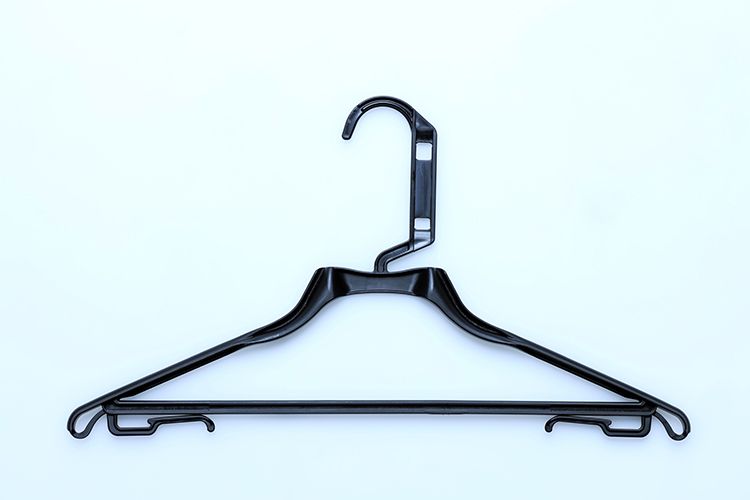
Plastic hangers – photographed by Satoshi Sekiguchi on February 12, 2026. The EU's next challenge is using recycled plastic for auto parts, which weigh an estimated 150-200 kg per standard car. This is a sector with high plastic use, alongside packaging and construction materials. The agreement reached last December stipulates that within 6 years of implementation, 15% of new car parts must be made from recycled plastic, with 20% of that sourced from scrapped car parts. However, the path of plastic recycling is not easy. According to Keisuke Yoshinuma, a research fellow at the JETRO Brussels Office, against the EU's target recycling rate of 50% by 2025, only 8 out of 27 member states are expected to achieve it by 2024 – a minority including Germany and the Netherlands.
Rose Ní Chléirigh (33), one of the representatives of the European NGO network "Rethink Plastic," which advocates for plastic policy from its base in Belgium, states:
“Although efforts in recycling have progressed thanks to the Ellen MacArthur Foundation, EU policies are lukewarm, and we also see corporate greenwashing without substance. We are far from reduction, and policies need to be strengthened more.”
PET Bottle Frenzy
"Coca-Cola Shock." This was whispered among recyclers in December 2024. The global beverage company Coca-Cola lowered its voluntary target of "50% recycled material in packaging like PET bottles by 2030" to "35-40% by 2035." While the policy of increasing recycling remains unchanged, it dampened industry expectations of "rapidly growing demand."
Additionally, in Europe, the cost of recycled plastic remains high, while the price of crude oil, the raw material for new plastic, had been stable until the beginning of this year. An insider estimates, "For PET bottles, the recent transaction price for recycled resin is about €1,700 per tonne, while new material is €1,100." Consequently, last year saw a series of bankruptcies and closures among recycling businesses.
PET bottles – photographed by Satoshi Sekiguchi on February 12, 2026.
Originally, PET bottles are made from a single material, polyethylene terephthalate (PET), and are considered "the most recyclable plastic" worldwide. Particularly in Japan, the habit of rinsing contents at home and sorting them as if new helps reduce the labor and cost of recycling.
Japan's PET bottles are called "recycling honor students." According to the Council for PET Bottle Recycling, annual domestic consumption exceeds 25 billion bottles. Recently, the proportion of "bottle-to-bottle" or "horizontal recycling," where used bottles are crushed, washed, turned into resin, and made back into bottles, has surged rapidly. As a result, the recycling rate reached 85.1% in FY2024, significantly higher than Europe's 42.7% and the US's 19.6% (both 2021).
Plastic waste other than PET bottles has high processing costs. Under the Container and Packaging Recycling Law, recycling businesses that collect and reprocess it receive financial subsidies. On the other hand, used PET bottles, depending on collection location and cleanliness, are often "commodities" that recyclers want to acquire as raw material. This is the background to the high recycling rate.
Japanese beverage makers also set voluntary targets. The All Japan Soft Drink Association declared in 2018, "By 2030, we will use recycled PET in half of the PET bottles we use." Responding to rising demand, there was even a situation resembling a "scramble" where beverage makers directly contracted with local municipalities collecting waste to buy used PET bottles. However, after the Coca-Cola Shock, a domestic recycler confides, "That is also calming down."