
Editor's Note
This editor’s note highlights the key facts and market implications behind “Dealing with Volatile US Tariffs, Greater Bay Ar”, with emphasis on sourcing, product fit, fabrication, logistics, or buyer impact.
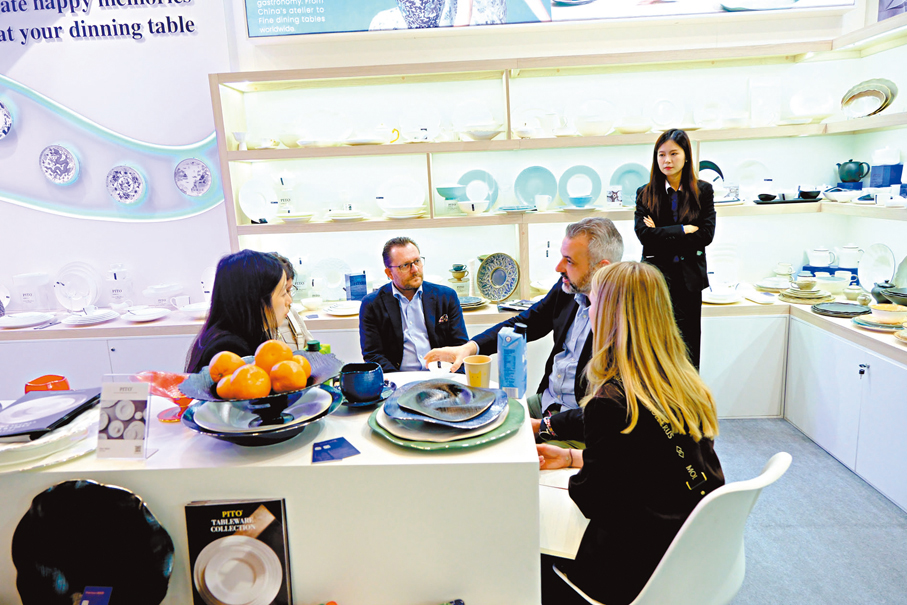
In the just-concluded Frankfurt International Spring Consumer Goods Fair, Pai Ceramics' products were favored by European and American customers. (Hong Kong Wen Wei Po Guangzhou fax)
HONG KONG WEN WEI PO (Reporters Ao Minhui, Li Changhong, Guangzhou and Shenzhen joint report) The U.S. Supreme Court ruled that Trump's tariff measures were illegal, and Trump immediately signed a proclamation imposing a 10% import tariff on the world. In the past 24 hours, the U.S. tariff policy has taken a sharp turn, affecting international political and economic changes. In China, foreign trade enterprises are both monitoring information and preparing for the start of production according to their established pace. Companies in the Greater Bay Area, in interviews with Hong Kong Wen Wei Po, pointed out that past experiences have taught them that relevant policies are highly uncertain. "We need to innovate, innovate in products, so that overseas markets truly recognize Chinese innovation and trust Chinese manufacturing."
At the just-concluded Frankfurt International Spring Consumer Goods Fair, Guangdong Pai Ceramics Co., Ltd. (hereinafter referred to as "Pai Ceramics"), which engages in the R&D, production, and sales of high-end craft ceramics and hotel tableware, received high recognition from international customers for its independently innovative products. Xu Ruisheng, General Manager of Pai Ceramics, told Hong Kong Wen Wei Po reporters that the company brought its design team to the exhibition, and the multiple innovative design products launched received extremely high praise from customers. Many customers returned multiple times during the exhibition to discuss cooperation.
"Our products have a strong sense of design. For example, the relief patterns on porcelain make the products appear light, high-end, and grand," Xu Ruisheng said. He noted that customers found that Chinese ceramics can completely become a substitute for European high-end ceramics, with higher cost performance. In recent years, Pai Ceramics has adhered to a path of branding and original design, breaking away from the traditional model of pure manufacturing. This has given the company stronger bargaining power and market resilience when facing various trade barriers.
Xu Ruisheng stated that in the face of a recent series of trade barriers, the company is fully prepared to meet challenges through independent innovation and branding strategies, letting the market, not tariffs, determine the company's future. Xu Ruisheng revealed that Pai Ceramics has few customers in the United States, and the company has long stopped considering the U.S. as a core market. In response to tariff increases, the company's main strategy is to negotiate price increases for exported products with customers and jointly reduce costs, rather than passively bearing the impact.
Xu Ruisheng believes that to open up the high-end customer market, it is necessary to persist in a brand route. "There are too many substitutes for low-end products. Only by taking the branding path can we form customer stickiness." He revealed that Pai Ceramics' overseas sales grew by 15% last year, and more importantly, the proportion of high-end customers increased significantly. To enhance brand influence, Pai Ceramics has cooperated with cultural enterprises such as the Palace Museum to promote the integration of Chinese and Western cultures, using cultural empowerment to increase product added value, giving Chinese ceramics a unique identity in the international market.
Accelerating the Layout of Diversified Global Markets
Faced with intensified barriers in European and American markets, Pai Ceramics is accelerating its layout of diversified global markets. Xu Ruisheng said that this year, the company will focus on developing regions such as Southeast Asia, the Middle East, and Central Asia, while not giving up on the European and American markets. Recently, the company established a European warehouse in Italy to serve as a strategic fulcrum for responding to the external environment.
Xu Ruisheng confidently stated that the company's production capacity and survival space are large enough. "The more difficult it is, the more we must strive. The expansion of the high-end customer market is actually an opportunity for us." Xu Ruisheng said that Pai Ceramics aims to achieve a 30% growth target this year, and the company will unswervingly follow the path of independent innovation, letting the market, not the tariff stick, determine the company's long-term development.
Intelligent Production Improves Efficiency and Reduces Costs
Hu Shimin, Chairman of Shenzhen Mingxin Packaging Co., Ltd., a Hong Kong-invested enterprise engaged in the production and export of fresh flower packaging bags, told Hong Kong Wen Wei Po reporters that this year the company plans to increase automation in its Shenzhen factory, promote transformation and upgrading, improve production efficiency, and reduce costs. At the same time, it is preparing to activate a 10,000-square-meter factory in Huizhou, purchasing automated equipment for production, using intelligent production to improve efficiency and better develop the market. Currently, the company's exports to the U.S. account for about 50% of its business, with Europe, Japan, and Australia accounting for the other 50%.
Source: Read the original article | Published: February 22, 2026