
Editor's Note
This editor’s note highlights the key facts and market implications behind “Designing for Health: How Interior Designers Can”, with emphasis on sourcing, product fit, fabrication, logistics, or buyer impact.
While many designers now specify low-VOC paints, Sternfeld emphasizes that material health goes far deeper than surface finishes. In her work, she evaluates entire assemblies—from adhesives and insulation to cabinetry cores and upholstery foams—because these components continue emitting chemicals long after installation.
“Some of the most significant sources of off-gassing are the ones clients never see,” she says. “Flooring adhesives, tile mastics, insulation, cabinet interiors, and upholstered furniture cores can emit chemicals for years after installation.”
“A low-VOC finish doesn’t tell the full story if what’s underneath carries a heavier chemical load. Designers need to look beyond surface specifications and consider how materials are made, what binds them together, and what is being permanently sealed into the home.”
From air and water quality to materials and lighting, WELL-certified designer Lisa Sternfeld explains how designers and architects can embed health into residential projects—starting at the earliest stages of design and construction.
Five Best Practices for Designers and Architects:
Treat wellness as infrastructure, not an upgrade: Address air, water, materials, and spatial comfort during schematic design—not after construction—so health outcomes are built into the project’s core systems.
Design for clean air first: Specify balanced whole-house ventilation (ERVs/HRVs) and low-emission materials so portable air purifiers become supplemental rather than essential.
Look beyond finishes to full assemblies: Evaluate insulation, adhesives, cabinetry substrates, flooring systems, and furniture cores for long-term chemical exposure—not just paint and sealants.
Integrate water filtration early: Use whole-house carbon filtration for bathing and steam exposure, paired with under-sink systems for drinking and cooking, for high impact without major complexity.
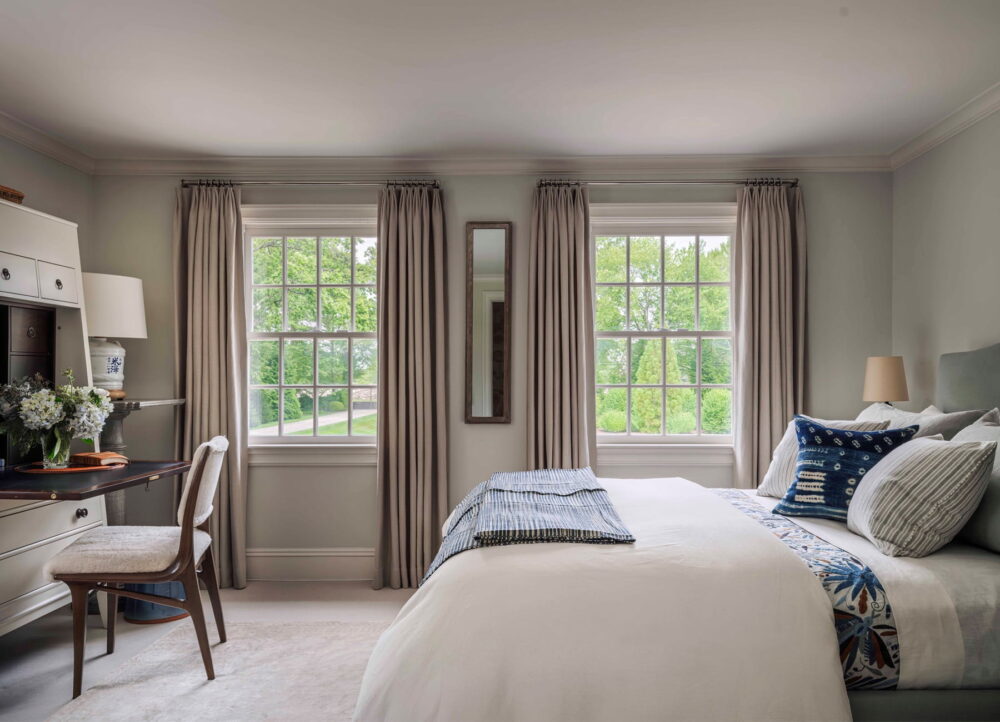
Design bedrooms for restoration: Prioritize clean air, natural materials, warm low-level lighting, acoustic comfort, and thermal stability to support sleep and nervous system recovery.
For decades, wellness in residential design has been framed as an upgrade: an air purifier added after move-in, a water filter tucked under the sink, a few plants to “soften” the space. But according to Lisa Sternfeld, founder of the home-wellness platform WLLW and a WELL Accredited Professional, this mindset misses where real impact happens.
“Wellness needs to be treated as infrastructure rather than something added later,” Sternfeld says. “When priorities are aligned early, and communication is clear across disciplines, health-forward decisions are far more likely to hold through completion.”
As more clients prioritize longevity, resilience, and quality of life at home, interior designers and architects are increasingly expected to understand how buildings influence sleep, respiratory health, stress levels, and recovery, not just aesthetics. Sternfeld’s work bridges design, environmental health, and building science, offering a framework for embedding wellness directly into the bones of residential projects.
Here, she outlines three core areas where design professionals can make the biggest difference and why these decisions must happen early to be meaningful.
Wellness as Infrastructure: Why Early Design Decisions Matter
The most consequential wellness decisions, Sternfeld explains, are often the ones clients never see: ventilation strategies, wall assemblies, plumbing layouts, insulation choices, and spatial organization. Once construction is complete, these elements are either impossible or prohibitively expensive to change; yet, they quietly shape how a home performs for decades.
“The earliest and most consequential decisions come down to alignment and a shared language around health across architects, engineers, designers, contractors, and the trades,” Sternfeld says. “When that alignment exists early, health can be embedded into the structure of a project rather than addressed after the fact.”
She notes that responsibility for wellness outcomes is often fragmented across disciplines, which makes health priorities vulnerable to value engineering and substitutions during construction. A designer may specify low-toxicity finishes, for example, only to have insulation, adhesives, or cabinetry substrates swapped for cheaper alternatives with higher emissions.
“In practice, this shows up in decisions that are largely invisible once a home is complete,” she adds. “How air moves through a space, how water is treated and distributed, what materials are sealed inside walls and floors, and how spaces are laid out to support daily life.”
For designers and architects, this means reframing wellness as a systems-level issue, not a decorative layer. Mechanical design, envelope assemblies, room adjacencies, and daylighting strategies should all be considered through a health lens at schematic design, not after construction documents are complete.
Frameworks like WELL can help teams align early, Sternfeld says, even if certification is not pursued.
“They provide a shared reference point,” she explains, “so health is treated as a core performance goal rather than a secondary aesthetic preference.”
Air, Water, and Materials: Reducing Invisible Exposure
Spray foam insulation, synthetic carpet systems, rug pads, and flame-retardant-treated furnishings are particularly concerning, she notes.
Air quality, in particular, should be addressed structurally rather than with reactive solutions like portable purifiers.
Source: Read the original article | Published: February 23, 2026