
Editor's Note
This editor’s note highlights the key facts and market implications behind “Engineered Stone Market Size, Share, and Industr”, with emphasis on sourcing, product fit, fabrication, logistics, or buyer impact.
Key Market Players
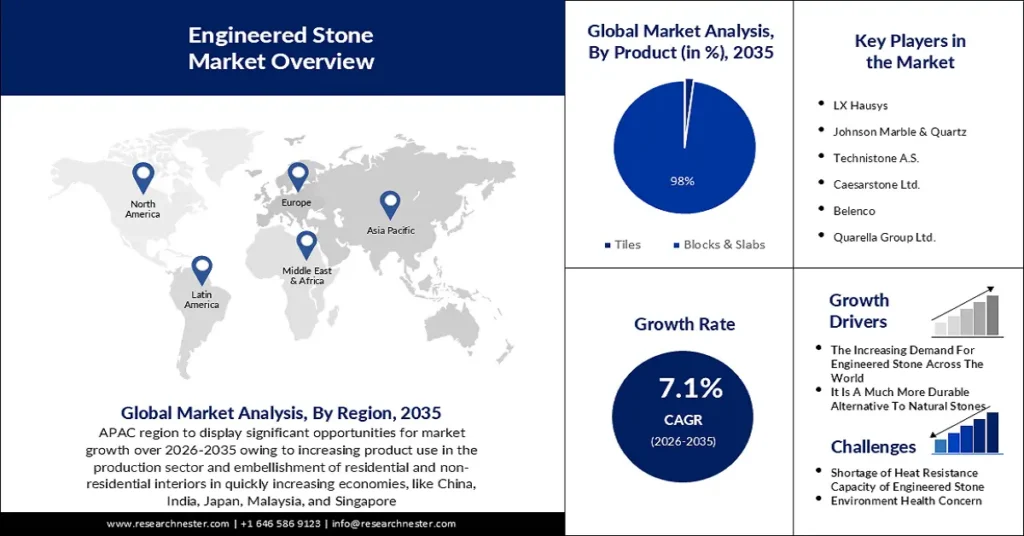
Key players in the market include LX Hausys, Johnson Marble & Quartz, Technistone A.S., Caesarstone Ltd., Belenco, Quarella Group Ltd., Quartzforms, Stone Italiana S.p.A., Cosentino S.A., VICOSTONE, Shimizugumi Sekizai Industry Co., Ltd., Yoshida Stone Industry Co., Ltd., Tosoh Quartz Corporation, and Taketo Shoten Co., Ltd.
Engineered Stone Market Outlook
The engineered stone market size surpassed USD 28.01 billion in 2025 and is expected to exceed USD 55.62 billion by 2035. It is projected to grow at a CAGR of over 7.1% from 2026 to 2035. The engineered stone industry size is estimated to be USD 29.8 billion in 2026. The primary reason for the growth of the engineered stone market is the increasing global demand for engineered stone. For example, quartz is one of the most abundant minerals on Earth. The quartz stone market, commonly known as the engineered stone market, is growing rapidly. Quartz slabs are made by combining approximately 90% crushed natural quartz with 10% polyresin, though these ratios can vary somewhat by quartz brand. Another reason expected to drive the engineered stone market during the forecast period is its significantly superior durability compared to natural stone. For instance, quartz is less likely to crack and is flexible for easy installation. Composed of an amalgam of 93% quartz and 7% resin, it is more durable than natural stones like granite or marble. In terms of durability, natural stone has rock-like characteristics. It is prone to staining if liquids are spilled, whereas resin-infused quartz is naturally water-resistant. Liquids spilled on natural stone must be removed promptly to prevent long-term damage. Quartz can be wiped clean with a sponge or water, requiring no maintenance cost. It also does not require sealing. In contrast, natural stone requires sealing every 1-2 years. Furthermore, quartz can be advantageous in terms of maintenance. Quartz is a non-porous material unaffected by acids from juice, coffee stains, or soot. It is highly durable and resistant to scratches. However, this does not mean quartz countertops are heat-resistant.
Key Engineered Stone Market Insights Summary
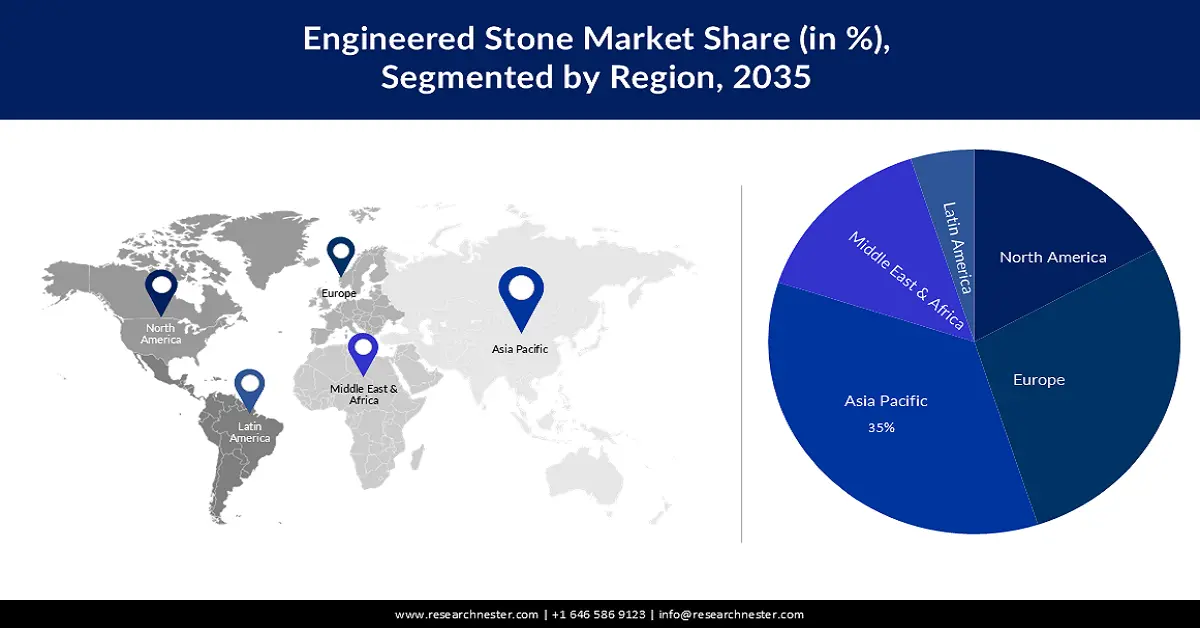
Regional Highlights The Asia-Pacific engineered stone market is expected to hold over a 35% share by 2035, driven by increased product usage in the construction and decoration of residential and non-residential interiors in rapidly growing economies. The European market is expected to see significant growth during the forecast period, fueled by strengthened mining regulations and policies to enhance the extraction and supply of essential raw materials for green and digital transitions. Segment Insights The block & slab segment of the engineered stone market is expected to hold a 98% market share by 2035, due to cost-effectiveness, easy installation, and suitability for kitchen applications. The countertop segment of the engineered stone market is expected to hold a 79% market share by 2035, due to its stain-resistant properties and lower cost compared to natural stone countertops. Key Growth Trends Increasing demand for visually appealing countertops. Expanding urbanization and rising investment in residential real estate. Key Challenges Lack of heat resistance in engineered stone. Environmental health concerns.
Global Engineered Stone Market Forecast and Regional Outlook
Market Size and Growth Forecast Market Size in 2025: USD 28.01 Billion Market Size in 2026: USD 29.8 Billion Projected Market Size: USD 55.62 Billion by 2035 Growth Forecast: 7.1% CAGR (2026-2035) Key Regional Dynamics Largest Region: Asia-Pacific (35% share by 2035) Fastest-growing Region: Asia-Pacific Key Countries: United States, China, Germany, Japan, Italy Emerging Countries: China, India, Japan, South Korea, Thailand
Engineered Stone Market Growth Drivers and Challenges
Growth Drivers Increasing demand for visually captivating countertops – One of the fascinating prospects of quartz is its colorful hues and patterns. These variations occur due to impurities present during its formation. For example, amethyst quartz appears purple due to traces of iron, while rose quartz appears pink due to titanium or manganese contaminants. This natural beauty makes quartz an attractive choice for architectural decoration. Quartz is an excellent choice for architects seeking diverse structural options. It can be styled in various ways to suit different architectural priorities. An architect can choose a timeless white for a sleek and elegant feel, or opt for vibrant, bold colors to create a captivating focal point. Furthermore, quartz can replicate the intricate veining patterns seen in natural stones like marble or granite, creating a luxurious ambiance without the separate maintenance. Expanding urbanization and rising investment in residential real estate – The impact of population growth on housing market expansion in developing economies is generally attributed to growth drivers in rural areas and the allure of cities. Urban populations are continuously increasing, which influences housing market expansion, despite high unemployment rates. Moreover, urbanization has spurred significant growth in both commercial and residential real estate sectors, leading to the construction of high-rise buildings, shopping malls, hotels, and other properties. Keeping pace with the rising demand for housing and commercial spaces, real estate developers have been actively investing in urban areas. Growing interest in eco-friendly building materials – The importance of renewable building materials in green construction hinges on their ability to enhance energy efficiency, reduce waste, and lower carbon emissions. By prioritizing the use of renewable building materials, green energy and green buildings not only offer a more sustainable future but also promote a shift towards heightened ecological awareness across the industry. International certifications like LEED (Leadership in Energy and Environmental Design) and domestic certifications like GRIHA (Green Rating for Integrated Habitat Assessment) are in high demand because they plan, produce, function, and manage cost- and resource-efficient, high-performing, and safe structures. Challenges Lack of heat resistance in engineered stone – Quartz countertops are artificially manufactured stone countertops made by mixing approximately 90% crushed quartz (a natural hard mineral) with 8-10% resin, polymers, and pigments under intense heat and pressure to form a solid slab. This stone forms an elaborate surface like granite but requires less maintenance. While quartz does not burn with very little heat, its surface should not be exposed to excessive heat. Quartz is an engineered stone manufactured by mixing about 90% crushed natural quartz with about 10% polyresin. Placing hot objects like hot pans or pots on a quartz countertop can cause severe damage. Placing very hot objects on a quartz countertop can cause burn marks and discoloration on the surface. This is because high heat melts the resin used on the surface. Environmental health concerns Cost and lack of awareness
Engineered Stone Market Size and Forecast
Report Attributes Details Base Year: 2025 Forecast Period: 2026-2035 CAGR: 7.1% Market Size in Base Year (2025): USD 28.01 Billion Market Size in Forecast Year (2035): USD 55.62 Billion Regional Coverage: North America (U.S. and Canada), Asia-Pacific (Japan, China, India, Indonesia, Malaysia, Australia, South Korea, Rest of Asia-Pacific), Europe (U.K., Germany, France, Italy, Spain, Russia, Nordic, Rest of Europe), Latin America (Mexico, Argentina, Brazil, Rest of Latin America), Middle East and Africa (Israel, GCC, North Africa, South Africa, Rest of Middle East and Africa)
Engineered Stone Market Segmentation
Product Segment Analysis The block & slab segment of the engineered stone market is expected to witness the largest growth during the forecast period and hold the largest share of 98% by the end of 2035. This dominance can be attributed to hassle-free installation, easy maintenance properties, and cost-effectiveness. Standard density concrete slabs are primarily 4-inch or 6-inch density but can be adjusted and controlled based on project requirements. Density is crucial in determining the final cost of a project. The thicker the slab, the more expensive it is. For example, a 4-inch slab can be USD 0.50 to USD 1 cheaper than a 6-inch slab. Unlike natural stone, it is suitable for kitchens as it is much less prone to stains from common food items like oil, wine, and juice. Engineered blocks and slabs can be manufactured in large sizes and are impermeable, making them usable in wet spaces like bathrooms, swimming pools, shower stalls, and bathtubs. Demand is expected to increase further in the future due to the rising need for beautiful countertops to enhance the appearance of interior decor. Application Segment Analysis The countertop segment of the engineered stone market is expected to witness the largest growth, recording an overwhelming revenue share of 79% by the end of 2035. This demand is due to the product's stain-resistant nature. Additionally, the price of quartz countertops ranges from USD 45 to USD 200 per square foot, varying based on factors like grade, color choice, and edge treatment. Engineered stone slabs are relatively cheaper than natural stone and offer a wider selection in terms of shape, design, color, and texture. Engineered stone is composed of polymer resins that are not resistant to UV rays, causing discoloration of the stone and cracking of the resin binder. An in-depth analysis of the global engineered stone market includes the following segments: Type: Engineered Quartz, Polymer Concrete, Engineered Marble Application: Flooring, Countertops, Wall Cladding, Customized Items Product: Tiles, Blocks & Slabs End-Use Industry: Residential, Commercial, Infrastructure
APAC Market Insights
The engineered stone market in the Asia-Pacific region is expected to lead in revenue generation and hold the largest profit share of 35% by the end of 2035. This is due to the increasing use of products in the construction and decoration of residential and non-residential interiors in rapidly growing economies like China, India, Japan, Malaysia, and Singapore. The Chinese government plans to invest CNY 92.4 trillion (USD 13.7 trillion) in green power transition by 2060. As part of this plan, the Chinese government aims to achieve net-zero greenhouse gas emissions by 2060. It also plans to source 33% of its electricity from sustainable energy sources by 2025. Infrastructure investment is an essential policy tool for the Chinese government to cope with economic crises or recessions, but it comes at a cost.
Europe Market Insights
Source: Read the original article | Published: September 16, 2025