
Editor's Note
This editor’s note highlights the key facts and market implications behind “Plastic Waste and Recycling in the EU: Numbers a”, with emphasis on sourcing, product fit, fabrication, logistics, or buyer impact.
The low recycling rate for plastic in the EU leads to significant losses for the economy and the environment.
Problems with Plastic Recycling
The main problem hindering plastic recycling is the quality and price of recycled products compared to brand-new ones. Companies that process plastic need a large quantity of recycled plastic, production must meet very strict control specifications, and the price must remain competitive.
Plastic Waste and Recycling in the EU: Numbers and Facts
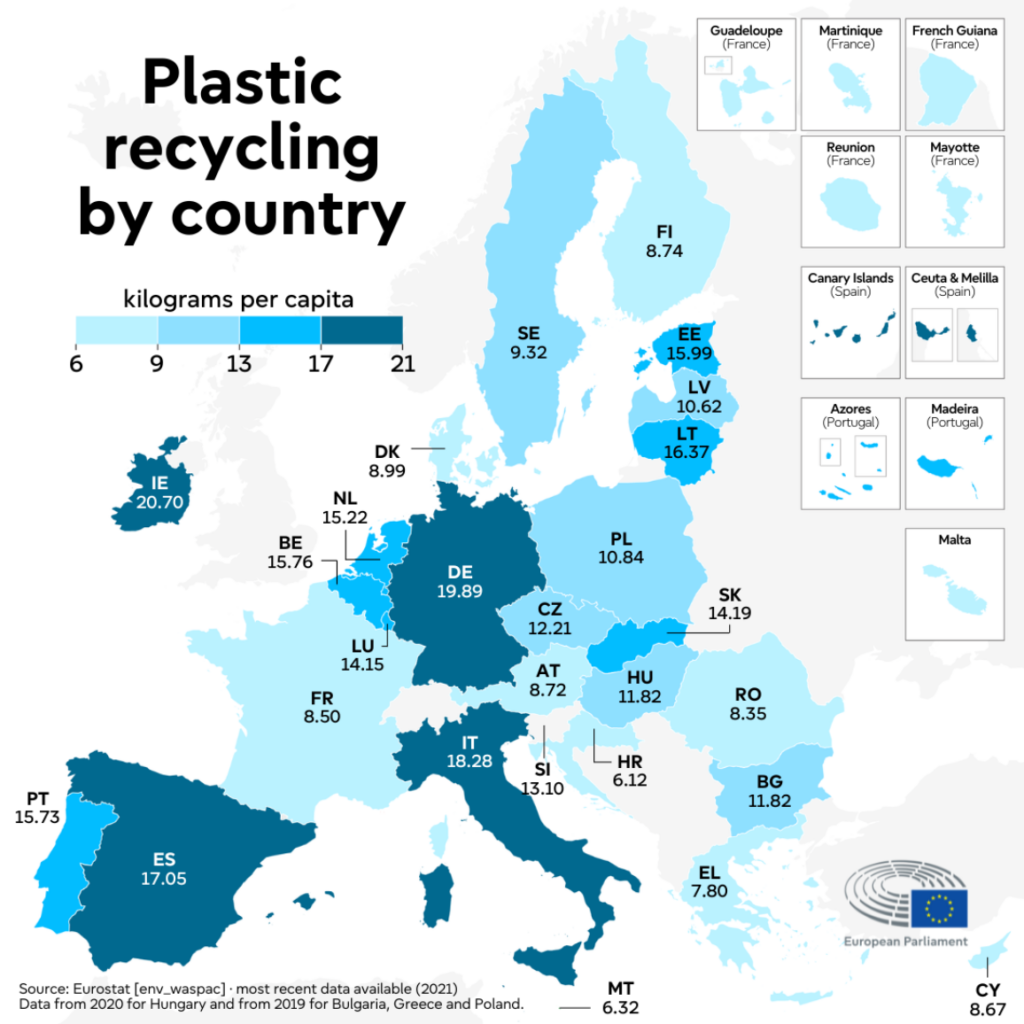
EU countries are making progress in plastic recycling, but waste generation continues to increase. There is still a long way to go. In 2021, each person residing in the EU generated an average of 36.1 kg of plastic packaging waste. The volume of plastic packaging waste generated per capita increased by about 8 kg per person between 2012 and 2022.

In 2022, the total plastic waste produced in the EU was 16 million tonnes. In the same period, 6.58 million tonnes of plastic waste were recycled, equivalent to 40.7% of the total.
Recycling of Plastic Waste in Europe
In Europe, the most used method for disposing of plastic waste is recycling (40.7%). The second most used method for treating plastic waste is energy recovery (35%), which involves converting plastic waste into heat, electricity, or usable fuel through incineration or other processes. The recycling rate for plastic packaging waste has steadily increased over the years, rising from 25.2% in 2005 to 40.7% in 2022. About 1.3 million tonnes of plastic collected for recycling was exported to be treated in countries outside the EU in 2023. Reasons for export include a lack of capacity, technology, or financial resources to treat waste locally. In the past, a large portion of plastic waste was shipped to China, but recent Chinese restrictions on plastic waste imports have caused EU exports to this country to plummet. The EU is seeking new ways to manage plastic waste in an environmentally friendly manner and in line with the circular economy.

Every year, between 19 and 23 million tonnes of plastic end up in soil, rivers, and oceans. This has a negative impact on ecosystems and directly affects people's livelihoods, food production capacity, and social well-being. In 2019, plastic generated 1.8 billion tonnes of greenhouse gas (GHG) emissions – 3.4% of global emissions – a large part of these emissions come from the production and conversion of fossil fuels. It is estimated that by 2060, emissions from the plastic lifecycle are set to triple. According to the European Environment Agency (EEA), in the European Union alone, the plastic value chain produced 193 million tonnes of CO2 emissions, more than the annual emissions of Belgium (123 million tonnes in 2019). Most emissions come from plastic production (63%), while processing into products accounts for 22% and end-of-life plastic waste treatment another 15% (mainly due to incineration). However, because plastics are easily customizable to the functional or aesthetic needs of each manufacturer, the diversity of raw materials complicates the recycling process, making it costly and affecting the quality of the final product. Consequently, demand for recycled plastic is growing rapidly. Plastic waste recycling rates in EU countries vary significantly: in 2022, the countries that recycled the most were Slovakia (59.6%), Belgium (54.2%), and Germany (51.1%), while the lowest rates were recorded in Malta (16.4%), Denmark (23.5%), and France (25.2%).
EU Solutions to Increase Recycling Rates

In June 2019, the EU approved new rules to address the issue of marine pollution from plastic, which includes a target of 25% recycled content in plastic bottles by 2025 and 30% by 2030. In April 2024, the European Parliament approved new measures to limit, reuse, and recycle plastic packaging in the EU. The rules stipulate that EU countries reduce total packaging waste per capita compared to 2018 by 5% by 2030; by 10% by 2035; and by 15% by 2040. There are also specific provisions for reducing plastic packaging waste. Some types of single-use plastic packaging will be banned from 1 January 2030. By 2029, 90% of single-use plastic and metal beverage containers (up to three liters) must be collected separately. In June 2019, the EU approved new rules to address the issue of marine plastic pollution. This includes a ban on certain single-use plastic items and the target of 25% recycled content in plastic bottles by 2025 and 30% by 2030. The European Parliament also supported the 2015 EU restriction on the use of lightweight plastic bags. MEPs have called on the European Commission to…
Source: Read the original article | Published: December 19, 2018