
Editor's Note
This editor’s note highlights the key facts and market implications behind “Countertop Specialist Pythagore Expands and Digi”, with emphasis on sourcing, product fit, fabrication, logistics, or buyer impact.
Pythagore, a designer and manufacturer of mineral-based kitchen countertops, is riding a strong growth wave fueled by lockdown trends. The Breton company is set to further expand its premises and digitize its production tools. Pythagore posted 40% revenue growth in 2021. Pythagore, a designer and manufacturer of mineral-based kitchen countertops, is riding an ever-expanding wave. With an average annual revenue increase of 10% over the past ten years, the company even achieved 40% growth in 2021, closing the fiscal year at €9 million. Based in Bon-Repos-sur-Blavet, Côtes-d'Armor, the 70-employee SME benefits from the enthusiasm for kitchens among private clients in Brittany and, more broadly, across the greater northwest quarter of France, which is its main market. Its clients are kitchen specialists, fitters, architects, and, for the past three years, real estate developers.
Nicolas Perrine, who bought the company eight years ago, explained: "This large-project activity, involving 100 kitchens for example, now represents 10% of our business and will continue to develop."
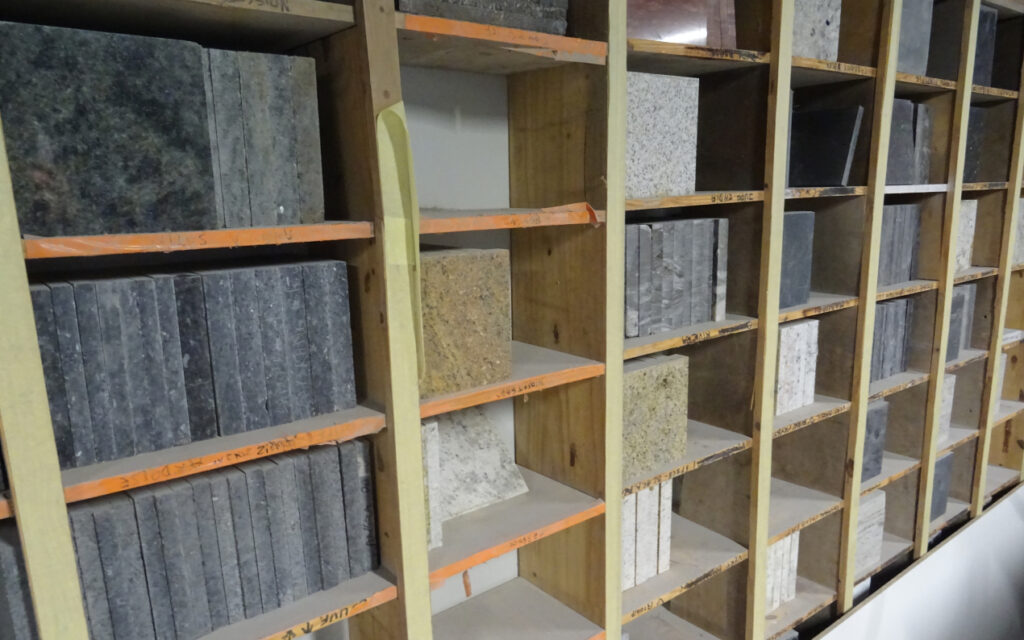
Pythagore specializes in mineral-based countertops: granite, marble, quartz, ceramic…

— Photo : Matthieu Leman
Within this new market for residences, aparthotels, etc., Pythagore operates across all of France and benefits from developers' desire to equip their kitchens with more durable materials than wood, offering a longer depreciation period. The Côtes-d'Armor company, which also works to a lesser extent on bathrooms, manufactures countertops in marble, granite, ceramic, quartz, reconstituted stone… sourced notably from Brazil, India, Norway, and Zimbabwe.
A €2 Million Extension
This growth naturally leads to an evolution of the company's production facility. Having already expanded by 1,500 m² in 2020, the manufacturing premises will now almost double in size, going from 3,700 m² to 6,700 m². The investment amounts to two million euros. On the machinery side, the budget is not yet finalized but is expected to be between €1 and €3 million, including at least three new cutting units. The company's CEO explained: "We are going to automate our process, which remains artisanal, by limiting product handling." The financial effort will also serve to implement digitalization tools, which will notably involve equipping each raw material entering the company with a barcode to track it through the production flow. Digitalization will also streamline the process by enabling better communication between the design office and the workshop. For example, layout (decoration) work can be prepared upstream, avoiding a loss of rhythm in production. The new facility is expected to be operational in the first half of 2023.
80 Employees by Year-End

— Photo : Matthieu Leman
This digitalization and automation work could not have been implemented without high-speed internet. Pythagore has come a long way in this area, as three years ago, when wanting to implement a new SaaS-based Enterprise Resource Planning (ERP) system, the SME realized its bandwidth was severely insufficient. After a year of searching, the solution came from the Finistère-based company Xankom, which developed a high-speed wireless system, supported by the Kreiz-Breizh Community of Municipalities (CCKB).
How far will the Côtes-d'Armor company go, already eyeing surrounding land for further development if needed? "There is real enthusiasm for kitchens, and major European players are investing heavily in their production capacities," observed Nicolas Perrine. "We are supported by the CCKB and the Brittany Region, who know we have grown from 22 employees eight years ago to 70 today." By the end of the year, the workforce will reach 80 employees.
He added: "The industrial adventure is interesting, and we appreciate upskilling many employees, but the reality is that we remain a family business, far from the European players posting €200 million in revenue."
Source: Read the original article | Published: April 29, 2022