
Editor's Note
This editor’s note highlights the key facts and market implications behind “Green Building Materials Market Size, Share, and”, with emphasis on sourcing, product fit, fabrication, logistics, or buyer impact.
Key Market Insights
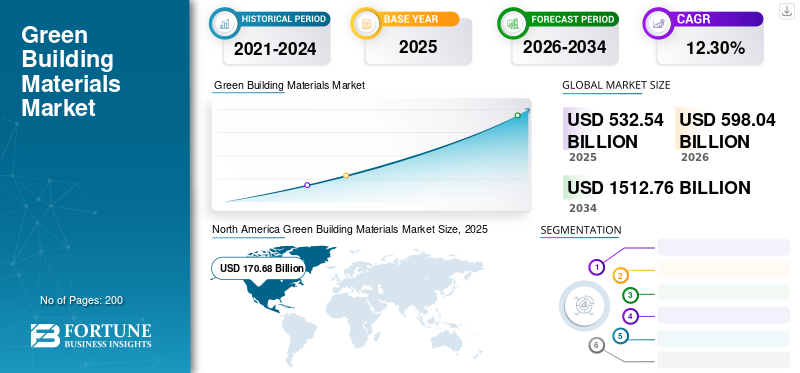
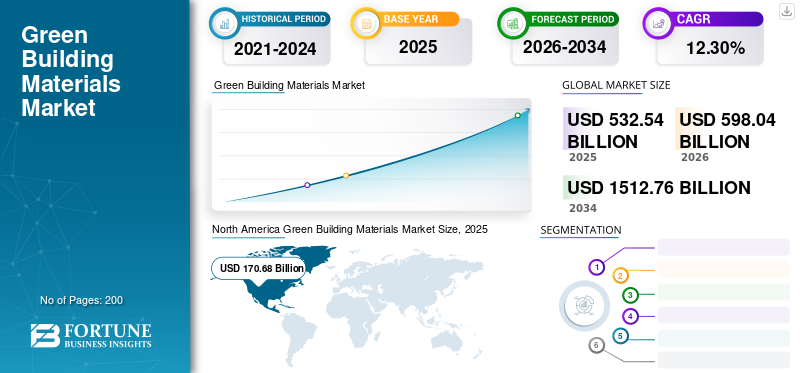
The global green building materials market size was valued at USD 532.54 billion in 2025 and is projected to grow from USD 598.04 billion in 2026 to USD 1,512.76 billion by 2034, exhibiting a CAGR of 12.30% during the forecast period. North America dominated the green building materials market with a share of 32.10% in 2025. Furthermore, the U.S. green building materials market size is projected to grow substantially to USD 289.5 billion by 2032, driven by increasing demand for roofing, insulation, framing, and various other residential, industrial, commercial, and infrastructure applications. Green buildings are being constructed using green building materials. The use of these materials helps conserve non-renewable resources, which are declining internationally. Integrating green materials into construction projects helps reduce the environmental impact associated with the extraction, transportation, manufacturing, processing, installation, recycling, reuse, and disposal of these raw materials. Due to these benefits, green building materials become the best alternative to conventionally used building materials. Furthermore, the growing preference for green building materials over traditional building materials will propel market growth. These materials offer the benefit of reducing carbon footprint, thereby reducing global warming. These materials are energy-efficient and eco-friendly, making them easy to maintain and cost-effective. Due to these benefits, they are chosen as ideal materials over conventional building materials. Moreover, the increasing demand for these materials is gaining popularity in several construction projects by reducing the environmental impact of building materials associated with manufacturing, installation, processing, transportation, recycling, and disposal. The growing preference for these materials over traditional building materials is expected to drive market growth. Additionally, governments in developed countries have implemented policies and incentives to promote green construction, which is expected to increase the demand for green building materials during the forecast period.
“Green building” is not just a concept that can save the world, but it can make our world safer, healthier, and more prosperous.
The COVID-19 pandemic in 2020 restricted the transportation of people and materials and severely impacted the supply chain of construction manufacturers. The global construction sector witnessed consequences such as shortages of construction materials, logistics issues, labor shortages, and uncertainty leading to the suspension or cancellation of construction activities. However, with the declining impact of the pandemic and government measures to normalize the economy, the construction industry stabilized over the years. Thus, the market witnessed an upward trend from 2021.
Global Green Building Materials Market Overview
Market Size & Forecast: Market Size 2025: USD 532.54 Billion Market Size 2026: USD 598.04 Billion Projected Market Size 2034: USD 1,512.76 Billion CAGR: 12.30% (2026-2034) Market Share: North America dominated with a 32.10% market share in 2025. The U.S. market is expected to reach USD 289.5 billion by 2032, driven by demand for roofing, insulation, framing, and residential, industrial, commercial, and infrastructure applications. Regional Insights: North America: Largest market in 2023, driven by demand for green roofing, insulation, framing, and government initiatives encouraging energy-efficient buildings. Asia Pacific: Fastest-growing market; growth due to residential & industrial construction, renovation, and extensive use of green materials such as galvanium panels and fiber cement composites. Europe: Significant growth expected, supported by plans such as the EU EPBD (Energy Performance of Buildings Directive) and stringent building regulations encouraging green materials. Latin America, Middle East & Africa: Moderate growth due to increased residential and commercial construction, driven by rising interest in environmentally efficient building practices.
Green Building Materials Market Trends
Increasing awareness and adoption of green building materials to boost market growth. Construction and building activities consume 3 billion tons of raw materials annually, accounting for 40% of global consumption. The use of sustainable building materials and products promotes the conservation of non-renewable resources, which are increasingly declining internationally. Furthermore, integrating sustainable building materials into construction and building projects can reduce the environmental impact of transporting, extracting, processing, installing, manufacturing, disposing, recycling, and reusing these raw materials for the construction industry supply. The increasing demand for these materials in building and construction activities is expected to drive market growth. The North America green building materials market grew from USD 120.84 billion in 2022 to USD 134.34 billion in 2023.
Green Building Materials Market Growth Drivers
Increasing Shift Toward Green Buildings to Drive the Market According to the International Energy Agency (IEA), in 2023, infrastructure operations accounted for 30% of global final energy consumption and 26% of global energy-related emissions. Of this, 8% was direct emissions from buildings, and 18% was indirect emissions from the production of heat and electricity used in buildings. The concept of sustainable construction involves including and integrating various approaches during the design, construction, and procedures of building projects. The use of green materials and products is one of the key strategies in building design. Green materials are primarily composed of renewable resources. These materials are environmentally responsible. Thus, using these substances helps reduce greenhouse gas emissions. Green building materials include timber, hempcrete, recycled plastic, ferrock, mycelium, straw bales, bamboo-reinforced earth, woodcrete, and grasscrete. The purpose of using these materials is to create energy-efficient structures that help maintain nature's ecological balance. These materials enhance the efficiency and sustainability of building structures during construction, design, renovation, and maintenance. These materials are highly energy-efficient and produced from renewable waste sources. Using green building materials can address various environmental issues such as freshwater resource pollution, air pollution, depletion of natural resources, loss of biodiversity, and abnormal climate change. Due to these advantages, green building materials become the best alternative to traditionally used building materials. The increasing demand for green buildings is expected to propel market growth during the forecast period. Green building is a field that applies resource-efficient and ecologically responsible procedures from site selection to construction, design, operation, service, deconstruction, and conversion of structures. The use of sustainable materials in constructing green buildings is increasing the demand for green building materials. For instance, according to an April 2022 report by CBRE India, a commercial real estate services and investment firm, green construction has gained significant attention over the past five years. During this period, the supply of green-certified buildings increased by 37%, reaching a certified stock of 78 million square feet. Thus, the increasing demand for green buildings propels market growth.
Restraining Factor
Price Volatility to Hinder Market Expansion Price volatility of materials due to availability and increasing demand from end-use industries is expected to restrain market growth. These materials are more expensive than conventional building materials. The cost can vary depending on several factors, such as finishes, accessories, and design. Using these materials involves a higher initial investment cost, which arises due to the long-term benefits of green buildings. Additionally, a decline in per capita income in some countries is expected to limit construction activities in the residential sector. This is expected to hinder product adoption in the construction industry.
Green Building Materials Market Segmentation Analysis
By Application Analysis Roofing segment leads due to increased product usage in construction. By application, the market is segmented into roofing, flooring, insulation, and others. Roofing is expected to remain the largest segment with a 41.23% share in 2026, owing to the increasing adoption of green roofing materials. Green roofs are gaining importance as a nature-based solution (NBS) to address several environmental and socio-economic issues related to climate change. Urban settlements account for 55% of the world's population and are expected to increase to 68% by 2050, raising interest in global development. Urban settlements comprise suburbs, cities, and towns. The sustainable development of urban settlements depends on the growth of cities. The new urban agenda and the 2030 Sustainable Development Goals support engagement in urban sustainability. The flooring segment is expected to witness significant growth during the forecast period. Green flooring is made using sustainable materials and sustainable processes that reduce demands on the ecosystem throughout their life cycle. This includes production, harvesting, use, and disposal. It is believed that green flooring creates healthier and safer buildings and ensures the future of traditional producers of renewable resources on which many communities depend. Additionally, green options often create a healthier environment for everyone who works or lives in a building. The insulation segment is expected to witness moderate growth during the forecast period, as it refers to energy-saving measures that provide resistance to heat flow. Naturally, heat flows from warm spaces to cool spaces through several surfaces of a building, such as ducts, walls, and roofs. Insulating a home reduces heat loss from the building in cold weather or climates and reduces excessive heat in warm weather or climates. By End-Use Industry Analysis Residential segment to dominate the market due to high adoption of green buildings. Based on end-use industry, the market is segmented into residential and non-residential. The residential segment is expected to dominate the market with a 65.10% share in 2026, owing to the increasing guidelines and building codes for energy-efficient construction. In the residential sector, there is a growing preference for green buildings. This has created a market for energy-efficient and eco-friendly building materials. The increasing awareness of the environmental benefits of sustainable building materials and the rising adoption of sustainable construction practices in the residential sector are key factors driving market growth in this segment. Additionally, the increasing demand for energy-efficient and eco-friendly homes and government regulations and initiatives promoting the use of green building materials in the residential sector are expected to drive the growth of the green building materials market.
Source: Read the original article | Published: March 23, 2026