
Editor's Note
This editor’s note highlights the key facts and market implications behind “In-depth Investigation Report on Jingdezhen ‘567”, with emphasis on sourcing, product fit, fabrication, logistics, or buyer impact.
Source: Hong Kong Commercial Daily 2025-11-25 20:03 Core Tip: The market warming of '567 Porcelain' (ceramic art and daily-use porcelain produced by Jingdezhen state-owned porcelain factories and the Ministry of Ceramics Research Institute from the 1950s to the 1990s, characterized by distinct era features, aesthetic qualities, and typical significance) is the result of the synergy between the '14th Five-Year Plan' cultural strategy and market demand. This report combines the achievements of the '14th Five-Year Plan' intangible cultural heritage protection and the guidance of the '15th Five-Year Plan' for building a culturally strong nation, analyzing its era characteristics, multidimensional value, and investment logic from four dimensions: policy, value, market, and risk control, providing professional reference for collectors and investors.
I. Policy Anchor: Value Awakening Driven by National Strategy
(I) '14th Five-Year Plan' Policy Empowerment: Upgrading from 'Old Objects' to 'Cultural Carriers' The value reassessment of '567 Porcelain' is not a mere market behavior but an inevitable result driven by the national cultural strategy. During the '14th Five-Year Plan' period, policies such as the '14th Five-Year Plan for Cultural Development' and 'Opinions on Further Strengthening the Protection of Intangible Cultural Heritage' were intensively introduced, explicitly proposing 'promoting high-quality development of traditional crafts' and 'exploring the value of red cultural material carriers.' In the 'Key Projects for Revitalizing Traditional Crafts' announced by the Ministry of Culture and Tourism in 2023, the technical inheritance of Jingdezhen state-owned porcelain factories was included as core content, directly driving '567 Porcelain' to upgrade from folk 'old objects' to 'living carriers of intangible heritage techniques' and 'symbols of new China's red crafts.' Policy dividends have been directly reflected in market data: from 2023 to 2024, the auction transaction rate of '567 Porcelain' marked with 'state-owned porcelain factory intangible heritage inheritance' reached 89%, 32 percentage points higher than ordinary old porcelain without policy association. Among them, the 'Spring Plowing' famille rose vase produced by the Ministry of Ceramics Research Institute in 1965, due to being included in the 'New China Craft History Sample,' saw a transaction price increase of 87% in 2024 compared to 2021.
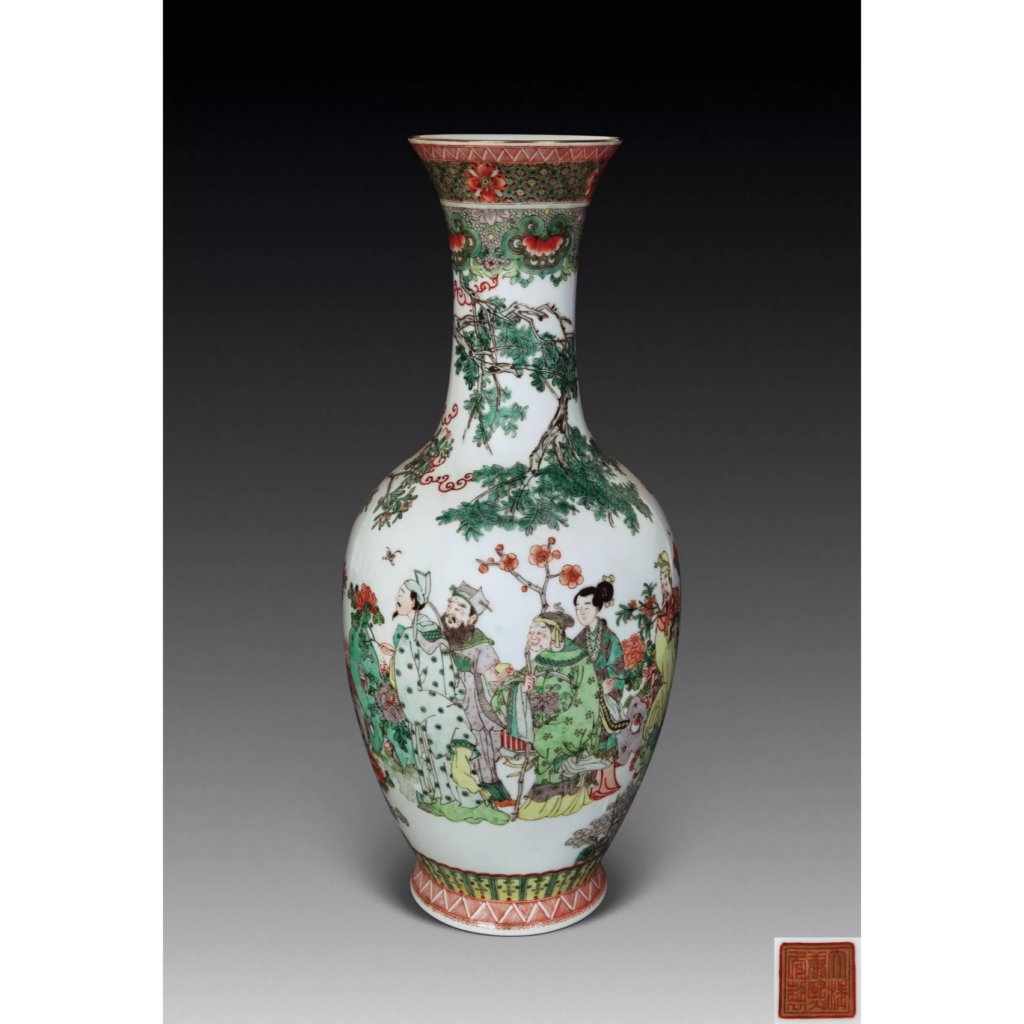
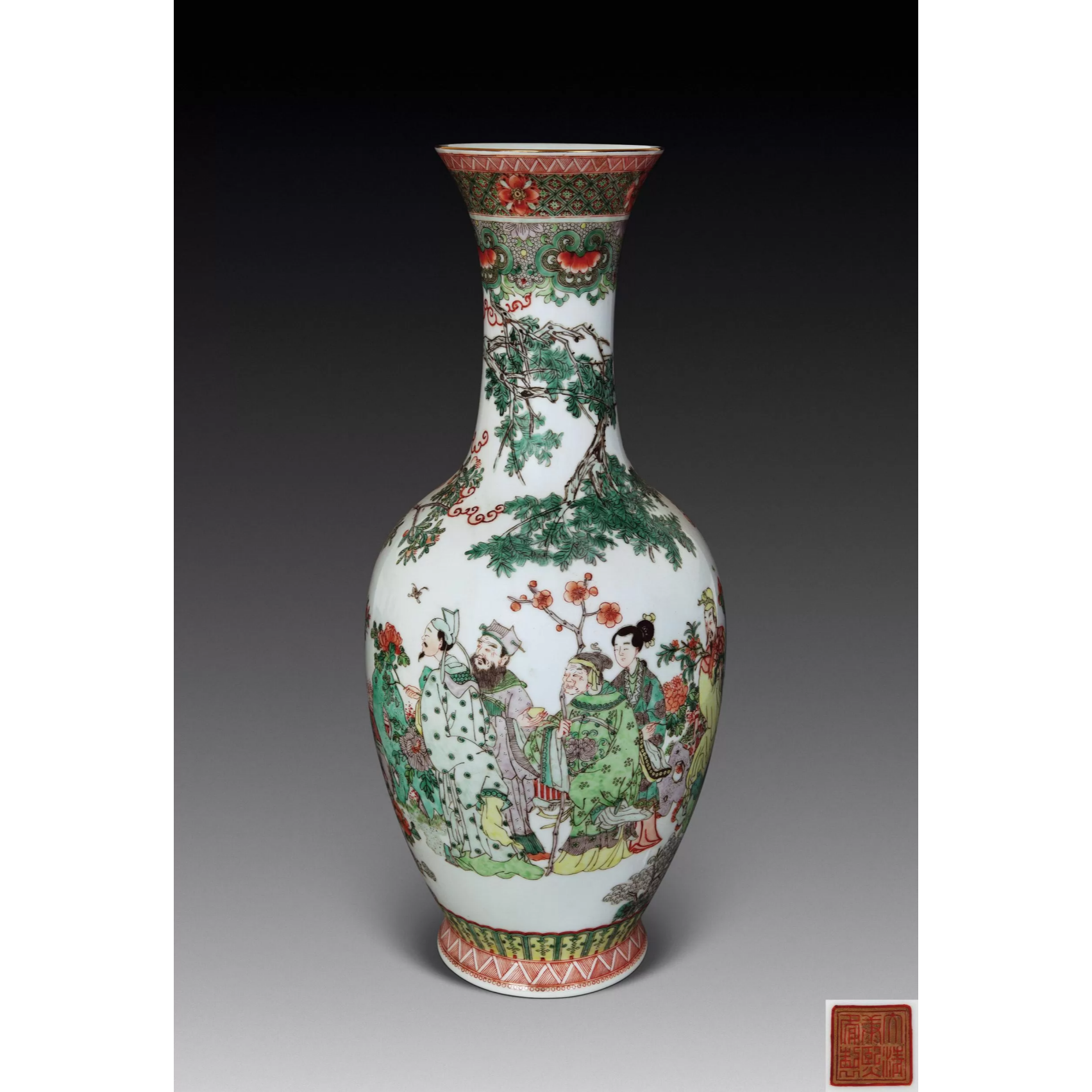
(II) '15th Five-Year Plan' Outlook: Value Space Under a Dual Protection System Ceramic culture is an important part of the excellent culture of the Chinese nation, the 'root' and 'soul' of Jingdezhen. Combined with the core goals of the '15th Five-Year Plan' to 'deeply implement the project for inheriting and developing excellent traditional Chinese culture' and 'deepen the stage of building a culturally strong nation,' '567 Porcelain' will be further incorporated into the dual protection system of 'New China Industrial Heritage' and 'Red Cultural Collections.' According to the 2025 special plan of the Jingdezhen Ceramics Museum, '567 Porcelain' will form the 'New China National Porcelain Exhibition System' together with 'Founding Porcelain' and '7501 Porcelain,' with a plan to launch a special exhibition at the National Museum in 2026, a move that will solidify its historical value from an academic perspective. At the same time, under the '15th Five-Year Plan' guidance to 'improve the quality of cultural trade,' export-oriented categories of '567 Porcelain' will become 'physical samples of new China's cultural trade history.' The export porcelain coordinated by Premier Zhou Enlai in 1972, as cultural companion gifts for 'ping-pong diplomacy' and 'Sino-US normalization,' has seen prices for overseas repatriated items continuously rise in recent years. In 2024, a 1973 famille rose flower-and-bird export vase repatriated from Sotheby's London sold at a price 30% higher than similar domestic items, confirming the scarcity value of 'cultural diplomacy carriers.' Figure 1: Image of a modern landscape porcelain vase
II. Era Characteristics: Ceramic Industry Innovation and Spiritual Condensation Under a Planned Economy
(I) Large-Scale Reorganization of the Production System: A Model of Industrialized Handicrafts
The production of '567 Porcelain' originated from the socialist transformation of traditional handicrafts in new China. Starting in 1953, over 300 private 'red shops' in Jingdezhen were consolidated into 13 state-owned porcelain factories, including Jianguo, Art, and People's, accompanied by the establishment of the Ministry of Light Industry Ceramics Research Institute (referred to as the 'Ministry Ceramics Research Institute'), forming a highly organized system of 'institute R&D + large factory production + small factory supporting,' fundamentally changing the decentralized model of master-apprentice inheritance. This system had both national mission and market functions: domestically, it provided 'national porcelain' for the Great Hall of the People and the Diaoyutai State Guesthouse; externally, it undertook the strategic task of 'exchanging porcelain for foreign exchange'—from 1955 to 1978, '567 Porcelain' exports accounted for 68% of Jingdezhen's total ceramic exports, serving as an important source of foreign exchange. Notably, different state-owned factories formed differentiated divisions of labor: Jianguo Porcelain Factory focused on producing color glazes, Art Porcelain Factory on high- and mid-grade famille rose, Xinhua Porcelain Factory on blue-and-white, Sculpture Porcelain Factory specialized in sculptural porcelain, while the Ministry Ceramics Research Institute was responsible for high-end custom orders and technological breakthroughs. This specialized layout directly enhanced the craftsmanship precision of '567 Porcelain.' Since the founding of new China, Jingdezhen has provided over 90% of the country's ceramic national gifts, establishing the only 'National Porcelain Office' in the nation. These pieces were exported to 124 countries and regions, used by the government for gifting foreign guests, display in overseas embassies and consulates, and as gifts for important international events, carrying the special historical memory of new China's efforts to break blockades and expand friendships. Figure 2: Image of a Xu Yaowen open-window gold-outlined famille rose landscape porcelain vase (II) Era-Specific Expression of Themes: A 'Ceramic History Book' of the Republic Social changes from the 1950s to the 1990s were directly reflected in porcelain themes, forming clear stage-specific characteristics highly aligned with national policy directions:
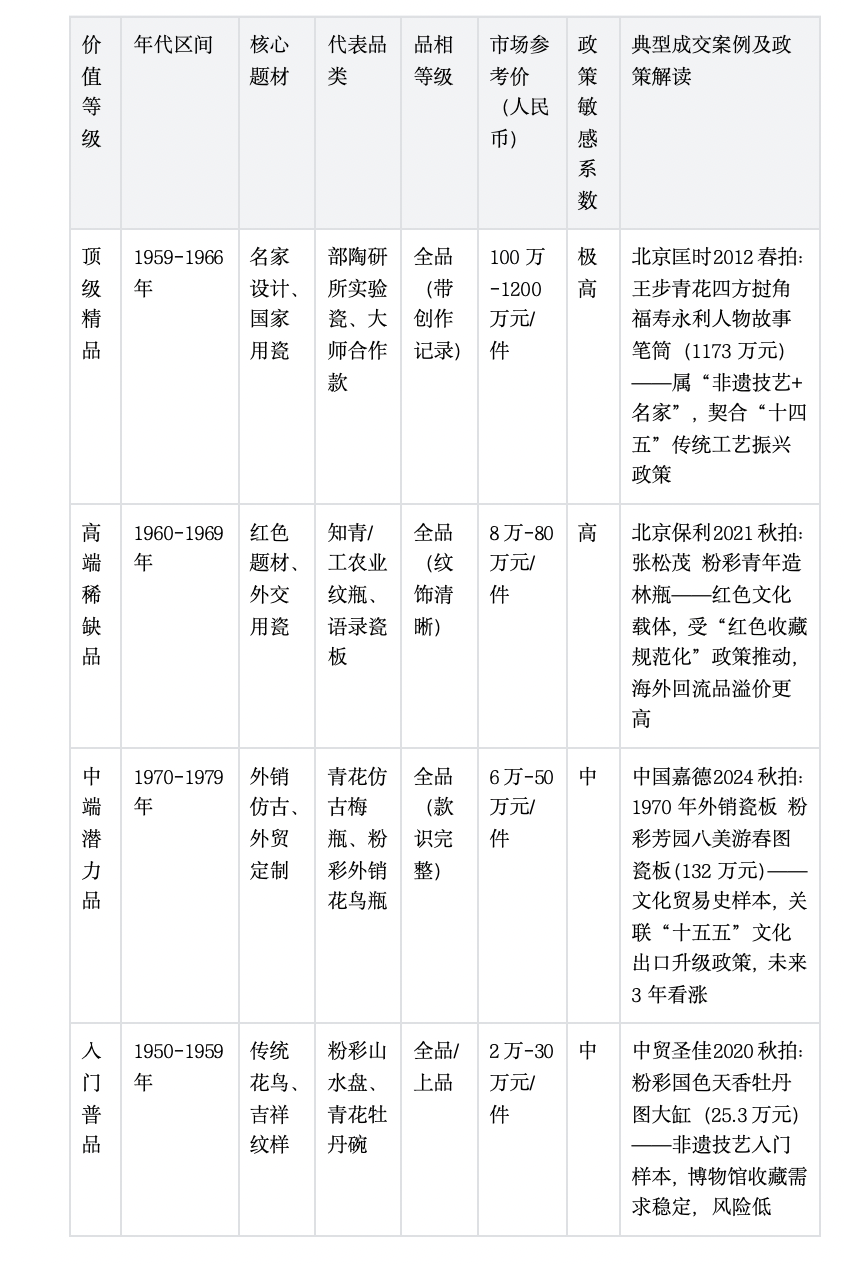
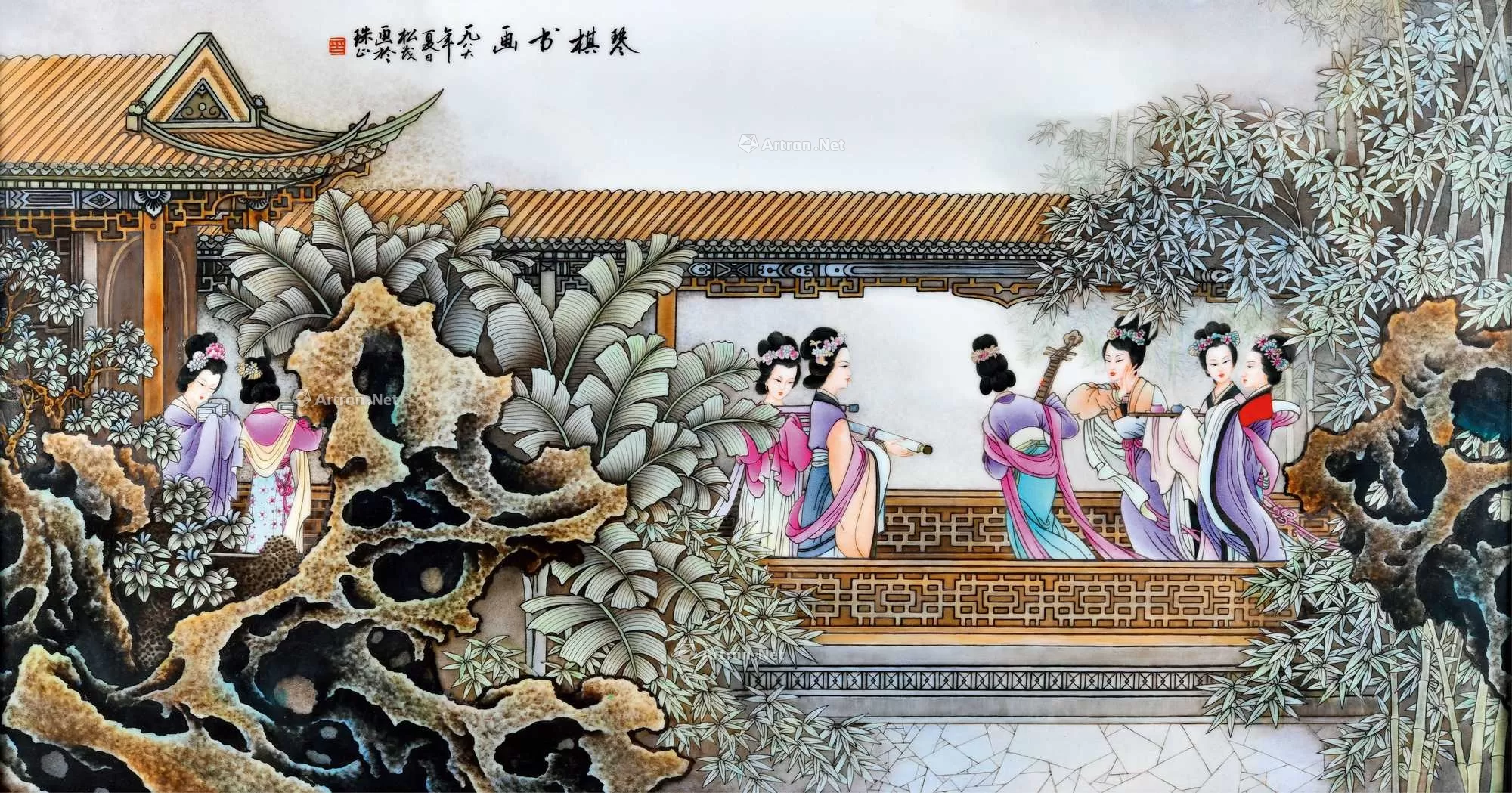
1950-1959 (Recovery and Development Period): Influenced by the 'early socialist construction' atmosphere, themes mainly included traditional landscapes, peacocks and peonies, and pine and crane longevity patterns, continuing traditional aesthetics while incorporating the era's spirit of 'thriving prosperity.' A typical example is the 1956 'Harvest' blue-and-white plate, created on the eve of the 'Great Leap Forward,' with a composition full of joy, echoing the agricultural production enthusiasm. 1960-1969 (Red Theme Period): Responding to the policy of 'literature and art serving workers, peasants, and soldiers,' themes such as educated youth going to the countryside and industrial and agricultural production became mainstream. The patterns were narrative and colorful, such as the 1965 'Educated Youth Going to the Countryside' famille rose vase designed by Zhang Songmao, which used focal perspective to depict the labor scenes of educated youth, with figures showing uplifting spirits, vividly recording a special historical period. 1970-1995 (Domestic and Export Dual Focus Period): With the normalization of Sino-US relations and Sino-Japanese diplomatic relations, foreign trade demand expanded, leading to a large number of antique-style export porcelains (e.g., imitations of Qianlong blue-and-white and Yongzheng famille rose), while retaining some realistic themes (e.g., 'Learn from Dazhai in Agriculture' patterned bowls), forming a dual-track pattern of 'domestic red themes + export antique themes.' From the late 1970s to the early 1990s, the Jingdezhen National Porcelain Office organized major factories to create over 40 varieties of national ceremonial porcelains, totaling more than 5,000 pieces. These treasures are cultural artifacts worthy of attention. Figure 3: Image of a 1960s-1970s large porcelain plate with chrysanthemum painting and era story (III) Standardized Craft Characteristics: Traceable 'Industrial-Grade Intangible Heritage'
Source: Read the original article | Published: November 25, 2025