
Editor's Note
This editor’s note highlights the key facts and market implications behind “Energy Transition in Construction: Federcostruzi”, with emphasis on sourcing, product fit, fabrication, logistics, or buyer impact.
In the field of materials, several decarbonization strategies are emerging, including the use of cements with lower clinker content, the use of recycled steels and aggregates, the use of wood-based and bio-based materials, and the development of ceramic and insulating products with lower energy impact.
Construction and Energy Transition: Federcostruzioni Report Captures Challenges, Innovation, and Decarbonization Potential
The Federcostruzioni Report on Energy Sustainability analyzes the role of the construction supply chain in the energy transition, highlighting consumption, emissions, and reduction potential throughout the entire building life cycle.
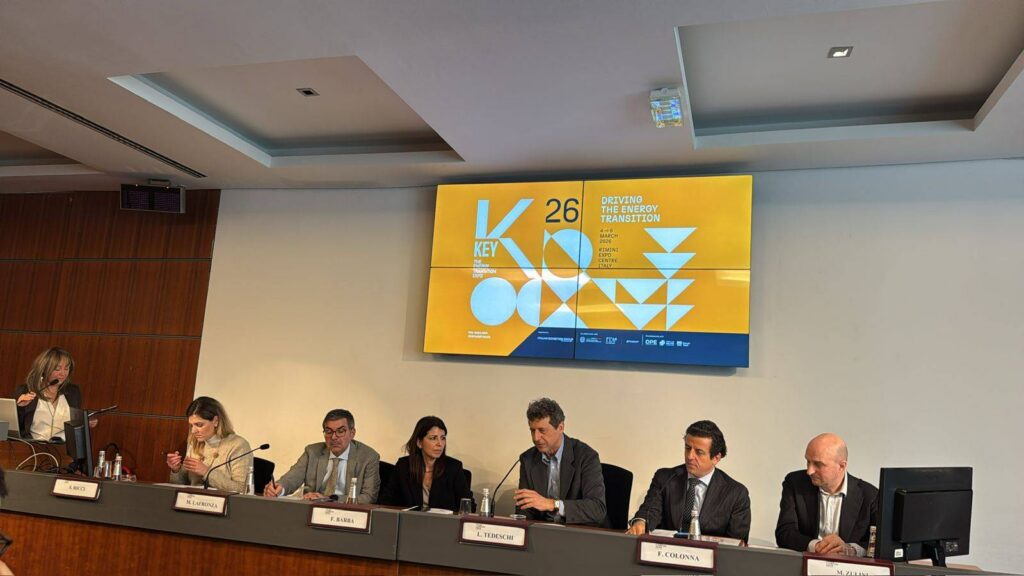
On the occasion of KEY – The Energy Transition Expo, Federcostruzioni presented the "Report on the State of Energy Sustainability in the Construction Supply Chain," produced in collaboration with the Polytechnic University of Marche and with the contribution of associations representing the various sectors of the industry.
Laura D’Aprile (MASE – Ministry of Environment and Energy Security), Emanuele Ferraloro (President of Federcostruzioni), and Gian Marco Revel (Polytechnic University of Marche) spoke at the presentation. Maria Chiara Voci moderated. The Report was created with a clear objective: to provide a systemic snapshot, based on data and technical-scientific analysis, of a complex and strategic supply chain for achieving European climate goals. The work aims to translate the real needs of companies into a coherent and comparable framework across very different sectors.
“The energy transition is confirmed as one of the most relevant and complex challenges for the European and national economy, and the construction sector is destined to play a decisive role,” said Emanuele Ferraloro.
"This scenario," added Ferraloro, "imposes a paradigm shift that does not only concern the improvement of efficiency in the use phase of properties, but involves the entire life cycle of the built environment — from design to material production, from systems to the construction site, from realization to management and up to decommissioning — requiring a profound transformation of industrial supply chains, construction models, and technologies employed."
In Italy, the construction supply chain significantly impacts the energy and emissions balance and deals with an often dated building stock, which contributes to amplifying the energy balance. At the same time, the sector operates in a context characterized by energy price volatility, rising raw material costs, and increasing international competitive pressure, elements that transform energy sustainability into a strategic lever not only environmentally but also industrially. The Federcostruzioni 2026 Report highlights how the sector's transition requires "a coordinated transformation of production supply chains, design, and construction processes, enhancing technological innovation, digitalization, low-emission materials, and consumption management and optimization," said the president of Federcostruzioni again, emphasizing that "despite persisting criticalities related to regulatory uncertainty, energy costs, and authorization complexity, the sector has a wide potential for reducing consumption and emissions throughout the entire life cycle of buildings."

The associations of the supply chain, united in Federcostruzioni, concluded Ferraloro, "are committed to this path, which despite the critical international geopolitical situation, must continue to commit and seize the opportunity to become one of the main drivers of sustainability and competitiveness of the economic system in the medium to long term and highlight the need to be increasingly involved in a dialogue with the Institutions to bring an effective and coherent contribution to the energy transition."
A Key Sector for Energy Consumption and Emissions
The construction sector plays a central role in the national energy balance. The built environment is responsible for about 40% of total energy consumption and a share between 37% and 38% of total greenhouse gas emissions. This is a figure that immediately makes clear how decisive the sector is for the decarbonization of the economy.
The report highlights how these emissions are distributed throughout the entire life cycle of buildings. The main share is associated with the operational phase, i.e., the energy used for building operation – heating, cooling, lighting, and services. Alongside this is the so-called "embodied" component, that is, the one linked to the production of construction materials, construction site activities, and related industrial processes.
In Italy, the part connected to construction and material production represents about 11% of the sector's overall emissions, with a subdivision that sees about 20% attributable to construction sites and 80% to the industrial processes of materials. These are activities often characterized by high energy intensity, particularly in extractive sectors and construction materials, where the cost of energy can account for up to 70-80% of production costs. According to estimates contained in the report, widespread efficiency interventions in the supply chain could improve energy performance by even 30-40%. This would mean achieving an overall reduction in national energy impact on the order of 13-14%, demonstrating how strategic the sector is not only from an environmental but also an economic and industrial point of view.
Methodology and Structure of the Report
The creation of the report required a
Source: Read the original article | Published: March 05, 2026